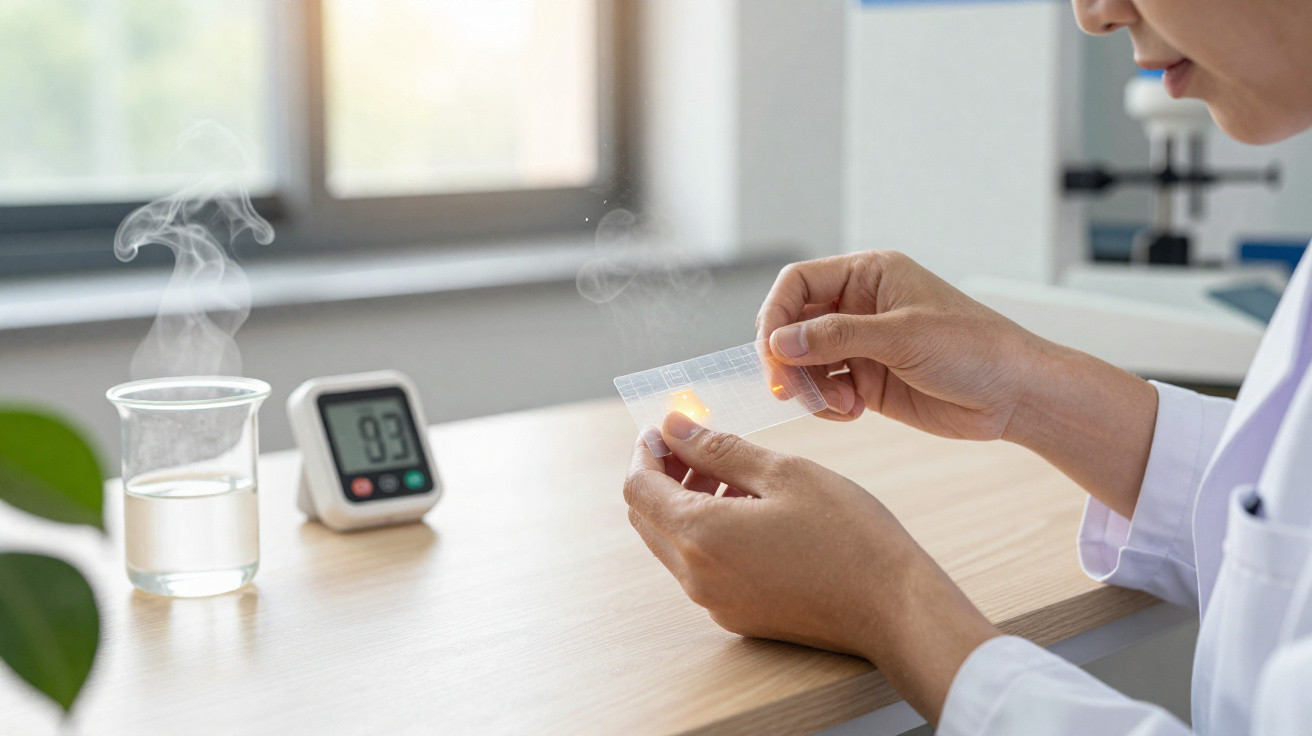
A newly made battery starts out entirely dry and activates only when it encounters humid air. It draws in water vapour to create the liquid required for operation. In effect, it is powered by little beyond the surrounding air.
It functions in settings ranging from dry deserts to tropical rainforests, while comparing well with widely available commercial cells. Since the cell activates only after becoming wet, it loses virtually no power while stored in its packaging.
The design tackles two long-standing obstacles for compact electronics. It could supply wearable and internet-connected devices with a lightweight, flexible power source that contains no toxic metals.
Battery power from air
Every battery requires two electrodes and a moist middle layer – the electrolyte – through which charge can move. Conventional cells trap this liquid inside, increasing their weight and creating a potential leak risk. By contrast, this battery is supplied dry and obtains its electrolyte directly from air.
The research was carried out in the laboratory of Amay J. Bandodkar, an engineering professor at North Carolina State University, alongside collaborators from Rice University. The cell combines a magnesium anode with a silver chloride cathode, materials both already common in medical devices.
A two-section separator placed between the electrodes performs the key function. Its first section is a cellulose sheet infused with lithium chloride, a salt with such a strong attraction to water that it extracts vapour from the air and turns it into liquid.
The other section absorbs this water before dissolving a preloaded amount of standard table salt. This produces the salty liquid needed to transport charge, formed in place from air and a small quantity of salt without any need for manual wetting.
The water-absorbing chemistry was borrowed from a very different application: extracting drinking water from dry air. Previous separate studies have shown that cellulose containing lithium chloride can collect water across a broad range of humidity levels. Bandodkar’s group adapted that principle.
When exposed to typical indoor air, the cell reaches stable output in around 7 minutes. Producing roughly 1.6 volts, it is slightly above a standard AA battery.
From sweat to air
This is not the first battery from the group to use a bodily fluid rather than carrying its own stored liquid. Several years ago, the researchers described thin cells worn on the skin that remained inactive until someone started sweating, using perspiration as the electrolyte.
Sweat is effective, but only when a body is warm and in motion. Tissue fluid, which the team subsequently used in implant-style batteries, is available only within the body. Moisture in the surrounding air eliminates that restriction.
Water vapour is present in the air in nearly every place where people live. As a result, the approach can be deployed much more widely than either of its predecessors.
Maintaining a dry cell until it is needed offers another benefit. Stored batteries gradually lose charge through slow, undesirable chemical reactions known as self-discharge.
Because a dry cell contains no liquid to support those reactions, it remains almost unaffected until humidity activates it.
Bending without breaking
A battery designed to adhere to skin or curve around an item must withstand bending without fracturing. Many flexible battery designs position rigid elements widely apart on elastic connectors, sacrificing space and reducing the amount of charge the device can store.
The researchers drew inspiration from the pangolin, a scaly anteater whose overlapping plates allow it to roll into a ball. They arranged rigid battery cells tightly together in a scale-like pattern and linked them using resilient S-shaped wires that bend as the sheet is stretched or folded.
Raudel Avila, a mechanical engineer at Rice University and study co-author, conducted the computer modelling that informed the design.
“Our simulations predicted how the entire battery deforms, allowing us to engineer the architecture so the interconnects absorb the motion while the battery cells remain protected,” Avila said.
The arrangement is compact enough for active cells to occupy 87% of the battery area, while still permitting stretching of up to 80% in two directions. Its resistance changes very little during bending and twisting because the wavy wires take up the movement and the cells remain stable.
In terms of basic output, the cell compares favourably with batteries sold in shops. It equals or surpasses several disposable commercial cells in voltage and energy per unit of weight. The researchers also produced an AA-shaped model that fits into existing devices.
Driving real gadgets
To demonstrate that the battery can operate demanding electronics, the team created two highly different devices.
“Our battery matches the capacity of many commercial AA and AAA alkaline batteries, making it a suitable power source for a wide range of electronics,” Bandodkar said.
The first device was a wireless pulse oximeter, the fingertip instrument that measures blood-oxygen levels and heart rate by passing light through the skin.
Their model consists of a reusable electronics unit and a disposable patch containing the battery and a skin adhesive. Small magnets connect the components, allowing an exhausted battery to be removed and a replacement attached without tools.
Powered by the moisture cell, the device sent oxygen and pulse measurements to a smartphone. In a breath-holding test, it recorded a volunteer’s heartbeat at approximately 70 beats per minute.
Sensor that self-destructs
The second demonstration explores a more unusual use of the technology. It is a covert surveillance monitor: a small wireless sensor that detects chemical vapours in air and includes a kill switch that destroys the device as soon as somebody tampers with it.
Below the sensor is a dry blend of aluminium and iodine powder, covered by a lithium chloride membrane that gradually absorbs moisture from the air. A thin divider separates the moist cover from the dry powder, preventing any reaction during ordinary use.
A strong press – the sort an unsuspecting person could apply – forces the two materials together. Water passes from the membrane into the powder, initiating an intense self-sustaining combustion that destroys the sensor, its electronics and any saved data within 3 minutes.
Humidity by itself cannot activate the mechanism. The reaction also requires mechanical pressure to bring the wet membrane into contact with the dry powder.
The group has used the same water-activated concept in other devices. One recent case is an inexpensive wound dressing that remains dormant until moisture activates it to provide healing electrical pulses.
What comes next
One component still presents a compromise. Incorporating glycerol, a viscous liquid, substantially lengthens the battery’s operating time by retaining water in the electrolyte section.
It could achieve this by making the polymer separator softer and reducing internal resistance, although the precise mechanism requires further investigation.
Storage is the drawback. Cells produced without glycerol retained almost all of their capacity after 15 days in sealed storage, whereas glycerol-containing cells lost most of theirs. The liquid probably encourages unwanted reactions at the magnesium electrode even while the cell is inactive.
The researchers intend to replace the liquid with a solid water-retaining material, such as the porous crystals used for water harvesting, to preserve runtime without reducing shelf life. They also plan rechargeable models and moisture-capture layers tailored to different climates.
The kill switch may also have wider uses. The team envisages a version incorporated into everyday consumer devices.
“Future consumer electronics, such as smartphones, could integrate similar remote kill switches. In the event of theft, owners could activate this feature to prevent unauthorized access to their private information,” Bandodkar said.
Why it matters
The study demonstrates something specific: a non-toxic, flexible battery can generate its own electrolyte from air while still matching commercial cells in the measures that matter.
That is the central development. Many green-chemistry batteries sacrifice performance in exchange for safety, whereas this one need not do so.
It could offer a route to powering the expanding range of wearable health patches and compact connected sensors without enclosing a rigid, toxic cell in every product. A device could be transported dry and inactive, then switch on as soon as it is unwrapped and worn.
Photo credit: Rajaram Kaveti














Comments
No comments yet. Be the first to comment!
Leave a Comment