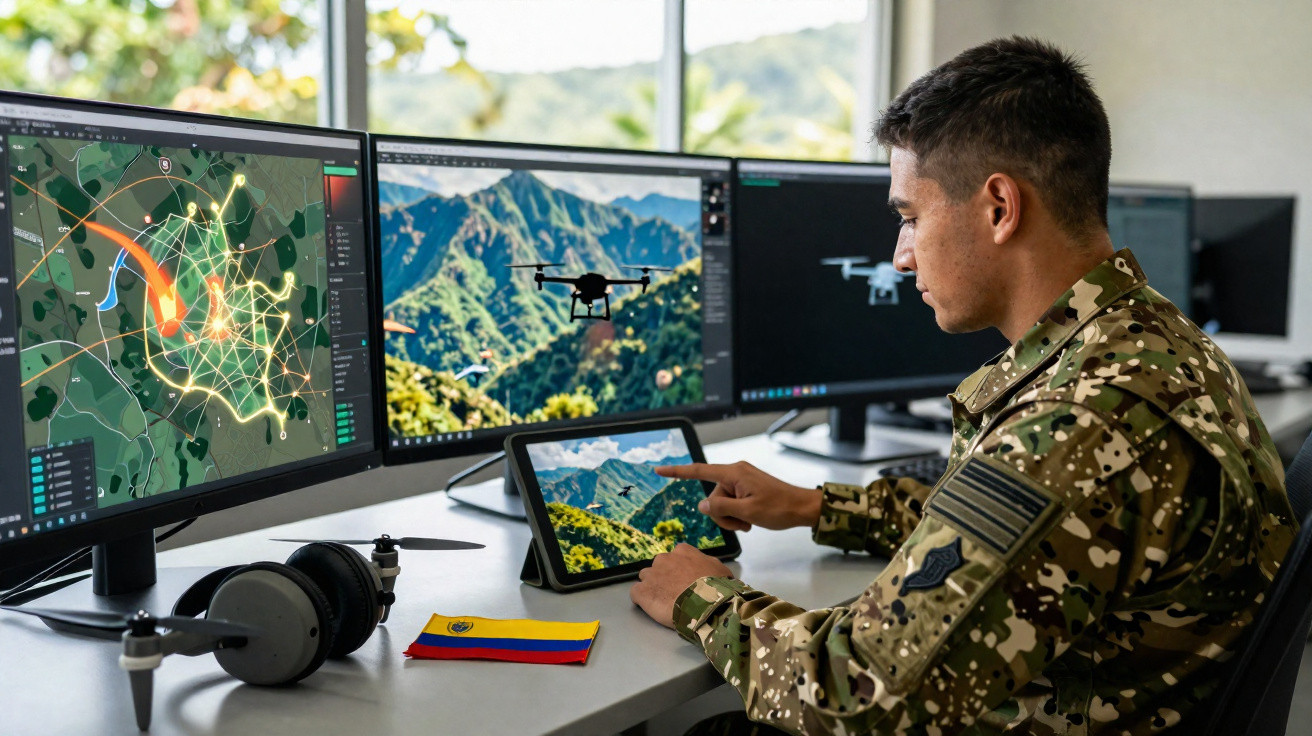
The Colombian National Army has allocated resources to introduce new technologies and train some of its personnel to operate the devices and systems it has acquired. This response follows advances and the applications made by various illegal groups, with the aim of protecting, monitoring and safeguarding the country’s territory and its people.
BANOT and unmanned aircraft operator training
For this purpose, the Army created the Unmanned Aircraft Battalion (BANOT), which operates as a comprehensive defence system and strategic support unit. Using drones, it provides assistance in intelligence, surveillance and reconnaissance, while also serving as an advanced training centre.
With support from the Military Education Centre (CEMIL), through the National Army Aviation School, the first graduation ceremony was held for soldiers trained to use this type of equipment. They received instruction in operating high-performance drones. The event marked the 16th Unmanned Aircraft Systems Operator Course and was held at Alberto Lleras Camargo Airport in Sogamoso, Boyacá.
A total of 105 soldiers qualified as certified Unmanned Aircraft operators. Among them was Corporal Third Class Karla Ceballos García, who became the first female non-commissioned officer to obtain this certification. Second Lieutenant Jhon Kennedy Murcia Cuéllar was also recognised for his outstanding operational performance.
The graduates completed 330 hours of technical and strategic instruction, alongside training in advanced systems including DRAGOM, multirotor drones, tactical drones and technical maintenance, among other courses.
BRICC communications, computing and cyberdefence
The Army also marked the fourth anniversary of the establishment of the Interoperability Brigade for Communications, Computing and Cyberdefence (BRICC). Its principal mission is to protect technological infrastructure and institutional information. It also provides support through its capabilities in communications, command, control, computing, cyberdefence and electronic warfare.
The brigade comprises the Communications and Computing Interoperability Battalion and the Cyberdefence and Cybersecurity Battalion, both based in Bogotá, D.C.
BRICC manages the system known as C5 (Command, Control, Communications, Computing and Cyberdefence). Since its creation in 2022, it has supported the Army by strengthening technological infrastructure and upgrading networks, storage systems and security platforms. It has also undertaken significant projects, including:
- Deploying the CEI 2.0 institutional email system, benefiting more than 53000 users.
- Leading key initiatives, notably the Nesher anti-drone system, designed to protect troops and critical infrastructure through the detection and neutralisation of drones.
- Improving cyberdefence capabilities through advanced protection techniques, vulnerability assessments and incident-response measures.
- Supporting military operations by ensuring communications-system compatibility and the secure real-time transmission of data.
- Providing technical support during joint operations involving the Army, Navy and Aerospace Force.
- Taking an active role in monitoring and protecting hydroelectric power stations and networks, as well as preventing hacking attempts.
The Colombian Army’s technological strengthening through specialised units such as BANOT and BRICC reinforces a comprehensive national defence system. These capabilities enable a more effective response to aerial, cyber and strategic threats, helping to protect the territory and safeguard the country’s critical infrastructure.
















Comments
No comments yet. Be the first to comment!
Leave a Comment