
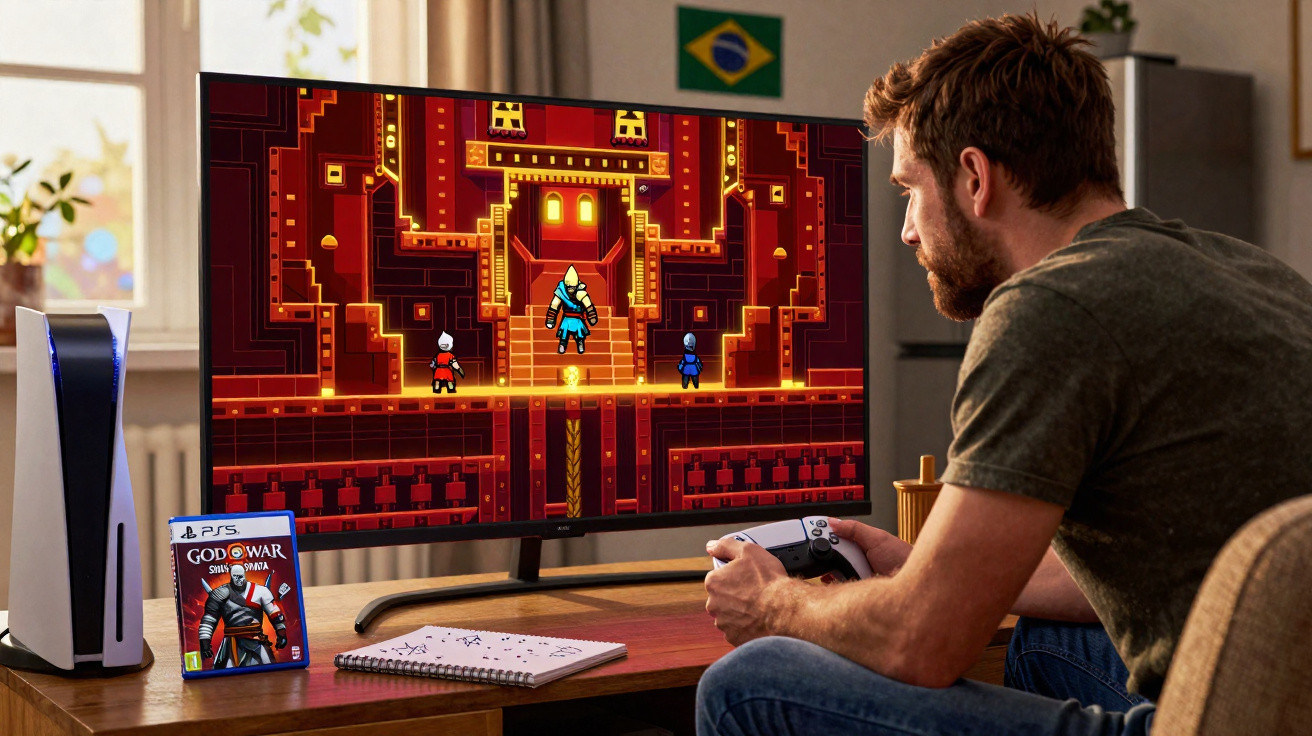
Kratos returns to the spotlight, but this time in a format that has split the fanbase and put the “next-gen” label under real scrutiny.
God of War: Sons of Sparta, exclusive to PlayStation 5, arrived carrying the full weight of the franchise name and the promise of a different take on Kratos’s journey. Early player reactions, however, paint a far more complicated picture-mixing specific praise with technical frustrations and a lively argument about whether the God of War branding is being used in the right way.
Player reception: a lukewarm score for a huge name
Among readers who rated God of War: Sons of Sparta, the average sits at around 11/20-a result that would be firmly mid-table for a big-budget release.
| Score range | Number of ratings |
|---|---|
| 16 to 20 | 1 player |
| 11 to 15 | 2 players |
| 6 to 10 | 2 players |
| 0 to 5 | 1 player |
The figures underline how divisive the game is: some players see a competent metroidvania, while others view it as a shallow product propped up by “PS5” marketing. That same split shows up across almost every area players comment on.
"More than simply ‘liking it or not’, Sons of Sparta has become a barometer for expectations around the God of War name in the current generation."
A God of War built as a metroidvania
For part of the audience, the first surprise is the genre itself. Sons of Sparta doesn’t follow the 3D, cinematic action template of the most recent major entries. Instead, it leans into a 2D metroidvania structure: an interconnected map, frequent backtracking, and abilities that gradually open up previously inaccessible areas.
On the positive side, some players consider the shift a bold move. Those already fond of metroidvanias highlight the central hub city’s layout, the feeling of steady progression, and the overall campaign length-some reporting nearly 32 hours to reach over 90% completion.
- Exploration across a large map, with routes unlocking bit by bit
- Abilities and talismans that change combat and traversal
- Returning to earlier areas to uncover secrets and optional side content
Others, though, describe the systems as too derivative-very close to games like Blasphemous-without enough fresh ideas to justify carrying the God of War name. A few sum up the gameplay as “fun, but repetitive”, pointing to recycled enemies and bosses that fail to stick in the memory.
Kratos, Deimos, and a layered story
Narratively, Sons of Sparta aims to explore a less-seen slice of Kratos’s life alongside his brother Deimos, in a setting closer to the Spartan era. One account notes that the story is framed as Kratos recounting events to Calliope, his daughter, giving the plot the tone of memory and confession.
For some players, that angle delivers genuinely affecting moments-especially in how the characters develop towards the end, with a more resigned Kratos and a Deimos working towards accepting past mistakes. Players familiar with the PSP spin-off Ghost of Sparta, however, flag inconsistencies in how the two brothers are characterised, which undermines the sense of continuity.
"When the series revisits periods that are already established in the timeline, every contradiction weighs more heavily than it would in a completely new chapter."
Graphics, art direction, and the pixel art debate
If there is one element that immediately jolts expectations, it is the presentation. Sons of Sparta commits to pixel art heavily inspired by 16-bit games, and the reaction is sharply divided.
Among the harshest criticisms is the feeling that the visuals “overdo the pixelation” and don’t reach the level of craft the style can offer. One player argues that classic 1990s titles had more polished sprites and livelier animation, even pointing to Mega Man X4 as an unflattering comparison for a 2026 release.
The soundtrack provokes a similar split. Some tracks echo the atmosphere of the first God of War on PS2 and land well with players who have strong nostalgia for the series. Others lean into a “retro NES” vibe that many feel clashes with the epic tone usually associated with Kratos.
Technical performance and frame-rate issues
Performance concerns also come up frequently. There are reports of frame-rate drops in wider, more open sections of the map, along with stutters during combat-problems that can be particularly damaging in a metroidvania where precision and responsiveness matter.
One player describes encountering bugs that outright blocked progress, forcing them to replay sections. In those cases, even players who enjoyed the exploration said they lowered their final score, hoping future patches will address the worst issues.
Difficulty, progression, and the power curve
Another repeated theme in player feedback is the pace of progression. Several accounts describe a slower opening where Kratos feels limited, followed by a turning point where he becomes far too powerful-especially after stacking talismans and upgrades.
That imbalance feeds directly into perceptions of challenge. Some players call certain bosses completely forgettable, including mention of a final boss defeated in under a minute. For a franchise known for standout encounters, that criticism carries weight.
At the same time, metroidvania fans often defend the very same power curve: building strength, returning to areas that once felt punishing, and then breezing through them is part of the genre’s appeal.
"Between the frustration of those who wanted epic battles and the satisfaction of those who prioritise a sense of progression, Sons of Sparta balances on a tightrope."
When the name matters more than the game
A recurring view is that Sons of Sparta would have been received more warmly if it didn’t carry the “God of War” title. The brand almost automatically sets expectations of visual spectacle, a grand narrative, and choreographed combat on the level of the most recent mainline chapters.
Instead, players are getting a mid-budget metroidvania with risky artistic decisions and a clearly smaller scale. For some, that feels like a broken promise; for others, it’s an opportunity to see the franchise try something different without the pressure to “reinvent the AAA formula”.
What players should consider before buying
For anyone following the series and thinking about picking up Sons of Sparta on PS5, a few practical points can help set expectations:
- The focus is 2D exploration, not 3D cinematic combat
- The structure resembles modern metroidvanias, with a strong emphasis on revisiting areas
- The visuals lean into pixel art, which may appeal-or put you off-depending on taste
- There are consistent reports of bugs and performance drops in larger map areas
- The story has interesting moments, but it touches sensitive points in Kratos’s timeline
Players used to more guided campaigns may find the amount of back-and-forth across the map hard to adjust to. Those who enjoy learning routes, mentally noting blocked passages, and hunting down secrets are more likely to get on with what the game is aiming for.
Terms and expectations that change everything
For those unfamiliar with it, the term “metroidvania” often causes confusion. It comes from blending Metroid and Castlevania: games built around non-linear exploration, an interconnected map, abilities that open new paths, and a constant loop of returning to earlier locations. Sons of Sparta fits that template, adding a layer of God of War-style combat-albeit in a simplified form.
Another sticking point is “next-gen”. In marketing language, it implies ultra-realistic visuals and heavy use of new hardware. Sons of Sparta makes a different bet: it takes the strength of the brand and applies it to a smaller-scale game with a retro visual language. Anyone buying it expecting a new God of War Ragnarok is likely to be disappointed; anyone open to a more restrained spin-off will find a package with clearly defined strengths and weaknesses.
A practical way to judge whether it’s for you is to picture two scenarios. In the first, the game is simply called Sons of Sparta, with no link to Kratos or PlayStation Studios. In the second, everything stays the same, but it’s sold openly as an experimental “side project” within the franchise. In which scenario would you be more willing to accept rougher pixel art, a few bugs, and a metroidvania-style structure? The answer says a lot about whether the purchase is likely to feel worthwhile.



Comments
No comments yet. Be the first to comment!
Leave a Comment