
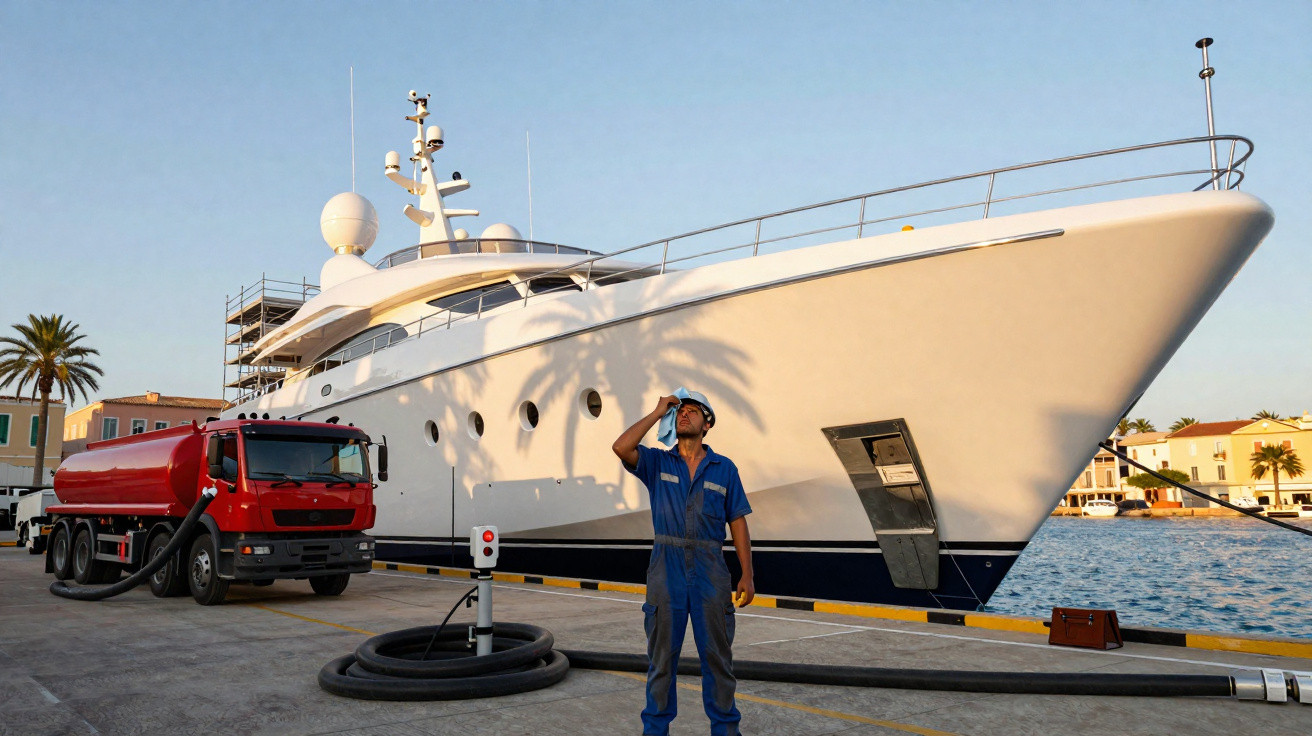
At sunrise in La Ciotat, the Mediterranean can look almost computer-rendered: a hard, luminous blue. In the dim early light, the shipyard stirs-cranes swing into life, steel complains, and an immense white shape looms over the harbour like a grounded glacier. Nearby, workers in orange hi-vis drink their coffee, barely bothering to look at the name on the stern: Launchpad. The $300 million superyacht widely believed to be linked to Mark Zuckerberg was brought in discreetly, under tow, after being damaged. On the Riviera, France is set to treat it with kid gloves at one of the world’s most sophisticated yards.
Standing on the quay, the contradiction feels as sharp as the tang of diesel in the air. This is a luxury industry-and a pollution bomb-sitting squarely in the age of climate crisis.
France rolls out the red carpet for Big Tech’s floating palaces
Seen from afar, it barely reads as a vessel. It resembles a sci‑fi building tipped onto its side, with tiered decks stacked like a Silicon Valley campus. The port of La Ciotat, between Marseille and Toulon, has turned into a low‑profile clinic for the ultra‑rich’s fleet. In effect, France is providing Mark Zuckerberg with a service only a tiny number of places can deliver: major repairs, near-total confidentiality, and a level of care calibrated for luxury.
On Google Maps it’s labelled as an ordinary shipyard; up against the fences, it feels more like a hub of influence.
Months ago, images started circulating of a vast blue-and-white yacht being towed into La Ciotat Shipyards. Industry watchers quickly identified it as Launchpad, the superyacht commonly associated with the Meta founder-delivered in 2024 and priced at roughly $300 million. Reports suggested the vessel struck a structure during sea trials in the Netherlands and required intricate work-exactly the sort of job only a small circle of yards can handle.
La Ciotat once built tankers; today it receives everything from Jeff Bezos–style megayachts to owners who never appear in print. Each arrival redraws the skyline for a while, then fades quietly from the headlines.
So why France? Because the Riviera is more than beaches and rosé. It’s an ecosystem of premium shipyards, naval architects, climate-controlled dry docks, and crews who can take apart and reassemble a 120‑metre maze of steel, glass and electronics. The payoff is substantial: contracts worth millions, hundreds of jobs supported, and specialist expertise kept alive.
The awkward truth is that these giants consume fuel and materials on a scale that shatters any tidy eco-friendly storyline. France is playing both sides: climate leader on paper, luxury service provider in practice.
The ultra-polluting reality behind the dream yacht
Put the glamour aside and look at emissions. A yacht in the 100‑metre class, like Launchpad, can guzzle hundreds of litres of fuel per hour while cruising. Not for war. Not for rescue. Simply to move a private palace across clear water for a small group of guests. These are also the sorts of ships that keep generators running even when anchored, just to supply jacuzzis, cinemas and server rooms packed with screens.
The yacht is undeniably impressive. The exhaust is not.
Environmental groups frequently point to a stark comparison: one heavily used superyacht can produce more CO₂ in a year than thousands of average Europeans. A 2023 study examining billionaire lifestyles even singled out superyachts as among the worst personal carbon offenders. They are not merely oversized toys; they are floating declarations about the climate.
When Launchpad reached La Ciotat, local campaigners highlighted the paradox. France urges restraint, promotes a move away from fossil fuels, and signs climate accords-while also providing a sheltered, high-end base where the machinery of extreme consumption is repaired, buffed, and sent back out.
Even so, the picture is not purely black and white. The same yard hosting Zuckerberg’s yacht pays wages to welders, electricians, cleaners, engineers and small subcontractors from nearby towns. For many households, these contracts mean the difference between insecurity and stability. The mayor speaks of “industrial reconversion” and “excellence of French shipbuilding”.
Be realistic: when the end of the month depends on it, very few people are eager to abandon a decent wage. Caught between ecological concern and economic necessity, most simply… avert their eyes and carry on.
The Riviera’s discreet playbook: how you host a billionaire’s yacht
A vessel like Launchpad doesn’t arrive the way a small sailing boat does. Weeks in advance, specialist agencies arrange towing routes, authorisations, security perimeters and non-disclosure agreements. As the yacht enters the harbour, the details are tightly managed: draught and depth, crane schedules, road access, customs. On the French Riviera, this choreography has become almost routine.
The brief is straightforward: finish the work fast-no fuss, no leaks, no selfies from inside.
For staff, the hardest part is not necessarily the engineering. It is the emotional split of starting a shift beside a $300 million object. Some talk about a “Disneyland effect”: corridors that feel unreal, marble bathrooms, gyms facing the sea. Then they head home to a two-room flat 20 minutes away, in a place where rents edge higher each time another billionaire yacht ties up.
Most people know that jolt-suddenly realising how far your daily life sits from someone else’s. On the Riviera, that distance is literally moored along the quay.
On condition of anonymity, one technician sums it up in a sentence that sticks: “We repair them, they pollute, and we applaud the contracts because it keeps the lights on.”
- What France gains
High-value employment, tax income, and a leading position in luxury maritime work-particularly for complex refits. - What France risks
A credibility gap on climate, reliance on polluting activity, and rising friction with locals who feel priced out. - What this reveals
That a country can champion ecological transition while discreetly maintaining the engine room of extreme wealth. - What the Riviera becomes
More than a postcard coastline: a behind-the-scenes zone where 21st-century contradictions sit side by side. - What readers can question
The narratives around “green tech”, the halo effect surrounding tech billionaires, and how public funding and public image intersect with private luxury.
Between climate speeches and diesel tanks, a country’s fault line
At one level, it’s just another repair: a single yacht, one of many. A few months in dry dock, bills running into the millions, and then Launchpad will slip away towards quieter bays. Yet what’s happening in La Ciotat compresses a much larger question-bigger than France, bigger than Mark Zuckerberg, bigger than the Riviera. Who is allowed to behave as though the climate emergency is optional, while everyone else is instructed to unplug chargers and separate their rubbish more diligently?
When a nation celebrated for climate diplomacy hosts one of the most lavish, ultra-polluting emblems of Big Tech wealth, the message is inevitably mixed.
| Key point | Detail | Value for the reader |
|---|---|---|
| France’s strategic role | Riviera shipyards such as La Ciotat draw the world’s largest superyachts for complex repair work | Understand why billionaires’ boats keep ending up on French coasts |
| Environmental contradiction | Superyachts generate huge CO₂ emissions while France publicly champions climate action | Spot the gap between political messaging and economic decisions |
| Your perspective as a citizen | Jobs, tax revenue, prestige versus pollution, inequality and climate anxiety | Clarify how you personally feel about this trade-off and discuss it with others |
FAQ:
- Question 1 Is Launchpad officially confirmed as Mark Zuckerberg’s yacht?
No-there is no official confirmation with his name on the paperwork. However, maritime databases, industry leaks and the timeline strongly suggest he is the beneficial owner.- Question 2 Why was the yacht sent to the French Riviera for repairs?
Because yards such as La Ciotat combine rare assets-very large dry docks, highly specialised teams and strict confidentiality procedures-that billionaires and insurers are willing to pay for.- Question 3 How polluting is a superyacht of this size?
A large superyacht can burn thousands of litres of fuel per day at sea and also consumes significant fuel while stationary; if used often, its annual emissions can be comparable to those of several thousand ordinary citizens.- Question 4 Does France benefit financially from hosting these yachts?
Yes. Shipyards, local suppliers, hotels and service providers generate sizeable income, and the sector supports hundreds of skilled coastal jobs.- Question 5 Are there real efforts to make superyachts greener?
Some vessels trial hybrid systems, cleaner fuels and energy optimisation, but the idea of a 100+ metre private palace at sea remains inherently high impact.






Comments
No comments yet. Be the first to comment!
Leave a Comment