
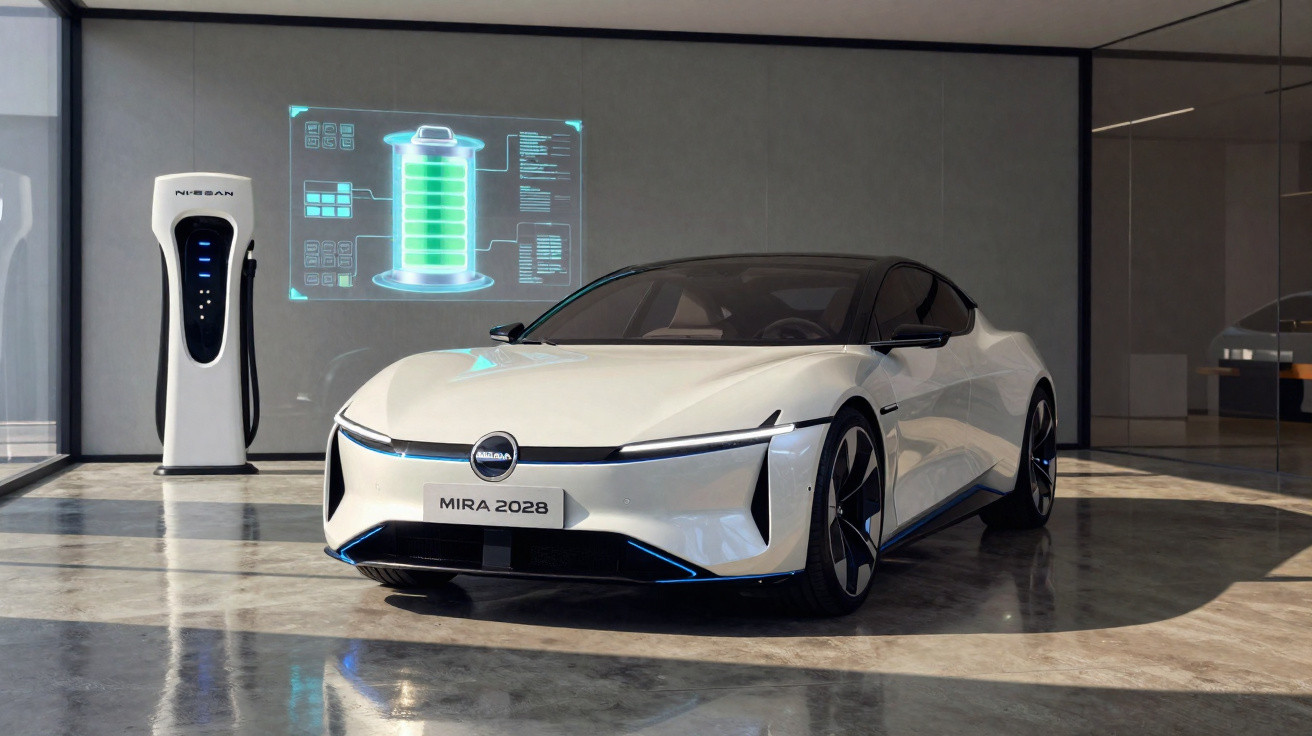
Nissan wants to begin mass production of an electric vehicle using solid-state batteries as early as 2028. If everything goes to plan, the technology could deliver twice the energy density and take three times the charging power.
Nissan’s solid-state battery timeline (2025–2028)
Speaking to Autocar in the UK, David Moss, Nissan’s Vice President for Research and Development (R&D) in Europe, said the Japanese carmaker expects to have a pilot plant up and running in 2025.
Moss also points to 2026 as the year Nissan should have finished the full development programme for the battery cells. Even so, the current engineering team-working with scientists from the University of Oxford-has already made major progress, moving from small button-sized cells to cells measuring 10 square metres.
Even so, the final cells are expected to be closer in size to a laptop battery.
Twice the density and triple the charging power
Also in comments to Autocar, David Moss outlined the promise of this technology and sounded highly confident: “We want to cut the cost (compared with lithium-ion batteries) by 50%, double the density and triple the charging speed”.
On charging, Moss put the upper limit at around 400 kW, which is indeed roughly three times what, for example, the Nissan Ariya supports (130 kW). That said, the highest figures in today’s market are 500 kW for the Rimac Nevera and 1000 kW for the Tesla Semi (the Tesla Cybertruck will support the same power, according to Elon Musk).
More consistent charging closer to the maximum
Unlike today’s lithium-ion packs, and again according to Moss, solid-state batteries should be able to maintain more consistent charging rates, operating closer to the maximum the charging system can deliver.
At the same time, with density set to double, these batteries would be able to store twice as much energy (in other words, range…) for the same volume and weight as a current battery. In theory, that means packs could be smaller overall.
On that point, Moss expects Nissan could offer two solid-state battery sizes: a smaller option and a “larger one for users who need huge range”.
A new platform to support Nissan solid-state batteries
As for which model might be first to receive the technology, everything suggests it will sit on a completely new platform: “Once you commit to something like solid-state, you have to change the entire mechanism and the whole vehicle architecture”, Moss explained.
Source: Autocar





Comments
No comments yet. Be the first to comment!
Leave a Comment