
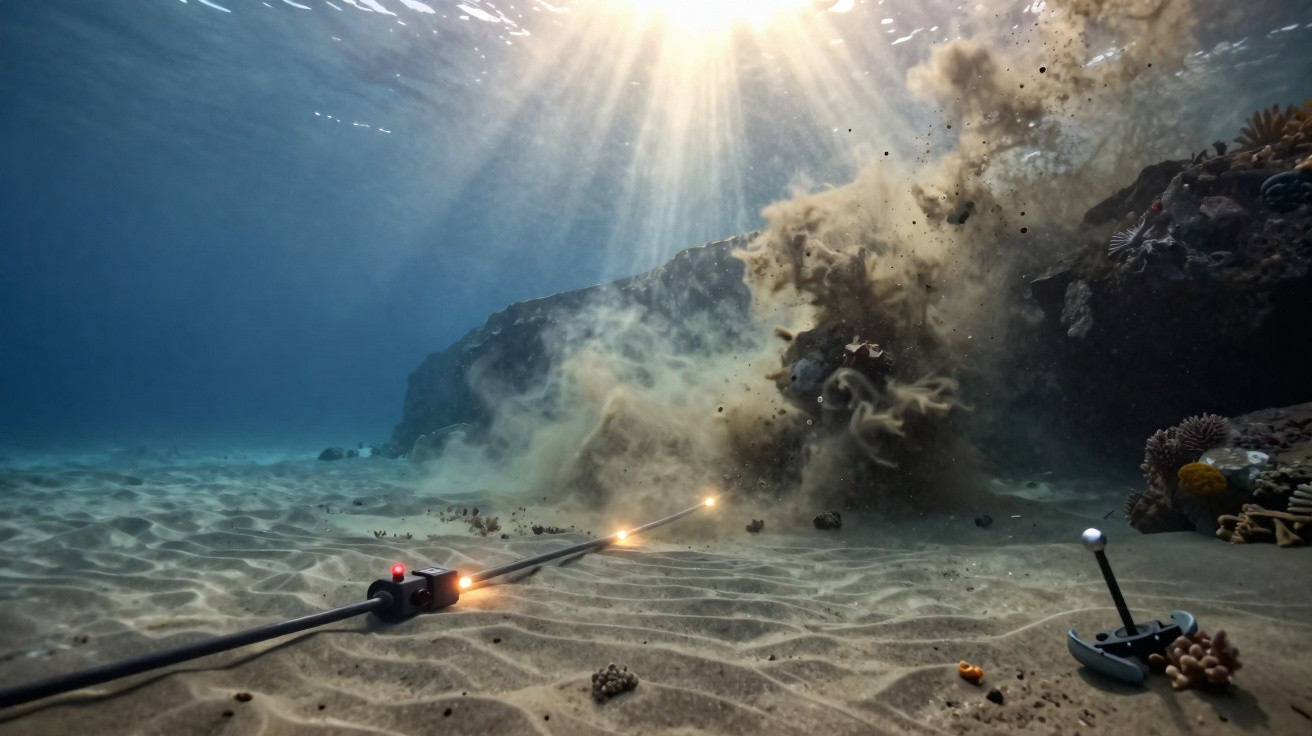
Underwater avalanches are formidable natural processes that occur continually beneath the ocean’s surface. Because they are invisible from above and exceptionally hard to monitor, scientists still have only a limited grasp of how they initiate and behave.
Underwater avalanches and fibre-optic seafloor cables
These events matter well beyond marine geology. As the internet has expanded, so too has the web of fibre-optic seafloor cables that now carries virtually all global internet traffic.
Current estimates suggest there are more than 550 active seafloor cables worldwide, with a total length of 1.4 million km - enough to loop around Earth’s circumference 35 times.
When an underwater avalanche severs seafloor cables, disruption can be extensive and costly. In 2006, the Pingtung earthquake in Taiwan set off underwater avalanches that broke multiple cables linking south-east Asia to the wider world.
At the height of the incident, China’s largest internet operator reported a 90% loss of traffic to the US. Taiwan, meanwhile, saw between 74-100% loss of internet traffic to nearby islands.
The knock-on effects reached global markets, as the reduced connectivity sharply limited the volume of financial transactions that could be completed. Restoring the network to full capacity took 39 days, along with millions of US dollars in ship time.
The cable-breaking underwater avalanche involved in this episode moved rapidly, reaching a top speed of 72km per hour. Even so, it was modest compared with the giant underwater avalanches I have studied in the Atlantic.
Despite the risks, the sheer number of seafloor cables makes a worldwide internet shutdown extremely unlikely. The Pingtung earthquake shows that even if main routes are cut, at least some data can still be rerouted via alternative pathways.
A 60,000-year-old Atlantic underwater avalanche offshore of Morocco
In a new research paper, my colleagues and I charted the impacts of a huge underwater avalanche that occurred 60,000 years ago, originating in a source area offshore of Morocco.
From there, it ran 400km through the world’s largest submarine canyon, before continuing for a further 1,600km across the Atlantic seabed. This makes it the second largest underwater avalanche ever recorded.
To document it, we combined high-resolution mapping of seafloor topography with hundreds of sediment cores taken across an enormous region. Each core intersected deposits left behind by the avalanche. We examined these deposits for fossils, allowing us to date the event to 60,000 years ago and to match the same individual avalanche layer across thousands of kilometres.
In total, the flow carried enough sediment to fill 140,000 Wembley Stadiums (162km³). It was taller than a skyscraper (more than 200 metres) and travelled at least 54km per hour. Along the way it gouged out a trench 30 metres deep and 15km wide for 400km - roughly the distance from London to Liverpool - obliterating everything in its path.
Afterwards, it spread across an area comparable in size to Germany, covering it with roughly a metre of sand and mud.
What triggers underwater avalanches - and why size is hard to predict
Our results indicate the avalanche did not begin as a massive slope failure. Instead, it started as a relatively small landslide and then expanded by more than 100 times along its route. That scale of growth far exceeds what is typical on land, where avalanches usually increase by only four to eight times and are tiny by comparison. This directly challenges the common assumption that the biggest avalanches must start as the biggest slope collapses.
What we can now say is that underwater avalanches may begin small yet intensify along their path into catastrophes of extraordinary power. These findings could alter how geologists evaluate the geohazard potential of such events, potentially shifting attention towards conditions along the avalanche pathway rather than focusing mainly on the initial landslide zone.
How frequently underwater avalanches occur varies greatly from place to place. Submarine canyons that begin relatively close to river mouths draining high-rainfall catchments can experience several small avalanches per year. By contrast, systems far from river discharge - such as the Agadir Canyon off north-west Morocco - may produce just one giant avalanche every 10,000 years.
Many different mechanisms can trigger underwater avalanches, including earthquakes, tides, typhoons, river floods and even volcanic eruptions. Climate change is expected to increase the frequency and intensity of some of these triggers.
Even so, a trigger does not ensure an avalanche will follow, and it does not determine how large the resulting event will be. In 1755, for instance, a major earthquake struck Portugal’s coast, devastated large parts of Lisbon and killed tens of thousands of people - yet it produced only a tiny underwater avalanche.
In contrast, a large earthquake off Newfoundland, Canada, in 1929 unleashed the biggest underwater avalanche ever documented.
Using detailed seafloor surveys alongside sediment cores, my colleagues and I reconstructed this event’s characteristics. The avalanche raced downslope at 68km per hour, transporting a dense mix of boulders, sand and mud, and snapping 11 seabed cables as it travelled.
It was so immense that it generated a tsunami that killed 28 people along the nearby coastline. To this day, it remains the first and only giant underwater avalanche to have been directly measured through cable breaks.
Although the science of underwater avalanches is still at an early stage, ongoing research continues to reveal where they occur, how they evolve, and just how powerful and destructive they can be. They are a striking reminder of how many remarkable processes remain concealed in the deep sea.
Christopher Stevenson, Senior Lecturer in Quantitative Sedimentology, University of Liverpool
This article is republished from The Conversation under a Creative Commons licence. Read the original article.






Comments
No comments yet. Be the first to comment!
Leave a Comment