
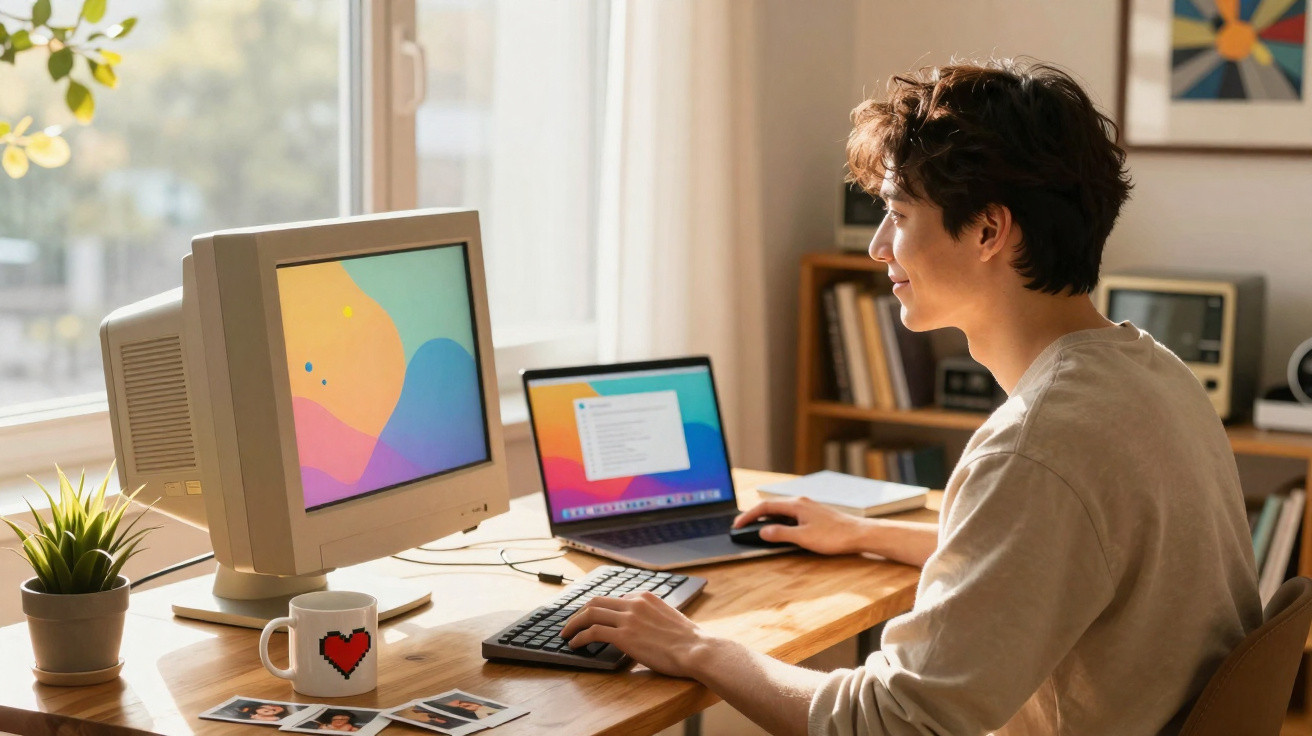
The way we experience the internet is shifting - "the times, they are a-changin'", as Bob Dylan would say. You may not be able to pinpoint exactly what’s altered, yet it’s hard to ignore that the internet feels unlike it did before.
For some people, it’s now "less fun and less informative" than it once was. Others find that search results are increasingly dominated by "cookie cutter" pages that bury genuinely helpful information beneath scams, spam and material produced by artificial intelligence (AI).
Meanwhile, social media timelines can feel like an endless stream of attention-grabbing, provocative, hyper-targeted or anger-inducing posts - from strange AI-generated images to oddly robotic replies. And if you’re fortunate, your video feed isn’t entirely taken over by commands to "subscribe".
So how did we arrive at this point? And is it possible to claw our way back?
Commercial interests rule
A key reason the internet looks and feels the way it does today is over-commercialisation: money has become the primary driver behind huge volumes of what we see online. One consequence is the spread of sensational content, where the goal is often to go viral rather than to provide high-quality information.
Disguised and misleading advertising has also become commonplace, making it harder to distinguish between commercial messaging and non-commercial material - a tactic designed to win attention and boost engagement.
Alongside this is the outsized influence of tech giants such as Google, Meta and Amazon. With reach into the billions globally, these companies exercise extraordinary control over the information and media that many people consume.
Their services rely on sophisticated tracking tools and largely opaque algorithms to deliver hyper-targeted content, fuelled by vast quantities of user data. The result can be filter bubbles, where people encounter a narrow slice of information that strengthens existing beliefs and biases, as well as echo chambers in which alternative perspectives are actively dismissed.
Bad actors - including cyber criminals and scammers - have long been part of the online landscape. But changing technology, particularly generative AI, has amplified what they can do, helping them produce convincing fake images, deepfake videos and cloned voices.
At the same time, AI-driven automation has enabled an unprecedented flood of low-quality, deceptive and harmful content across the web.
Overall, rapid commercialisation, the dominance of major media and technology platforms, and persistent malicious activity have seeped into much of what’s online. The growing role of AI only heightens these pressures, contributing to a more disorderly internet than ever.
Some of the 'good' internet remains
That raises a question: what is the "good internet" many people remember - and miss - with nostalgia?
In its early days, the internet was imagined as a freer, more egalitarian environment where people would "surf" and "browse". Knowledge sharing sat at the centre of that vision, and places like Wikipedia and The Internet Archive still stand as important repositories of information.
Before filter bubbles became widespread, the internet also operated as a kind of creative playground. People could explore unfamiliar ideas, debate across differing viewpoints, and work with individuals from "outgroups" - those beyond their own social circles who might see the world very differently.
Early social media, too, was shaped around reconnecting with old classmates and relatives you’d lost touch with. Many people still rely on online communities, acquaintances and family networks to stay in contact. That "connection" side of the internet remains vital - something highlighted clearly during the COVID pandemic.
Another value many want to protect is privacy. A New Yorker cartoon from 1993 captured the early mood with the line "on the internet, nobody knows you're a dog". Today, by contrast, everyone - advertisers in particular - is trying to find out exactly who you are. As the Office of the Australian Information Commissioner puts it, one core principle of privacy is "to be able to control who can see or use information about you".
At minimum, people want more say over what big tech firms learn about them - especially when that information can be turned into profit.
Can we ever go back?
We can’t stop "a changin'" times, but we can try to hold on to as many of the internet’s better qualities as possible.
One starting point is to vote with our feet. Users can push for change and draw attention to problems on existing platforms. Recently, this has been seen in people leaving X (formerly Twitter) for other services, and in the platform-wide protest against Reddit after it altered third-party data access policies.
That said, voting with our feet only works when real competition exists. In X’s case, there are multiple alternatives - from Mastodon to Threads to Bluesky - allowing people to choose spaces that better match their preferences, values and social circles. Search, too, has other options, including DuckDuckGo or Ecosia.
Yet genuine competition often depends on shifting towards decentralised systems and breaking up monopolies. Something similar occurred in the internet’s earlier period during the 1990s "browser wars", when Microsoft was later accused of unlawfully monopolising the web browser market in a landmark legal case.
As technology users, we all need to stay alert to risks affecting our privacy and our access to reliable knowledge. With generative AI now cheap and widely available, scams and misleading content can appear more convincing than ever.
We should practise sensible scepticism and make sure those most vulnerable to online harms - including children and older people - are taught about potential risks.
Keep in mind: the internet is not optimised for your best interests. It’s for you to decide how much influence you hand to the tech giants who are building theirs.
Marc Cheong, Senior Lecturer of Information Systems, School of Computing and Information Systems; and (Honorary) Senior Fellow, Melbourne Law School, The University of Melbourne and Wonsun Shin, Associate Professor in Media and Communications, The University of Melbourne
This article is republished from The Conversation under a Creative Commons licence. Read the original article.




Comments
No comments yet. Be the first to comment!
Leave a Comment