
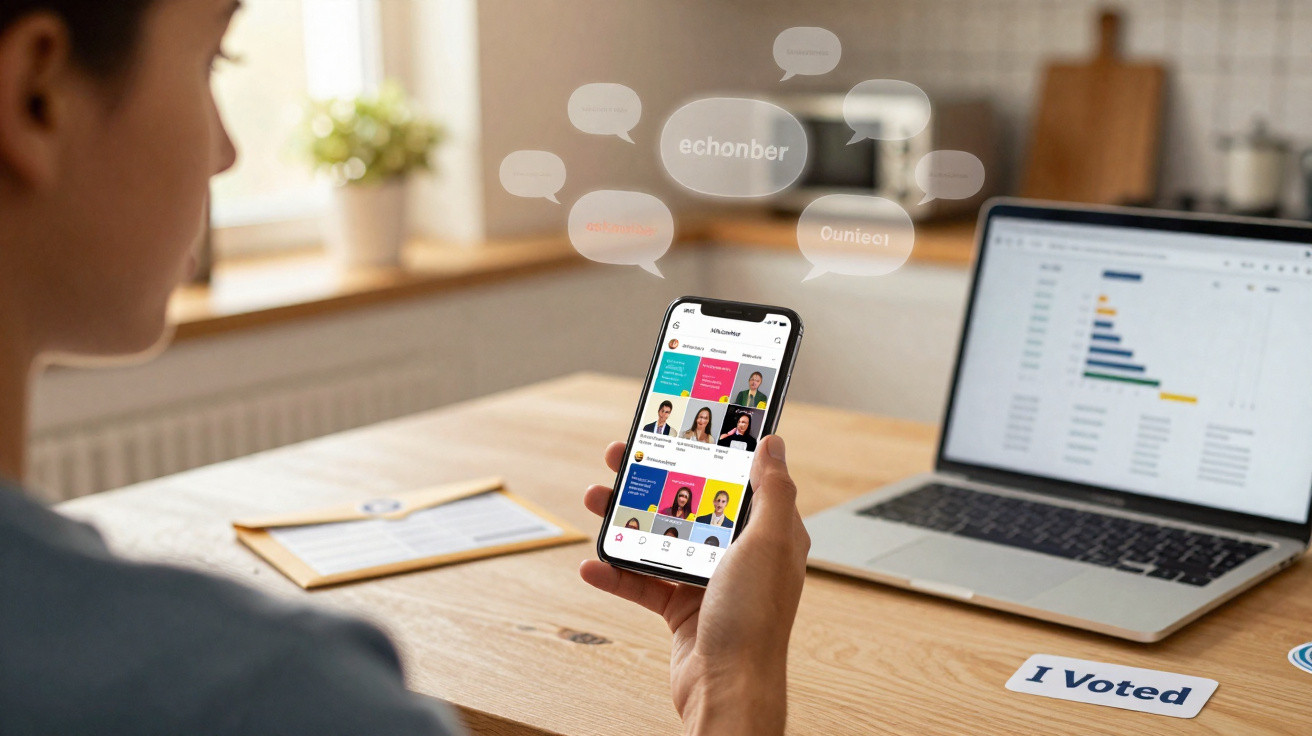
Unreliable publishers routinely circulate false and provocative material across social media, and many assume this kind of content reshapes public opinion.
That led to an apparently straightforward remedy: remove the worst material and people’s beliefs should move accordingly.
During the 2020 U.S. election, a group of university scholars working alongside Meta researchers put that assumption to the test.
They limited how often posts from untrustworthy sources appeared in the feeds of thousands of consenting Facebook and Instagram users, and then tracked whether those users’ views shifted. Although the feeds were noticeably different, participants’ opinions stayed essentially the same.
Misinformation reached few users
One unexpected finding appeared even before the intervention began. On Facebook and Instagram, most people encountered very little material from sources known for repeatedly spreading misinformation.
For half of Facebook users, such content accounted for 1.1 percent or less of what they saw. On Instagram, it was only 0.1 percent.
Instead of being evenly distributed, exposure clustered among a small minority. Roughly 23 percent of Facebook users and 11 percent of Instagram users were responsible for around 80 percent of all the untrustworthy content viewed.
In absolute terms, that corresponds to about 53 million Facebook accounts and 22 million Instagram accounts.
Echo chambers did the work
Brendan Nyhan, a professor in the Department of Government at Dartmouth College, was among those leading the research.
“Exposure to content from untrustworthy sources on social media is less common and more concentrated than people typically think,” he said.
Tim Tangherlini, who researches rumours and conspiracy theories on social platforms at the University of California, Berkeley, was not involved in the project. He said the distribution matched a long-observed pattern in folklore research.
“Stories don’t spread evenly through a population,” he said.
“They flow on and across social networks predisposed to receive them, retell them and refine them – basically like an echo chamber.”
Researchers cut misinformation sharply
For three months around the election, the team reduced how much untrustworthy material people in the treatment group were shown.
Olivier Bergeron-Boutin, a political science Ph.D. student at the University of California, Berkeley, oversaw the analysis. His group recruited 15,928 adults across the two platforms and intentionally ensured that many heavy consumers of this content were included.
The project was conducted in collaboration with Meta, and some authors were Meta employees. The academic researchers kept final control over the analysis and the published paper, and they received no payment from Meta.
On Facebook, untrustworthy content in the main feed declined from 1.8 percent to 0.5 percent. On Instagram, it dropped from 2.5 percent to 0.8 percent. In both cases, the decrease was about 70 percent.
The intervention was large in practical terms: people assigned to the treatment group encountered far less of the material the study aimed to reduce.
Less misinformation, same opinions
When the survey data came in, however, almost nothing looked different.
Beforehand, the researchers specified 10 outcomes they would examine. These covered belief in false claims, trust in mainstream media, sentiment towards the opposing political party, and perceptions of the 2020 election.
Across 20 primary measures, nearly every estimate hovered close to zero. For 17 of those measures, the results allowed the researchers to rule out anything larger than a small effect.
“The intervention was successful in the sense that it reduced what it was supposed to reduce, in this case, exposure to information from untrustworthy sources,” said Bergeron-Boutin.
“But the resulting changes in attitudes were much smaller than some would have expected.”
The same pattern held among the most exposed users. For participants who began with the highest levels of untrustworthy content, the reduction was even greater-yet their views still did not shift.
Networks outlast feeds
Tangherlini said the findings are easier to understand when beliefs are treated as properties of communities, not isolated reactions to individual posts.
“A platform intervention changes what flows into the network,” said Tangherlini, “but it doesn’t change the underlying social network or the beliefs shared within it.”
He likened changing entrenched beliefs to steering a large oil tanker: minor adjustments can nudge direction, but meaningful change requires time.
Why nobody can rerun this
Bergeron-Boutin said the outcome should not be taken as reassurance about misinformation on social media.
“We shouldn’t interpret these results to mean that misinformation is no big deal,” he said.
“But there’s no quick fix. Anyone who proposes a simple solution to misinformation or political polarization should be viewed skeptically.
“Tinkering at the margins can help, but ultimately, institutional features of American democracy provide fertile ground for these issues to rise.”
Study results need context
The researchers also emphasised key constraints on what the study can show. It occurred during a single U.S. election and focused on two platforms that have changed substantially since 2020.
The intervention also ran for only three months, which is too brief to detect effects that might accumulate over years.
One limitation outweighs the others. In January 2025, Meta ended its U.S. fact-checking programme, which had enabled the interventions used in this experiment.
Because of that, the same study cannot be replicated today, and the researchers caution that their 2020 results may no longer describe how the platforms operate.
At present, nobody knows what exposure to untrustworthy sources looks like now, and the tools previously used to measure it are no longer available.






Comments
No comments yet. Be the first to comment!
Leave a Comment