
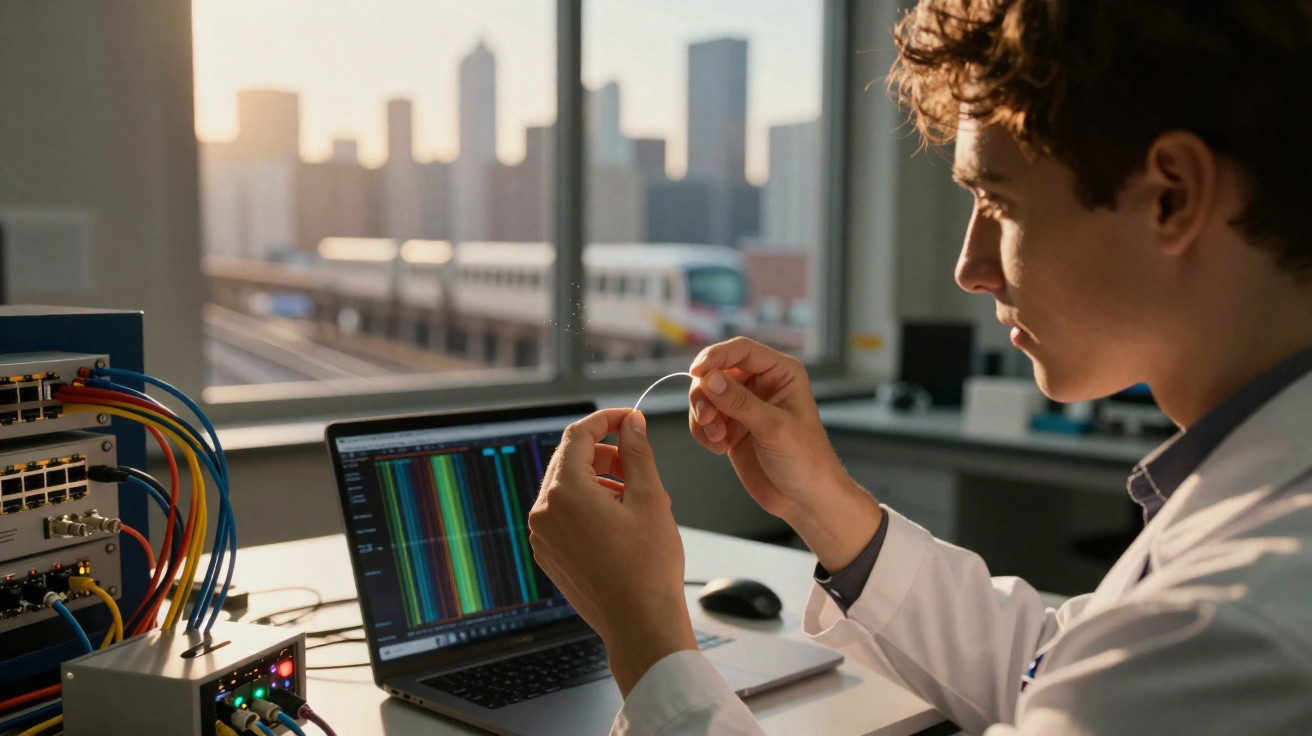
Quantum information is so easily disrupted that even a brief glint of stray light can ruin it. That is why a group of physicists decided to send it down a fibre already thundering with everyday internet use, simply to find out whether anything would make it through.
Imagine a glass filament, slimmer than a human hair, laid under the streets between Evanston and central Chicago. It carries a torrent of normal online activity: video meetings, films on streaming services, and cloud back-ups.
In those conventional data pulses, each flash of light contains millions of photons. Now picture inserting a single, solitary photon instead - one that holds quantum information so delicate that the faintest unwanted light can wipe it out.
Would that lone photon survive the ride? A team at Northwestern University set out to test exactly that.
What they found may influence how the quantum internet - often promised, but seldom demonstrated outside controlled settings - is eventually constructed.
An ant among elephants
The internet we use today encodes information as bits: 0s and 1s. A quantum internet, by contrast, would rely on quantum states, including entanglement - an unusual connection between two particles that persists regardless of how far apart they are.
In principle, entangled photons could underpin ultra-secure communications, link quantum computers between cities, and even move quantum information without transporting it physically, via a technique known as teleportation.
The central problem is straightforward - and severe. Quantum signals are carried by single particles of light, while standard internet data surges through fibre with enormous intensity.
The study’s senior author, Prem Kumar, is a professor of electrical and computer engineering at Northwestern’s McCormick School of Engineering.
Kumar leads the Center for Photonic Communication and Computing. The paper’s first author is Gina Talcott, a graduate student in his research group.
“Quantum signals are very, very tiny compared to classical signals,” said Kumar.
“It’s like an ant traveling through a path filled with elephants. Our results show that photons can survive the journey and remain entangled.”
Out of the lab
In 2024, Kumar’s group demonstrated quantum teleportation through a fibre already filled with high-speed internet traffic - a notable achievement.
However, that entire set-up was confined to the laboratory: roughly 30 kilometres (19 miles) of fibre wound on a spool in a room, never exposed to real-world network conditions.
“In that experiment, we showed the art of the possible,” Kumar said. “We achieved actual quantum teleportation over 30 kilometers, but it was in the lab. We wanted to add more realism and bring the experiment into the real world.”
For this new test, the researchers moved into the field. On Northwestern’s Evanston campus, they produced pairs of entangled photons.
They kept one photon from each pair on site, while sending its partner through just over 24 kilometres (15 miles) of installed fibre to the StarLight communications exchange in central Chicago.
StarLight is an operational hub that routes live network traffic continuously. There were no spools and no carefully controlled lab environment - only the internet’s real, working infrastructure.
Sharing a crowded road
The quantum photons were not given an empty line. Alongside them ran two classical data channels, each operating at 800 gigabits per second.
On top of that, the team added extra optical power to emulate a fully utilised commercial fibre.
“The fiber carried enough power to potentially transmit 36 terabits-per-second of classical data,” Kumar said.
“That’s roughly equivalent to 20 million YouTube videos streaming simultaneously through a single fiber.”
A major threat in this setting is Raman scattering. The high-intensity classical light interacts with the glass and throws off faint noise into other wavelengths - easily enough to overwhelm a single photon.
Dodging the noise
To avoid that interference, the team placed their quantum signal in a calmer part of the spectrum known as the O-band.
Meanwhile, the heavy classical traffic remained in the C-band, where commercial optical systems typically operate. The researchers then used narrow filters to remove most of the stray light that still bled across.
Another challenge remained: the two ends of the experiment were in different cities. Identifying entangled photon pairs requires knowing when each photon arrives with extreme accuracy - down to trillionths of a second.
To achieve this, they relied on White Rabbit, an optical timing system first developed at CERN, to synchronise clocks in Evanston and Chicago with picosecond-level precision. That timing alignment allowed the team to pick out matching pairs despite the persistent background noise.
What survived the journey
It would be reasonable to assume the quantum signal would arrive degraded - if it arrived at all. That did not happen. The entanglement reached the far end with more than 94% fidelity, indicating how well the quantum link was preserved.
The unexpected detail was this: when the researchers repeated the measurement with the classical traffic turned off, the fidelity was essentially the same.
Under full traffic, the quantum state matched the quiet-fibre result to nearly 99%. In other words, the data flood itself left almost no trace.
The remaining small flaws were attributed to the photon source and other equipment, rather than interference from the co-propagating classical signals.
The team also intentionally pushed the classical power up to its maximum, meaning that a typical real-world network would probably be less harsh on the quantum photons.
What’s still missing
A link of just over 24 kilometres (15 miles) is an opening step, not a complete network. The researchers note that longer spans - around 48 to 97 kilometres (30 to 60 miles) - still need to be explored.
The quieter O-band channel also experiences higher loss than the standard band, a penalty that increases with distance.
During the demonstration, only 1.6 terabits of actual data were transmitted; the remainder of the striking 36 was added as filler light, although the noise generated is physically the same.
The next bridge to cross
The broader implication is what gives the work weight. Building a quantum internet using entirely new, dedicated fibre would be enormously expensive.
Demonstrating that sensitive quantum signals can coexist with the cables already in the ground changes the economics.
Next, the team aims to attempt full quantum teleportation across metropolitan fibre that is carrying commercial traffic - something Kumar has, so far, only managed within the laboratory.
“We crossed a major bridge, showing we can do entanglement distribution,” Kumar said. “But there are two steps in teleportation.”
“First, you need to distribute entanglement. Then, you need to transfer information. Each step is progressively more complicated and difficult, but we are showing that it’s possible.”
Somewhere beneath Chicago, an ant has just made it through a corridor packed with elephants and emerged unscathed - unnoticed by the herd. The next question is whether it can bring something along as it goes.




Comments
No comments yet. Be the first to comment!
Leave a Comment