
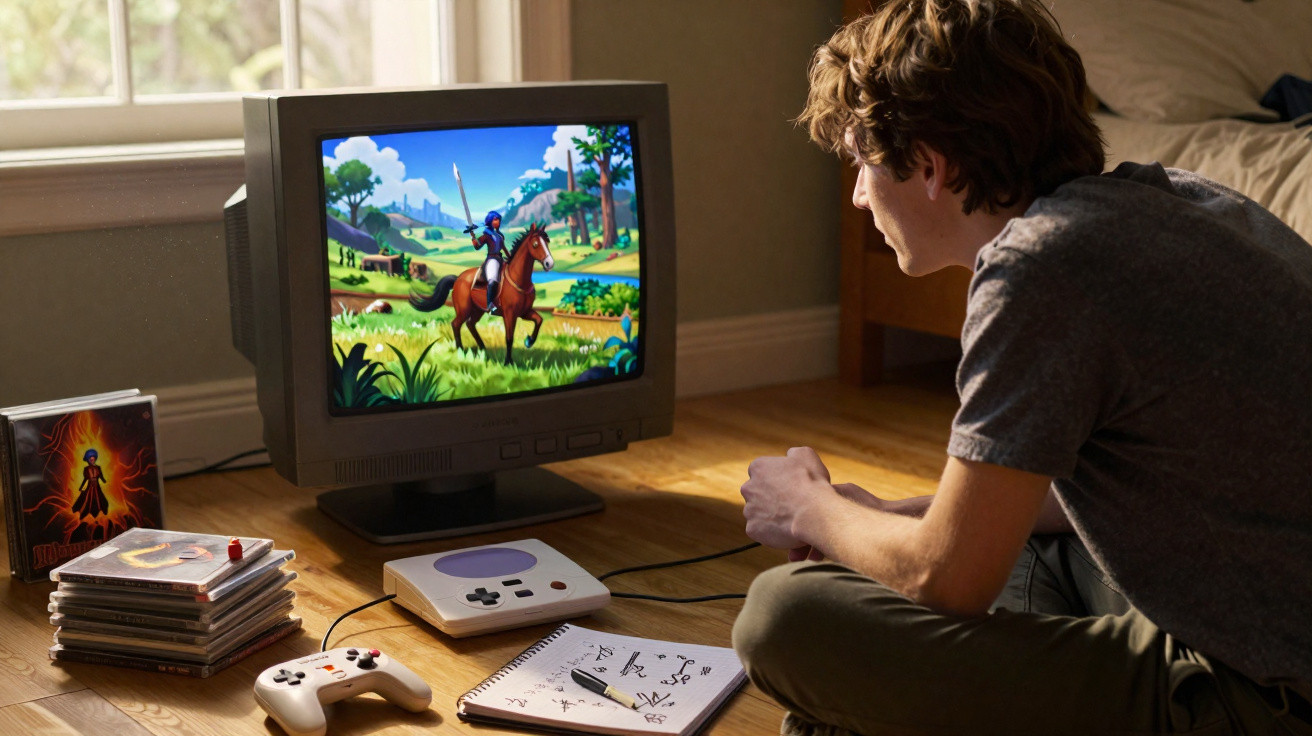
Retro fans are currently doing a double-take: The Legend of Zelda: Ocarina of Time - for many the most formative action-adventure of their childhood - is suddenly running on the Sega Dreamcast. An unofficial port is building a bridge between Nintendo’s cult era and a console that has been officially discontinued for years, reigniting debate around retro games, fan projects and video game preservation.
Unexpected comeback: Ocarina of Time runs on the Dreamcast
Back in 1998, Ocarina of Time launched on the Nintendo 64 and raised the bar for 3D action-adventures. These days it is often treated as a textbook example of level design, pacing and atmosphere. Seeing it appear not on Nintendo hardware but on Sega’s Dreamcast initially feels almost like a bad joke.
In reality, it is a serious community effort. A developer who goes by the name “jnmartin” online has released a port of the game. They are distributing the files via a developer platform where hobby coders and professionals share projects. On the technical side, the work draws on the reconstructed codebase of Ocarina of Time - the result of years of fan analysis and a translation of the original into C code.
Ein Fanprojekt bringt Ocarina of Time auf eine Konsole, die Nintendo nie im Blick hatte – und zeigt, wie lebendig Retro-Communities noch sind.
Compared with the Nintendo 64, the Dreamcast offers more processing power and a different graphics architecture. That creates scope for changes such as steadier frame rates, alternative resolutions and potential visual tweaks. For now, the port is focused on staying as faithful as possible to the original experience, though further refinements are technically conceivable later on.
Why choose the Dreamcast for Link’s adventure?
The Dreamcast launched in Japan in 1998 and in Europe in 1999. Sega hoped it would deliver a comeback in the console market, but the major breakthrough never arrived; within a few years, the company withdrew from the hardware business. That backstory is precisely why the console has since become a cult object.
It was also more advanced for its time than many people remember: a fast processor, a relatively modern graphics chip and a built-in modem. Plenty of its games felt ahead of the curve, yet never reached the audience they arguably deserved. The result today is a small but intensely active fanbase producing new games, ports and mods for the Dreamcast.
In recent years, other classics originally built for entirely different platforms have already found their way onto Sega’s hardware, including:
- Super Mario 64 - Nintendo’s landmark platformer as a fan port
- Doom 64 - the darker shooter spin-off from Nintendo’s 64-bit era
- various homebrew remakes of 2D arcade hits
Ocarina of Time now joins that lineup, standing as a clear example of how many players treat the Dreamcast as a playground for experimentation.
How well does Ocarina of Time hold up in 2026?
What makes this port interesting is not so much whether it can be done, but what it feels like to play. Returning to Hyrule today makes one thing obvious: many of the design ideas still feel surprisingly fresh. The structure of distinct dungeons, the smart target-lock combat system, and the balance between puzzles and action all hold up remarkably well on modern displays.
Visually, the game inevitably shows its age, yet it has a clean, coherent style. Polygonal models, simple textures and bold colours - on the Dreamcast this reads less as dated and more as charming. Many fans say the slight technical uplift helps them “see the game the way they remember it back then”.
Story, Spielfluss und Musik tragen das Abenteuer bis heute – Technik spielt da nur die zweite Geige.
The iconic moments, in particular, remain powerful: the first step onto Hyrule Field, the time jump into the future, and the encounter with Ganondorf in the castle. On Dreamcast hardware, all of that can be experienced almost unchanged; the main differences are the controller mapping and a handful of technical details.
Between nostalgia and a legal grey area
Fan ports like this usually sit in a delicate space. Ocarina of Time is still an active Nintendo brand. Official re-releases have appeared, among other places, on the Nintendo 3DS and as part of online subscription services. The Dreamcast port, by contrast, does not come from the rights holder - it comes from the community.
From a legal standpoint, a lot depends on what a fan project actually provides. Often, developers share only executables or patches, while users are expected to supply a legal copy from their own game version. This approach avoids directly distributing copyrighted material, but it can still fall within a grey zone in which publishers could intervene if they chose to.
For many retro players, however, a different concern takes priority: preserving gaming history. Old consoles fail, cartridges degrade, and digital shops get shut down. Fan projects attempt, at least technically, to fill some of those gaps.
Retro boom: why old games are in demand again
The Dreamcast port of Ocarina of Time fits neatly into a broader trend. Retro games have been enjoying a genuine resurgence for years, for several reasons:
- Nostalgia: players from the 1990s want to revisit the titles they grew up with.
- Collecting: original hardware and cartridges are gaining value as enthusiast items.
- Game design: many older games rely more on clear mechanics rather than overloaded systems.
- Technical appeal: tinkerers enjoy pushing old hardware with new projects.
At the same time, publishers are releasing official remakes and remasters. From Resident Evil and Final Fantasy to classic platformers, the industry has realised that retro is not just a hobby - it is a business model. Fan projects like this Dreamcast port run alongside that, appealing to an audience that enjoys experimenting and getting hands-on.
What fans can expect from the Dreamcast port
Anyone looking to try the port should keep a few practical points in mind:
| Aspect | What players can expect |
|---|---|
| Hardware | An original Dreamcast or a compatible emulator setup is required |
| Convenience | Setup requires basic technical understanding; it is not plug-and-play |
| Feel | Very close to the N64 original, with partly smoother presentation |
| Legal | Typically assumes you own an original, legally purchased copy |
Those willing to commit will not only get a classic Zelda adventure, but also a different angle on console history. Pairing Nintendo software with Sega hardware feels almost forbidden - and that sense of transgression is part of the appeal.
Why fans put so much work into projects like this
From the outside, it can look absurd: months of labour, complex tooling and countless tests - all for a game that already exists in official re-releases. Yet in conversations with retro enthusiasts, the same motivations come up again and again:
- Technical curiosity: “Geht das überhaupt auf dieser Konsole?”
- Respect for classics: games like Ocarina of Time are seen as cultural artefacts.
- A sense of community: small scenes form and grow around projects like these.
- A desire for control: fans choose for themselves which hardware they use for their favourites.
There is also another factor: many developers working in games professionally today grew up with these very classics. Fan ports are not only about playing; they are also about learning. Anyone working on a Dreamcast version of Ocarina of Time inevitably gains a detailed understanding of how the original is put together.
What this port means for the future of retro games
Ocarina of Time turning up on the Dreamcast highlights a shift in how game culture is carried forward. Classics are no longer preserved only in museums or through official reissues; instead, they are made to run on an ever wider range of devices. From PCs and handhelds to long-retired consoles, small parallel ecosystems for older games are emerging everywhere.
For players in the German-speaking world, that creates a clear opportunity: anyone interested in gaming history, technology and modding has more ways in than ever. At the same time, it is worth taking a critical view of the legal and moral questions: can a fan project be more than a friendly tribute when companies are earning money from the same brands? The answer remains disputed.
One thing is certain: if a Zelda classic can find a new home even on a Sega console that failed commercially, its status is not in doubt. Ocarina of Time has long since outgrown the boundaries of its original platform - and with every new port it underlines why it is still regarded as a benchmark for action-adventures.




Comments
No comments yet. Be the first to comment!
Leave a Comment