
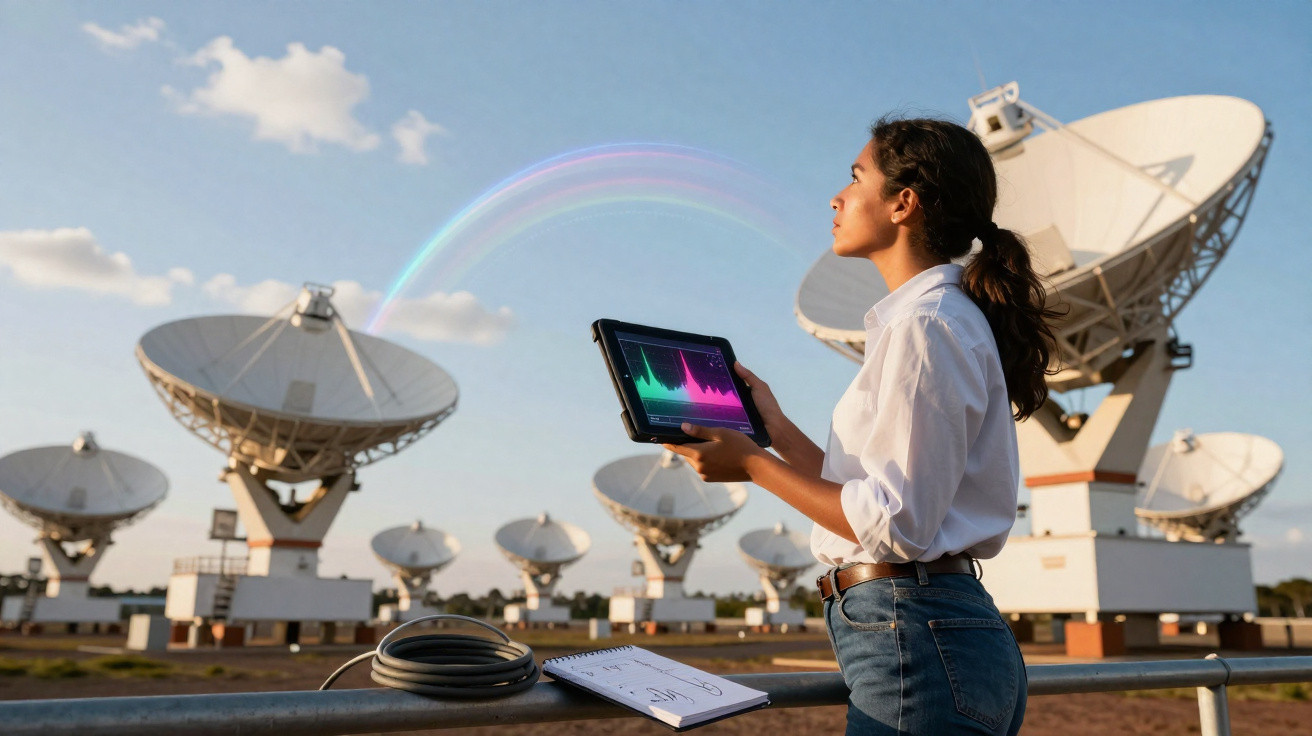
A radio telescope in South Africa has picked up a signal that began its journey eight billion years ago, when the Universe was not even half its current age. The source is a colossal collision between two galaxies - and the signal is amplified by an unusual cosmic “chance alignment” that steers the beam towards us as if through a natural magnifying glass.
A radio signal travels for more than eight billion years to Africa
The observations centre on an object with the matter-of-fact designation HATLAS J142935.3-002836. Behind the catalogue entry lies a pair of galaxies in the process of colliding at tremendous distance: around eight billion light years from Earth. In other words, the radio waves now arriving set off when the Universe was roughly five billion years old.
Under typical circumstances, a signal like this spreads out so much over such a long journey that even large radio telescopes cannot reliably separate it from background noise. Here, however, something unusual happened along the line of sight.
"By chance, another galaxy lay between the source and Earth, whose gravity warps space and boosts the distant radio signal like an optical lens."
This so-called gravitational lens acts like an enormous magnifier in space. The mass of the intervening galaxy bends spacetime and concentrates the radio waves from the faraway collision, increasing the measured intensity many times over. Only this interplay of source, lens and Earth made the beam detectable in the first place for the South African instrument.
MeerKAT as a radio view into deep space
The signal was recorded by MeerKAT, a radio telescope array in South Africa’s Karoo Desert. The system comprises 64 dishes that work together as though they were a single, vast telescope. MeerKAT surveys a large portion of the southern sky at radio wavelengths and is designed to track down faint emissions from distant galaxies.
The team led by astrophysicist Marcin Glowacki at the University of Pretoria analysed measurements from the MeerKAT Absorption Line Survey. In this programme, researchers sift through observations for distinctive radio signatures from gas and molecules in space. Within these data, the group found a signal that stood out clearly from the usual background.
Their assessment shows the emission originates from a hydroxyl megamaser - and in this case it is markedly more powerful than any previously observed example of its kind. The researchers therefore propose calling it a “gigamaser”, essentially a supercharged variant of this cosmic laser-like phenomenon.
When galaxies collide and space lasers ignite
The physical origin of the signal is hydroxyl (OH) molecules embedded within the enormous impact zone where two galaxies are merging. When systems containing billions of stars crash into one another, vast clouds of gas and dust are placed under extreme pressure.
This compression triggers several processes at once:
- Gas clouds are squeezed and heated.
- Molecules such as hydroxyl are driven into an excited energy state.
- New stars form at an exceptionally high rate.
- Shockwaves and radiation further heat the surrounding environment.
In HATLAS J142935, the conditions appear to reach an extreme: estimates suggest stars form there each year with a combined total of several hundred solar masses. This sustained fireworks-like activity keeps the hydroxyl molecules in a state where they preferentially release energy at one specific radio wavelength.
"The result is a cosmic maser - a relative of a laser that emits not visible light, but radio waves."
Such megamasers function like natural beacons in the cosmos. Their directed, amplified emission can stand out even across immense distances. The newly detected gigamaser exceeds the brightness of earlier known examples, pointing to especially intense activity in the central regions of the merging galaxies.
What the radio waves reveal about distant galaxies
For scientists, megamasers are far more than curiosities. Their emissions make it possible to map the distribution of molecular gas in far-off galaxies. From that, researchers can infer how strongly new stars are forming and how galaxies change during collisions.
Each additional discovery also helps to gauge how common such dramatic mergers were in the young Universe. The hope is to better understand how today’s large galaxies - including our own Milky Way - grew into their present-day form.
MeerKAT as a forerunner to the mega-project SKA
The new result is regarded as the first confirmed hydroxyl gigamaser made visible with the help of a gravitational lens. That provides support for an observing approach many teams have backed for years: when lens, source and Earth happen to align favourably, the number of detectable signals multiplies.
Researchers intend to scale up exactly this idea in the coming years. MeerKAT is serving as a proving ground for the international Square Kilometre Array (SKA). This network of thousands of antennas in South Africa and Australia is intended to boost today’s radio sensitivity substantially.
| Instrument | Location | Distinguishing feature |
|---|---|---|
| MeerKAT | South Africa, Karoo Desert | 64 antennas, high sensitivity in the southern sky |
| SKA (Phase 1) | South Africa & Australia | Thousands of antennas, about ten times more sensitive than MeerKAT |
With the first SKA phases expected to begin from around 2028, teams anticipate uncovering thousands of previously hidden megamasers. Regions containing massive galaxy clusters are particularly compelling, because many gravitational lenses can act at once. These parts of the sky are set to be monitored in a targeted, regular way.
A new map of the radio Universe
By combining datasets from MeerKAT and the SKA, scientists aim to produce an unprecedented radio map of the distant cosmos. This will allow trends in star formation to be traced across billions of years - at distances where optical telescopes run into their limits.
Gigamasers like the one now identified act as anchor points. They highlight locations where conditions also matter for the development of supermassive black holes and dense star clusters. Systematic studies of such sources enable models of galactic-centre growth to be tested.
What terms like maser, gravitational lens and light year actually mean
Many of these technical terms sound like science fiction, yet they refer to very concrete physical phenomena. A maser is, in essence, a laser that emits radio waves rather than visible light. The amplification arises when many identical molecules in the same excited state “trigger” together, releasing their energy at the same wavelength and in the same direction.
A gravitational lens works in a completely different way, rooted in general relativity. Mass bends spacetime, and light or radio waves follow that curvature. If the distant source, the lens and the observer lie almost exactly along a single line, one faint signal can produce several images that are significantly magnified.
A light year, finally, is not a measure of time in the literal sense, but of distance: how far light - or radio waves - travels in one year through a vacuum, about 9.5 trillion kilometres. At a distance of eight billion light years, the present detection shows how far back into the Universe’s past radio telescopes can now see.
Discoveries like this can seem abstract at first glance, but they carry practical value for astronomy. The better researchers understand processes such as galaxy mergers, gas flows and maser emission, the more reliably they can build simulations of the cosmos’s past and future. Those models, in turn, support the planning of new missions, the design of telescopes, and the search for rare phenomena.






Comments
No comments yet. Be the first to comment!
Leave a Comment