
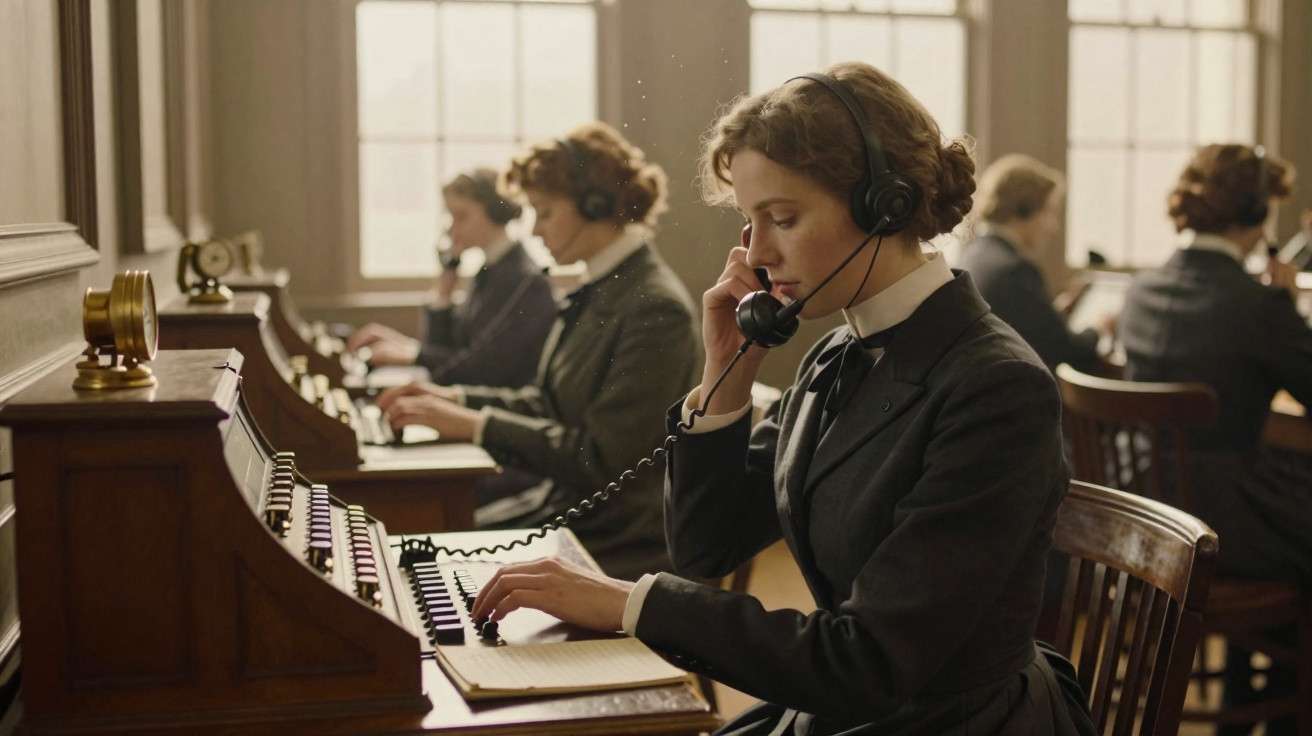
Long before the world wars drew large numbers of women into factories and offices, a nineteenth-century invention had already created tens of thousands of roles for them. The telephone demanded staff who could connect calls quickly and politely, yet the first operators-teenage boys-soon became known for pranks, impatience and rudeness.
The first operators were young boys
The earliest commercial telephone exchanges appeared in the late 1870s. With no direct dialling available, every call relied on an operator: the subscriber would make a request, and the operator would find the required line and plug cables into a switchboard packed with metal sockets.
Telephone companies initially hired boys who already had telegraph experience. But once they were dealing directly with the public, difficulties emerged. Historical accounts describe arguments, unsuitable language, calls being cut off, and customers being teased-behaviour that undermined confidence in a technology that was still new.
Emma Nutt changed history in 1878
On 1 September 1878, Emma Nutt began work at a Boston telephone exchange, becoming the first known female telephone operator. Within a few hours, her sister Stella was hired too. The results convinced companies that women could run the switchboards effectively.
The Smithsonian Institution records that, for around a century, women became the majority in telephone exchanges across various countries. Firms praised voices they considered calm and courteous, while also realising they could offer lower wages than those paid to male workers.
How did a telephone operator complete a call?
When a subscriber turned the crank on the telephone, an electrical signal triggered an alert at the exchange. The operator would plug into the circuit, ask for the number required, and connect a second lead to the matching socket. Calls between towns and cities could require coordination with several exchanges along the route.
- Recognise the signal sent from the subscriber’s telephone
- Ask for the recipient’s number or name
- Insert cords into the correct switchboard sockets
- Contact intermediate exchanges for long-distance calls
- Disconnect once the conversation had ended
This routine could take several minutes, especially for long-distance connections. Operators had to learn procedures by heart, respond instantly, and keep track of multiple calls at once. Because they had access to private lines, they were expected to maintain confidentiality-although stories about operators listening in on conversations still spread.
Watch the video shared by the YouTube channel UpLife listing 20 facts about Emma Nutt, the telephone operator who changed history.
The telephone created a mass women’s profession
As networks expanded, telephone service became one of the biggest sources of employment for young women. According to historical records compiled by Time magazine, more than 177,000 women worked as telephone operators in the United States in 1920, before the Second World War dramatically reshaped the labour market.
The job provided wages and a chance to work beyond the home, but it also came with strict discipline. Operators were monitored by supervisors, required to use standardised phrases, and had to deal with impatient callers. Even so, they built professional experience and held roles that were vital to the modern economy.
Telephone operators connected far more than calls
By the early twentieth century, women already made up most US operators. During the First World War, workers known as Hello Girls served in US military communications, routing messages faster than many soldiers who had been hurriedly trained.
Automation gradually removed the large manual switchboards, but it does not diminish the significance of the operators who ran them. Remembering this history shows that women’s entry into paid work began before the wars and faced inequality from the outset. This story needs to be preserved now, before the voices behind the telephone revolution are forgotten.





Comments
Кто такой флорист и что он делает?
? Инструменты для флористики должны быть хорошего качества, чтобы ими было удобно и легко работать https://artcraftbouquet.ru/articles/post/buket-nedeli-198
Дешевые модели, как правило, очень быстро выходят из строя https://artcraftbouquet.ru/articles/p/2
?
1 https://artcraftbouquet.ru/magazin/folder/cvety-dlya-zheny
Курсы флористики – быстрый и практичный способ освоить основы профессии https://artcraftbouquet.ru/articles/post/suhocvety
Длительность может составлять от нескольких дней до нескольких месяцев https://artcraftbouquet.ru/magazin/folder/cvety-na-pashu/p/3
Флористика – это искусство работы с цветами, которое требует не только творческого подхода, но и глубоких знаний о растениях, их сочетаниях и правилах ухода https://artcraftbouquet.ru/magazin/product/komnatnoe-906
Флорист — это специалист, который профессионально занимается составлением букетов, созданием цветочных композиций и украшением различных пространств с помощью растений https://artcraftbouquet.ru/magazin/product/aromatika-609
Авторские букеты живых цветов — это не просто композиции, а настоящие произведения флористического искусства, созданные с учетом современных тенденций и индивидуальных пожеланий https://artcraftbouquet.ru/magazin/folder/bukety-s-rozami/p/5
В интернет-магазине «Мосцветок» (Москва) вы можете заказать уникальные букеты, которые подчеркнут стиль, настроение и особенность любого события https://artcraftbouquet.ru/magazin/product/buket-127
сбалансированность всех частей композиции https://artcraftbouquet.ru/magazin/folder/vesennie-sadiki
Leave a Comment