
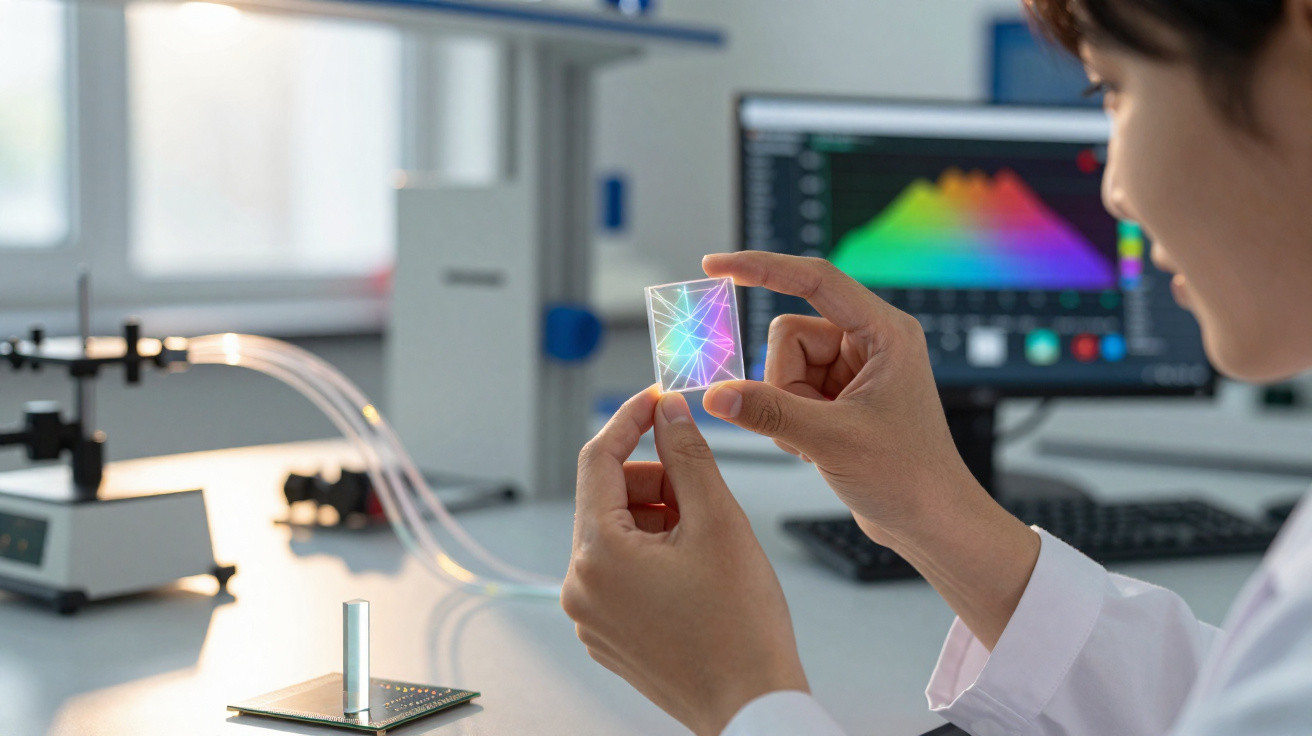
A prototype that computes with light has achieved near state-of-the-art AI accuracy without the steep energy costs associated with traditional electronic circuitry.
By shifting one of AI’s most power-intensive operations into a small optical unit, the work points towards machines that can run faster and cooler, with more autonomy, instead of depending on power-hungry chips.
How light powers AI
At the heart of the setup was a compact optical cavity in which light cycled between partially reflective mirrors and a clear LCD panel only a few millimetres thick.
By sending the beam around this loop repeatedly, Xingjie Ni and colleagues at Penn State showed that the returning light patterns could represent the nonlinear decision steps required by AI.
With each extra circulation, the transformation grew stronger, enabling outputs beyond what purely linear models can produce.
This added nonlinearity helps explain how the prototype could compete with conventional neural networks-and highlights the load that electronic hardware typically carries.
AI chips waste energy
Today’s AI largely runs on chips containing billions of transistors that switch continually, drawing power even during everyday processing.
When these computations run on a GPU, a large share of the electrical energy ends up as heat. In data centres, that heat forces investment in cooling and power infrastructure, not merely additional chips.
Those operating costs influence which AI tools remain in the cloud and which are practical on battery-powered devices.
Light processes data without wires
Because light can carry information without driving electrical charge through wires, researchers have long investigated optical computing-using light itself to perform data processing.
As photons-tiny packets of light energy-generally pass through one another without interacting, a single optical system can handle many signals in parallel.
Once engineers shape the optical path using lenses and mirrors, incoming patterns can be subjected to large, fixed mathematical operations almost instantly.
The drawback is that this minimal interaction makes decision-making steps hard to implement, since light typically responds proportionally, in a linear fashion.
Light achieves nonlinear AI decisions
AI relies on nonlinear decision steps, where outputs can increase more quickly than inputs, and delivering this behaviour has been a persistent challenge for optical hardware.
In many previous approaches, teams depended on specialised materials or very high optical power to induce nonlinearity.
“Our approach targets this bottleneck directly,” said Ni.
Instead of introducing exotic components, the researchers repeatedly sent the same light pattern through the optics until the output shifted sharply.
Just one layer needs training
Once the optical stage produced a rich, complex pattern, a small digital layer then learned which output pixels corresponded to each label.
Rather than training the entire system, the team used an extreme learning machine, which trains only the final layer.
This approach builds on a 2006 paper showing that fixed internal patterns can still enable accurate learning.
By leaving most weights unchanged, the optical module performed the heavy transformation, while electronics adjusted only the final readout step.
Accuracy of the system
On standard handwriting image benchmarks, the optical setup achieved 96.82% accuracy with white light and 96.54% when using a laser.
On the same data, a simpler digital model peaked at about 91.50%, while a fully nonlinear model reached 97.21%.
When evaluated on handwritten Chinese characters, accuracy rose to 98.20%, and the system achieved 81.21% on a dataset mixing uppercase and lowercase letters.
In addition to image classification, the system also completed the classic XOR logic task-where the output activates only when the inputs differ-on visual problems that straightforward linear models cannot solve.
Where the power goes
In 2024, the International Energy Agency estimated that data centres account for roughly 1.5% of global electricity use.
In the United States, consumption was 4.4% in 2023, and forecasts suggest it could rise to between 6.7% and 12% by 2028.
A significant portion of that increase is tied to racks of GPU servers running AI, where every watt spent on computation ultimately turns into heat.
Removing the costliest mathematics from GPUs would cut electricity demand and ease the cooling burden, particularly during intensive training runs.
Light-powered AI can be expanded
If accelerators become smaller and cooler, more AI could run close to where data is captured, rather than sending everything to remote servers.
On phones, vehicles and factory sensors, heavy GPU workloads can drain batteries and trigger throttling, so a low-power optical module would shift that balance.
Processing locally also reduces how much data must travel across networks, which can improve privacy and reduce latency in safety-critical applications.
Before such deployment, developers must package the optics so it can tolerate vibration and temperature variation outside controlled laboratory conditions.
Future research directions
At present, the light loop could be contained within an optical stack about 2.0 mm thick (0.08 inches), but the complete arrangement still sat on a laboratory bench.
“Going forward, our goal is to turn this proof of concept into an optical computing module that is programmable, robust and ready to deploy,” said Ni.
To reach that point, engineers need to stabilise alignment, reduce noise in the camera readout, and allow software to tune the optics for specific tasks.
Even with improvements, the device would function as a co-processor, so its usefulness will depend on reliable connections to standard chips.
For AI developers, the results describe a route to move one of the most demanding computations into light, leaving only a simple readout layer to be trained.
“Although we don’t see this replacing electronic computing, it could substantially accelerate it,” said Ni.



Comments
No comments yet. Be the first to comment!
Leave a Comment