
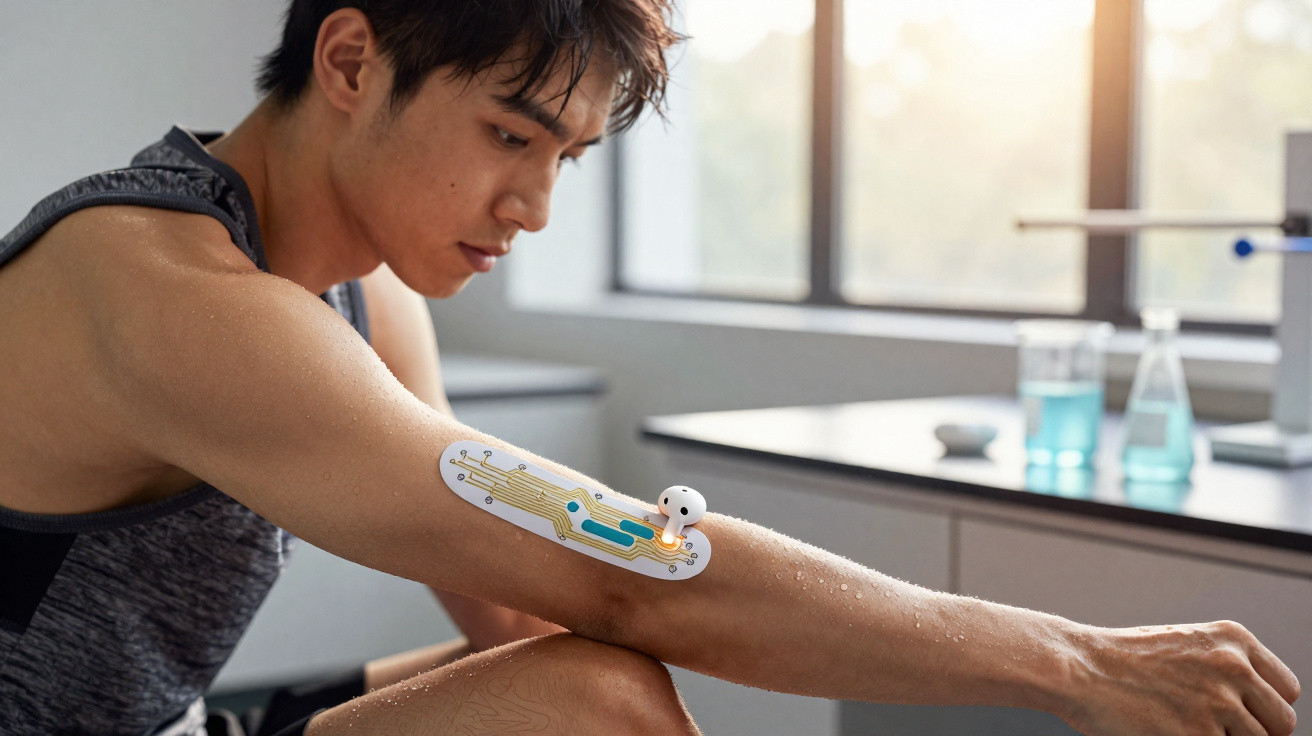
A new water-based enzyme ink has allowed engineers to screen-print fully functioning sweat-powered biofuel cells in a single manufacturing pass.
By turning what was once a delicate, multi-stage method into one printable layer, this development moves battery-free health patches closer to genuine mass production.
Printing in one pass
Printed onto a thin paper substrate, the deposited layers become a pair of electrodes that generate electricity directly from chemicals found in sweat.
Within this paper-based set-up, Associate Professor Isao Shitanda at Tokyo University of Science (TUS) showed that one enzyme-loaded ink can create both halves of the power cell at the same time.
Instead of adding enzymes through separate coating-and-drying stages, the updated formulation embeds them in the printed structure, keeping their activity intact while still delivering electrical performance.
Reducing the process to a single pass also cuts device-to-device variability, leaving the next hurdle: converting laboratory prints into robust, wearable sensors.
The bulk problem
Skin-mounted sweat sensors can already be made very small, yet the coin-cell battery still accounts for most of the thickness and bulk.
A battery has to hold charge, remain sealed against moisture, and tolerate flexing, which often steers designers towards more rigid enclosures.
For disposable health patches, batteries increase cost and complicate disposal, even when the sensing layer itself is as thin as paper.
If the battery is removed, the patch must generate energy where it is worn, meaning the power source needs to be straightforward to print.
Power from body chemistry
Rather than relying on stored energy, these printed cells tap into chemicals that naturally leave the body via sweat.
Known as enzymatic biofuel cells, they are small devices that convert body chemistry into electricity, with enzymes acting as catalysts.
In a single cell, an enzyme extracts electrons from lactate, and the circuit moves those electrons to oxygen at the opposite electrode.
Because both fuel concentration and sweat rate can change rapidly, the electrical output can also vary during movement and exercise.
Scaling remains difficult
Conventional biofuel cell production is hard to scale because it involves several intricate stages that often require manual work.
Typically, after a carbon layer is printed, technicians drip enzyme solutions onto it and then wait while irregular films dry.
Minor differences in how much solution is applied, or the drying time, can shift both power generation and sensing results from one patch to another.
“We need to bring an enzyme ink to the market that can be printed uniformly and is suitable for mass production,” says Dr. Shitanda.
Designing printable bio-inks
Achieving a true one-pass print required converting fragile enzymes into an ink that levels evenly and adheres precisely where it is deposited.
At TUS, the researchers adjusted the formulation for screen printing-forcing ink through a mesh onto a surface-so the process could be handled with standard tools.
Porous carbon powder served as the support for the enzymes, while a water-based binder and thickener helped the paste remain stable throughout printing runs.
By avoiding aggressive solvents, the ink preserved more enzyme activity after printing, which is essential for a wearable power cell.
Printing the oxygen side
To complete the circuit, the device also needs an oxygen-consuming electrode, and that side has historically been difficult to print cleanly and consistently.
Engineers refer to this electrode as the cathode-the oxygen-using side where electrons finish-and the enzymes used there are especially sensitive and hard to stabilise.
By incorporating the oxygen-processing enzyme into the same printable mixture, the method produced the cathode in a single pass.
With both electrodes printable as inks, a major bottleneck is removed, although the paper substrate still has to withstand sweat, movement, and day-to-day wear.
Measuring power output
In bench tests, the printed electrodes produced higher currents and retained activity for longer compared with older drop-on enzyme coatings.
When the lactate-powered cell operated, it achieved about 1,065 microwatts per square inch 1,065 microwatts per square inch (about 165 microwatts per square centimetre) at peak power, and an open-circuit voltage of 0.63 volts.
Storing the cells under vacuum at 5°C (41°F) offered the best preservation of enzyme activity, suggesting a workable route for shipping and shelf life.
Despite the improvement, the available power is still modest, so every part of a patch must be designed to minimise energy use.
Matching sweat chemistry
During exercise, lactate in sweat can rise, providing a direct indicator of increasing muscular effort.
A published review reported typical sweat lactate levels of roughly one to 25 millimoles per litre during sport.
The newly printed cell was designed for that same range, turning higher lactate availability into more electrons as sweat supplies the fuel.
However, the relationship between sweat lactate and blood lactate remains complex, so any health-related claims will require careful validation in real-world use.
Uses in daily life
Athletes and coaches want rapid feedback without finger-prick tests, and sweat lactate can offer a quick read on rising exertion.
A self-powered patch can convert that chemistry into electricity and a sensor signal, enabling data to be transmitted off the skin in real time.
In nursing and elderly care, continuous monitoring could highlight dehydration, infection, or heat stress sooner than occasional spot checks.
Ultimately, usefulness in practice will depend on patches that are comfortable to wear, maintain stable measurements, and provide clear signals for users and clinicians.
Next steps for wearables
By transforming a fragile laboratory approach into a printable ink, the TUS team points towards sweat-powered sensors that manufacturers can realistically produce.
To reach real products, longer wear trials, dependable wireless connectivity, and evidence that measurements remain meaningful across different people and conditions will still be required.





Comments
No comments yet. Be the first to comment!
Leave a Comment