
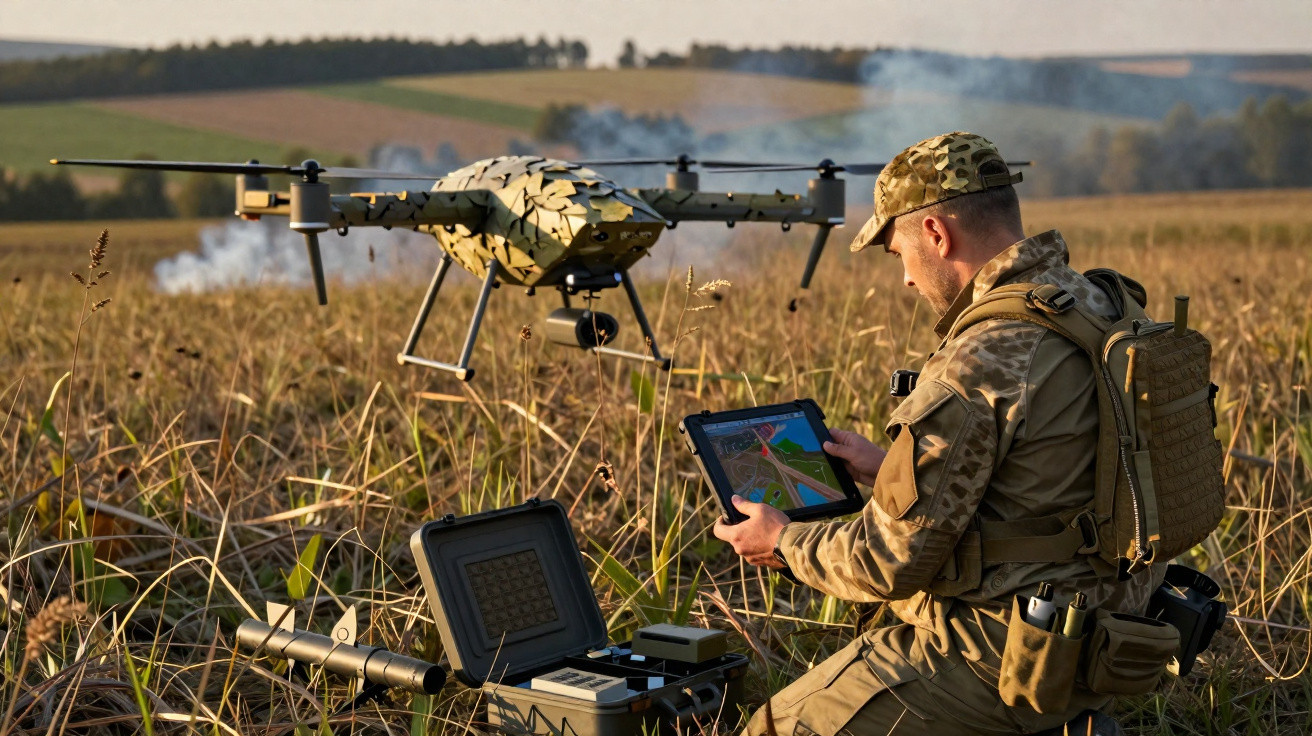
As the use of unmanned systems continues to rise on the battlefield, Russia’s Armed Forces have fielded the new Prince Oleg (KVO) drone in Ukraine. The aircraft was developed specifically to carry out reconnaissance missions at distances of up to 45 kilometres from its deployment point, supporting special operations units. According to reports from Russian state media, the system also stands out for its high survivability, with the ability to blend in by resembling certain Ukrainian drones.
Survivability and the impact of FPV air-defence drones
Alexey Chadayev, current Director General of the Ushkuynik Research and Production Centre (PRC) in Veliky Novgorod, stated:
“The development of FPV air-defence systems - drones against drones in the sky - has led to a real genocide of reconnaissance drones on both sides. (…) The KVO showed an unexpectedly high survival rate for the simple reason that the Ukrainians mistake it for some of their own aircraft, which it only resembles in appearance. Of course, over time, the enemy will learn to tell them apart, but for now this feature has allowed us to fly over Sumy, Kharkiv and other locations.”
Lower costs, 3D-printed spares and a simple launch system
Chadayev also said the new KVO drones deliver not only the capabilities of an advanced reconnaissance platform, but also the benefit of costing less than other systems currently used by the country’s Armed Forces-making large-scale production easier. In the same vein, he explained that if any component were to fail and require repair, replacement parts could be produced quickly and cheaply using 3D printers, reducing both cost and turnaround time.
That approach, he added, has been carried over to the launch method as well. In Chadayev’s words:
“Prince Oleg does not have a complicated launch system: basically, you just drive two stakes into the ground and launch it.”
Target detection and integration with precision strike munitions
In further comments to local media, Chadayev stressed that the KVO will be particularly valuable when used alongside precision strike munitions already held by Russian forces, helping to detect potential targets. It is worth noting that this role has largely been carried out using commercial unmanned systems, such as Mavic models, whose range is considerably shorter than what is claimed for this new platform-by around 20 to 30 kilometres.
Finally, it is important to mention that the KVO’s image transmission system is already fully integrated with other software used for precision strike munitions. This would reportedly allow the operator of these “kamikaze drones” to receive real-time imagery on the same displays used to view feeds captured by the new reconnaissance drones, enabling strikes with greater situational awareness.




Comments
No comments yet. Be the first to comment!
Leave a Comment