
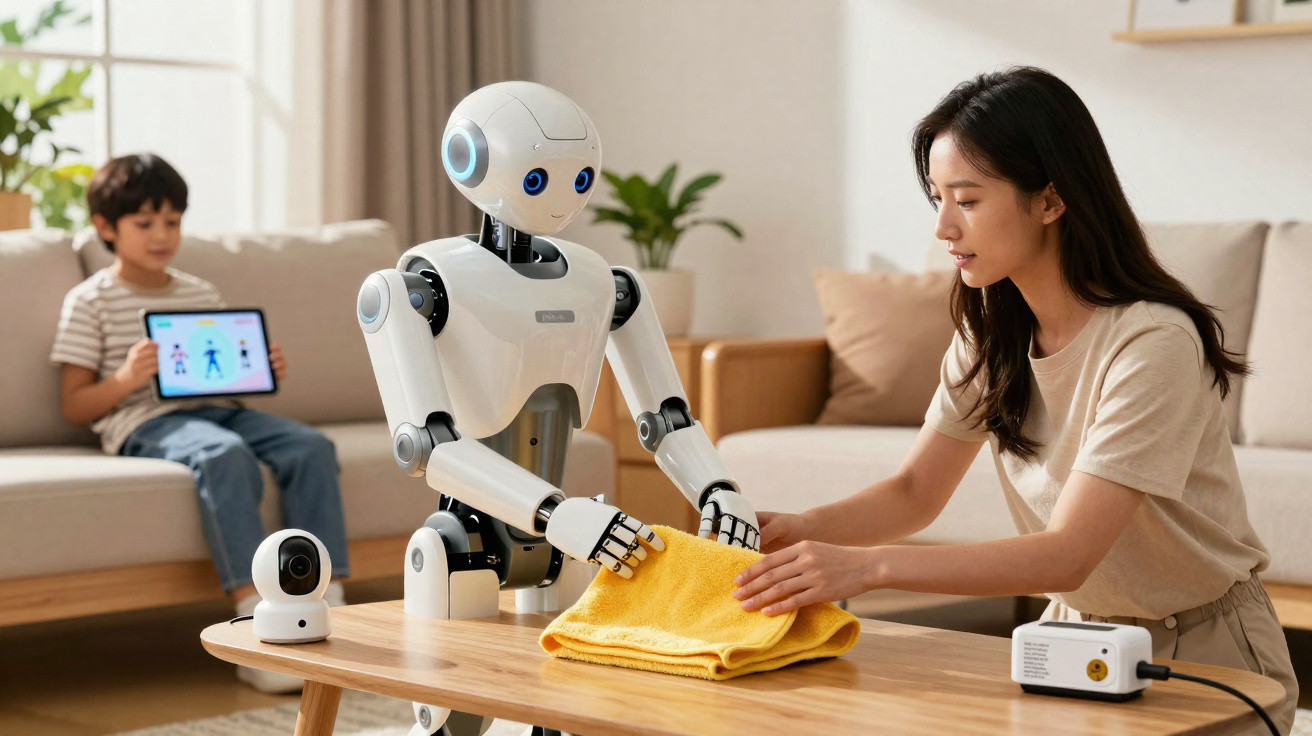
A humanoid robot built for use in private homes has now reached the consumer market, bringing with it the ability to wash up, fold washing, and lend a hand with meal preparation.
Its arrival marks a notable shift: everyday domestic labour is beginning to move from people to machines that can navigate rooms, recognise objects, and react within normal living spaces.
Early trials of home robot
During the launch of Neo, a full-sized humanoid robot intended for household duties, early adopters were given an initial view of what a domestic robot can and cannot do when faced with day-to-day tasks.
Engineers at the artificial intelligence firm 1X, working alongside these early deployments, showed the robot fetching items, folding clothes, and completing straightforward jobs around the house.
In these early trials, the machine moved carefully through kitchens and sitting rooms, carrying out basic chores with a person overseeing the process.
Taken together, the demonstrations highlight both the potential benefits of robotic help at home and the constraints that still define how today’s systems behave.
Seeing, steering, recording
Footage from cameras positioned at head height enables a robot to identify objects and orient itself, but it also introduces the possibility that another person could be watching what the robot sees.
Engineers refer to this as teleoperation: controlling the robot remotely in real time, typically introduced first as a safety fallback.
Using a virtual reality headset, a remote assistant can look through the robot’s perspective and guide its hands during more awkward moments in the kitchen.
When a company provides that assistant, policies governing when access is allowed, what the cameras can view, and whether anything is recorded become just as critical as the robot’s physical dexterity.
Simple chores remain difficult
Domestic spaces are full of variables that challenge robots, whether it is a crumpled shirt, a slick plate, or an object shifting in the robot’s grip.
To complete even a small action, the machine has to maintain balance, estimate distances, and modulate motor force-because a misstep can quickly become a fall and broken crockery.
Minor errors can cascade, as a twisting door handle or a damp towel sagging under its own weight can disrupt the entire movement.
This helps explain why early household humanoids tend to be slow and cautious, and why remote guidance still features in demonstrations.
Humans teaching robots
Improving speed and reliability often involves learning from people, so companies gather extensive video of humans folding washing or loading dishwashers.
A common approach is imitation learning, where robots are trained on human examples so those recordings can be converted into repeatable actions.
When a remote operator intervenes, the robot can save the successful sequence and attempt it later without assistance.
Additional practice may broaden capability, but it also means progress remains dependent on human effort and on very large collections of footage from inside homes.
Privacy rules for home robots
Purchasers agreed to contractual terms that may restrict remote access to particular hours and designate certain rooms as off-limits.
“If we don’t have your data, we can’t improve the product,” said Bernt Børnich, CEO of 1X Technologies.
Measures such as face blurring and exclusion zones can lower risk, yet they also underline how much the system is designed to observe.
Even when restrictions are in place, a home robot turns privacy into a configurable setting that households must actively manage, rather than a right that simply exists.
Safety limits in practice
Safety teams aim to ensure a helper remains non-threatening, since a humanoid robot with arms can still knock over a child.
To reduce harm, companies impose limits on how much the robot may lift, and sensors can halt motion when its hands encounter unexpected resistance.
Having a remote supervisor can prevent problems from escalating, but it simultaneously creates another avenue that attackers could target.
Until stronger standards are established, early buyers may receive a conservative robot that declines higher-risk chores and pauses to seek approval.
Autonomy races ahead
In parallel, Tesla has promoted Optimus as a general-purpose humanoid intended to take on dull or hazardous work.
Figure AI has developed Helix to link vision, language, and action, with the goal of enabling more self-directed behaviour.
Both paths still rely on data gathered from real homes, because robots often learn most effectively by making mistakes in environments where failure is controlled.
Greater autonomy could reduce exposure to remote viewing, but it may also shift responsibility for errors from a human check to software decisions alone.
Cost of owning a robot
Early customers could choose either a $499-per-month subscription or $20,000 outright ownership, with US deliveries beginning in 2026.
That price covers the hardware, ongoing software updates, and the human assistance that can step in when the robot cannot proceed.
A subscription model can distribute risk, as the company can replace faulty units and gather repair information across many households.
So long as remote support remains part of what buyers are paying for, the true cost includes not only money but also shared access to the home.
Questions before buying
Before bringing a robot into the household, families can insist on specific answers about who is allowed to watch, record, or take control.
Account controls should make time windows and room restrictions easy to review, and there should be clear on-device signals showing when a remote operator is active.
Written policies matter, but real-world practice matters more, because a domestic helper will eventually face edge cases nobody anticipated.
Until households enforce their own limits, convenience will continue to pull private spaces into systems built around learning from lived experience.
Promise and limits of robots
Humanoid assistants are now offering the prospect of less washing and more spare time, but their progress still depends heavily on people and data.
How these machines are perceived-useful tools or unwelcome intruders-may hinge on firm rules around access, safety, and privacy.

Comments
No comments yet. Be the first to comment!
Leave a Comment