
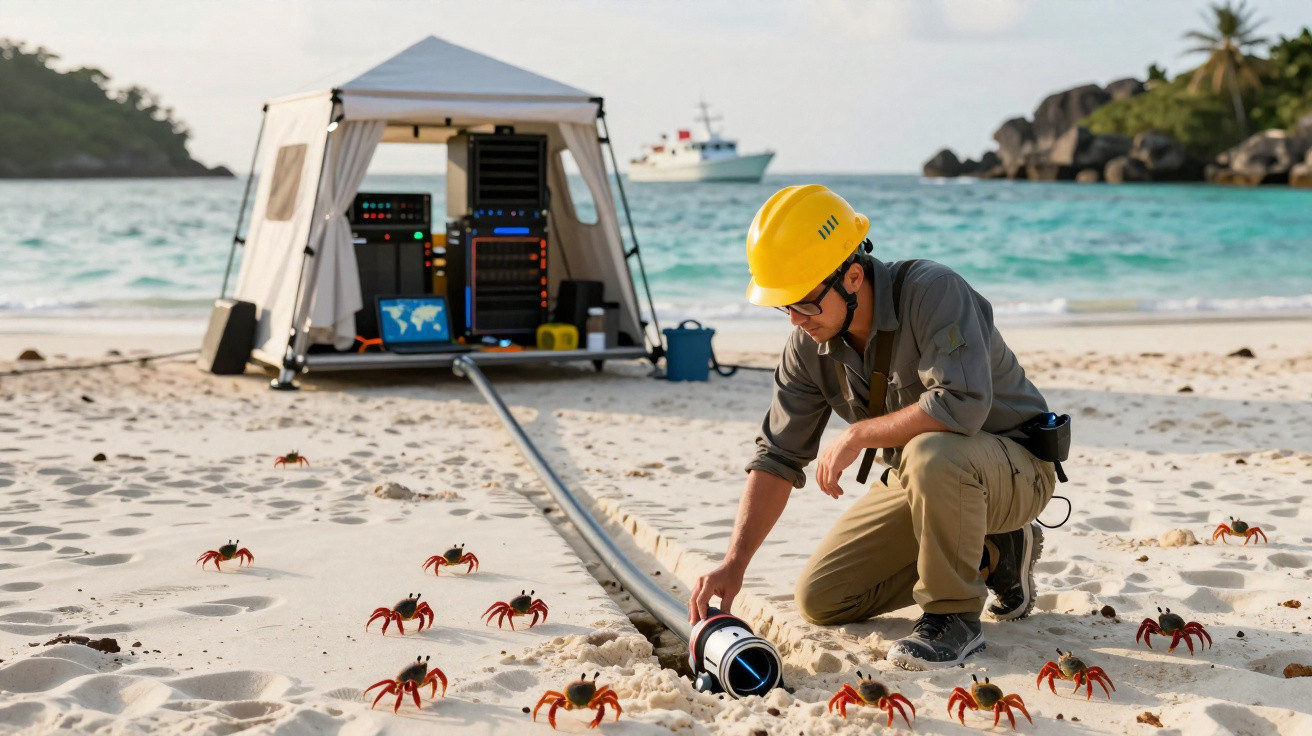
Around 1,500 people live on Australia’s Christmas Island, yet in peak season more than a hundred million red crabs spill across roads, beaches and rainforest tracks. That is also where Google now wants to bring in a new undersea cable to significantly boost data capacity across the Pacific - an unusual collision of cutting-edge infrastructure and a high-stakes wildlife spectacle.
Why Google needs this tiny island
Google runs a vast global network of undersea cables. More than 100,000 kilometres of fibre-optic lines already lie on the seabed, carrying data between continents - everything from video calls to streaming platforms. For the company, each additional cable is a strategic gain: extra capacity, stronger resilience and lower latency.
Christmas Island turns out to matter more than its size suggests. The remote Australian external territory covers just 135 square kilometres in the Indian Ocean, but it sits close to a sort of junction along important undersea cable corridors between Asia and Australia. Landing a cable here can help route data more efficiently and work around bottlenecks.
"Remote Christmas Island may look unremarkable, but it sits at a node of global data connections - ideal for new undersea cables."
From an engineering and planning perspective, the location offers several practical advantages:
- a relatively stable geological setting, away from major earthquake zones
- strong links into existing Australian infrastructure
- politically secure territory under Australian administration
- a strategic position between South-East Asia and the Australian mainland
It fits neatly with Google’s broader approach: not only connecting major coastal cities, but also using small, well-sited islands as switching points.
1,500 people, 120 million crabs
The complication is that Christmas Island is anything but a typical cable landing site. It hosts one of the world’s most striking animal populations. Estimates suggest that around 120 million red crabs move each year from dense rainforest down to the coast to release their eggs into the sea. For the island’s roughly 1,500 residents, the event is routine - and it shapes everyday infrastructure decisions.
During the migration, roads are closed, and dedicated crab bridges and underpasses steer the animals over and under tarmac. Lorries slow down, and some stretches can be blocked for days because the red procession simply takes priority.
When high-tech meets the crab migration
For the planned undersea cable, this mass movement becomes a real constraint. A cable can only be brought ashore at a specific point on the coastline - and those shorelines are often crossed by crab routes running from inland to the sea. Any construction on the beach, and any trench dug for works, can cut off pathways or injure the animals.
"For the cable project to work, excavators, engineers and red crabs will have to share an extremely narrow time window."
That leaves planners facing a blunt question: how do you deliver a major technical project without damaging one of Australia’s best-known natural phenomena?
How an undersea cable is actually laid
To see why the island’s setting is so sensitive, it helps to understand the process. A typical project follows steps like these:
- surveying the seabed and the coastal zone
- choosing the most sheltered possible landing point
- onshore preparations: trenches, ducts and equipment rooms
- paying out the cable from a specialist vessel
- lowering the cable and, in places, burying it in the seabed
The most vulnerable section is close to shore. Waves and surf are strongest there, currents can shift seabed material, and the risk of damage is highest - which is precisely where Christmas Island’s red crabs move in vast numbers.
Protective measures Google has to plan for
To stop the project turning into a red, chaotic bottleneck, several safeguards are likely options:
- scheduling construction outside the crabs’ main migration period
- installing temporary crab bridges and guiding barriers around the worksite
- moving the landing point to an area with lower crab density
- working closely with biologists and environmental regulators
For Google, this is not only about species protection, but also reputation. A company that promotes cleaner data centres can hardly afford international headlines showing crabs harmed at a construction site.
A protected area with global importance
Christmas Island is not just a dot in the ocean. Large areas are protected because the island is home to many endemic species - plants and animals found nowhere else. Red crabs are considered a keystone part of the ecosystem: they consume leaf litter, keep the forest floor more open and, in doing so, shape which plants can thrive.
"Interfering with the crabs’ life cycle indirectly alters the island’s entire rainforest."
Australian authorities therefore apply strict environmental conditions to development. For Google, that means comprehensive environmental impact assessments, expert reports and ongoing coordination with local administration. Delays are effectively built in if new information about crab routes emerges during the planning stage.
A clash between global data flows and local nature
The situation is a clear example of how digital infrastructure can come into direct tension with conservation. On one side is the demand from millions of users for faster, more stable connections - from video conferences in Sydney to streaming in Singapore. On the other is an exceptional wildlife event on a remote island.
Conflicts of this kind are becoming more common as data centres, mobile masts and cable projects push into increasingly far-flung places. For technology firms, environmental planning is no longer a peripheral nuisance - it is becoming a fixed part of business strategy.
What undersea cables really mean for our internet
Many people think first of Wi‑Fi routers or mobile phone towers when they think about the internet. In reality, an estimated over 95 percent of intercontinental data traffic travels through fibre-optic cables on the ocean floor. Satellites mainly play a supporting role, for instance in very remote regions or for specialist uses.
New cables tend to deliver several benefits at once:
- higher bandwidth for streaming and cloud services
- lower latency for video calls and online gaming
- greater resilience if another cable is damaged
- less dependence on any single line or operator
For countries like Australia, which are closely connected with Asia, an additional cable at a strategic site such as Christmas Island can be economically significant. In finance, logistics and telemedicine, every millisecond matters.
Risks, opportunities and an unusual coexistence
Where fibre meets crabs, two worlds collide. For island residents, the cable project brings mixed prospects. On the plus side, jobs could appear in construction and ongoing maintenance. Increased attention on the island may also attract more research, tourism and public investment over time.
On the other hand, some locals worry about extra pressure on a fragile ecosystem. Even now, roads need grilles and fencing to help crabs cross with fewer casualties. If a major technical hub is added on top, the human footprint could grow noticeably.
The dispute underlines how strongly global infrastructure projects now depend on factors once treated as footnotes: animal migrations, breeding seasons and local practice. Taking those constraints seriously allows more realistic planning - and, ideally, shows that fibre-optic cables and crab migrations do not have to be mutually exclusive.
For other technology companies, Christmas Island may become both a cautionary tale and a live test site: if a workable compromise is achieved between global data flows and local nature, it could provide a template for many other coastlines.




Comments
No comments yet. Be the first to comment!
Leave a Comment