
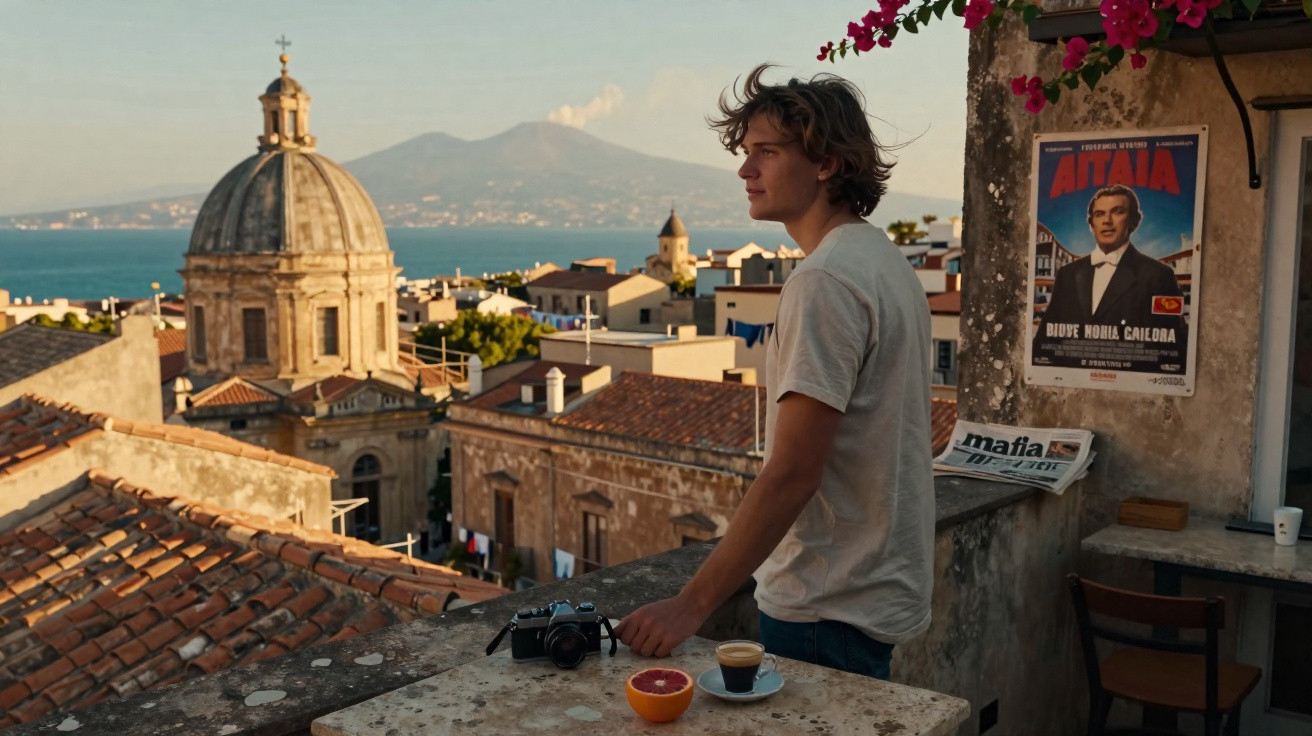
Film director and actor Alberto Sordi once joked that if God made Sicily first, it was to see how it turned out before creating the rest of the world. Sordi never shot a film on the island, but Giuseppe Tornatore certainly did-when he wrote and directed one of cinema’s great masterpieces, "Cinema Paradiso", in 1988. Partly because of the story of young Salvatore, who leaves the island to conquer the world, I had been dreaming about Sicily for decades. I went, explored a slice of it, and came back with a quiet certainty in my chest: I will return.
Sicily at the centre of the Mediterranean
Sicily is the Mediterranean’s cradle-a place with a kind of spell about it-which has sat at the centre of the world for the past 3,000 years and, for that very reason, has been coveted and fought over by everyone. Phoenicians, Greeks, Romans, Vandals, Byzantines, Arabs, Normans, Swabians, French and Spaniards all passed through, each leaving a trace without erasing what came before.
From Magna Graecia to Palermo’s golden age
The Greeks founded Syracuse and Agrigento, turning the island into the beating heart of Magna Graecia. Archimedes was born in Syracuse: the mathematician and engineer who measured earth, water and sky, and who defended the city against Rome with war machines. Legend has it he was drawing circles in the sand when a soldier killed him. One line of his has stayed with me as a personal motto: "Give me a place to stand and I will move the world".
Under Roman rule, Sicily became the empire’s granary. Then came the Byzantines, and the Arabs after them, who brought irrigation, the orange, jasmine and sugar, and made Palermo one of the Mediterranean’s wealthiest cities. Language, architecture and cuisine were marked for good.
In the 13th century, Frederick II of Swabia (a former kingdom in the region of Germany) turned Palermo into a centre of culture and science. Frederick could claim four crowns: King of Sicily, King of Germany, King of Jerusalem and Holy Roman Emperor. Educated in Palermo, he spoke nine languages, could write in seven, and made Sicily the heart of his empire.
He founded the University of Naples, strengthened central government, and sheltered poets and artists. At his court, Christians, Arabs and Jews lived side by side in peace; thanks to his reign, the island became a bridge between East and West.
Power shifts, legends and Sicily’s symbols
In 1282, the revolt known as the Sicilian Vespers split power on the island from power on the mainland: on one side stood the Kingdom of Naples; on the other, the Kingdom of Sicily.
During the Spanish occupation, one of Sicily’s most recognisable symbols appeared: the Moorish heads. The story goes that a young Sicilian woman fell hopelessly in love with a Saracen. When she discovered that her beloved had a lawful partner-children included-back in North Africa, she cut off his head, planted it in a pot of basil, and wept until the pot burst into bloom.
When Ferdinand IV of Bourbon reunified the crowns in 1816, he kept both titles. Thus the Kingdom of the Two Sicilies was born, with its capital in Naples but with half its soul anchored on the island.
Il Gattopardo, "Cinema Paradiso" and modern memory
The 19th century brought the unification of Italy. Giuseppe Tomasi di Lampedusa, the last Prince of Lampedusa-also known as Il Gattopardo, after the leopard on the Tomasi family coat of arms-wrote a single novel that launched him into literary fame. With talent and sensitivity, he captured the decline of the Sicilian aristocracy. From him comes the famous line: "If we want everything to stay as it is, everything must change", a description of a Sicilian spirit that resists change while pretending to embrace it. A languid, lingering melancholy drifts across the island and its people. It is the dolce far niente that soothes the senses and teaches us to savour the present.
Sicily’s story is steeped in grand passions and blood running through narrow, secretive streets. For decades, the Sicilian mafia-Cosa Nostra-held sway over the territory of the Two Sicilies. Two judges from Palermo, Giovanni Falcone and Paolo Borsellino, stood up to the fiercest beast. Falcone used to say that the mafia was a human phenomenon and, as such, it had a beginning and would also have an end.
Both men were murdered in 1992-Falcone at Capaci, along with his wife, Francesca, and Borsellino 57 days later-but they managed to bend the labyrinthine structure of families, Capi and Consiglieri. Palermo’s airport now bears both their names.
This is Sicily: an island invaded a thousand times, which turned every invader into a Sicilian. It gave us the physics of Archimedes, the clear-eyed melancholy of Il Gattopardo, the poetry of "Cinema Paradiso", and Falcone’s courage.
Singular, unique and irresistible, it is the heart of the Mediterranean.






Comments
No comments yet. Be the first to comment!
Leave a Comment