
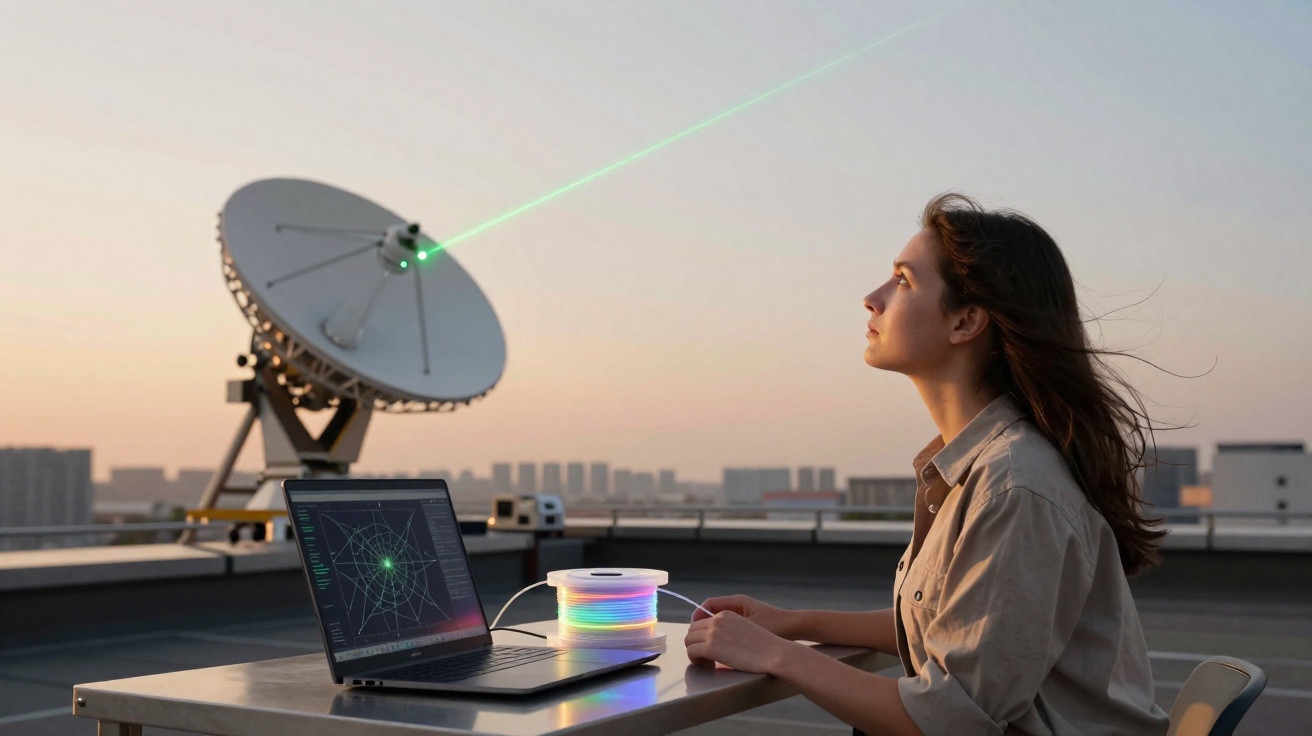
At an observatory in southern China, researchers have pulled off a satellite communications experiment that is likely to unsettle competitors in the US: a geostationary satellite delivered data to Earth using just 2 Watt of laser power - at speeds that outstrip many Starlink customer connections. The key advance is not on the spacecraft, but at the ground station, which counteracts atmospheric turbulence that would normally cripple an optical downlink.
How a weak laser clears the Starlink bar
The test took place at the Lijiang Observatory in Yunnan Province, south-west China. On the transmit side was a satellite in geostationary orbit at roughly 36,000 kilometres altitude. On the receive side was a 1.8-metre telescope that is used for astronomy - and, in this experiment, for reshaping distorted laser light back into something a communications receiver can use.
According to the team, the link achieved a data rate of around 1 Gigabit per second with a transmit power of only 2 Watt. For context, many real-world Starlink customer connections typically land in the 150 to 250 Megabit per second range. On that comparison, the Chinese link is roughly five times faster.
"An HD film from Shanghai to Los Angeles in under five seconds - with a laser that uses less power than a small desk lamp."
The contrast becomes more striking once you factor in the very different orbits involved. Starlink satellites operate a few hundred kilometres above Earth. The Chinese transmitter was more than 60 times farther away - yet still reached gigabit throughput.
Why the distance makes this so remarkable
Geostationary satellites orbit Earth at the same angular speed as the planet’s rotation, so to an observer on the ground they appear fixed in the sky. That makes them ideal for television broadcasting, weather monitoring and high-capacity data hubs - but it also makes long-distance, low-power links especially challenging.
- Distance: roughly 36,000 kilometres above the Equator
- Light travel time: about 0.12 seconds each way
- A very long path through space, followed by dense layers of atmosphere at the end
- Extremely sensitive to scattering, scintillation (twinkling) and distortion
In practice, the hardest part is not the journey through vacuum, but the final kilometres through turbulent air. Temperature gradients, winds and density variations bend light like an invisible, constantly shifting funhouse mirror. The received spot flickers, breaks up and loses shape and sharpness.
This is exactly where the Chinese approach comes in: rather than treating that distortion as a show-stopper, the ground system accepts the damaged wavefront and reconstructs a stable data link from it.
The technology behind it: 357 micro-mirrors and eight light channels
At the heart of the ground station is a 1.8-metre telescope feeding a sophisticated optical correction stage. That stage uses 357 tiny mirrors that can deform independently in real time - an approach known as “adaptive optics”.
"Instead of fighting the atmosphere, the optics adapt to it from second to second - like glasses that refocus with every ripple of air."
The researchers use a two-step method:
- Adaptive optics: the 357 micro-mirrors smooth the incoming beam by correcting its wavefront, turning a severely warped pattern back into a more ordered signal.
- Multi-channel splitting: a “Multi-Plane Light Converter” divides the corrected light into eight base modes - put simply, eight separate paths in which parts of the signal remain reasonably intact.
The receiver electronics then selects the three strongest of those eight channels and combines them to reconstruct the data. In other words: it takes what the atmosphere leaves behind and extracts as much usable information as possible from the fragments.
The team refers to this pairing of adaptive optics and multi-channel reception as “AO-MDR synergy”. The measured benefit is substantial: in testing, the share of usable signals increased from 72 to 91.1 per cent. So the result is not only peak speed, but noticeably improved stability.
What this laser link does differently from typical satellite links
Most satellite connections in service today rely on radio waves in the microwave or millimetre-wave bands. Laser communications behave very differently:
| Feature | Radio link (traditional) | Laser link (optical) |
|---|---|---|
| Bandwidth | Limited by available spectrum | Very high data rates possible |
| Beam width | Quite broad, large coverage area | Highly focused, low spread |
| Susceptibility | Vulnerable to radio interference | Vulnerable to cloud and atmospheric turbulence |
| Interception resistance | Can be intercepted with significant effort | Harder to intercept due to the narrow beam |
Optical links are best suited to “backbone” routes: moving large volumes of data between satellites, ground stations and data centres. That is also what the Lijiang result points towards - not in-camper Wi‑Fi, but heavy-duty capacity for operators, government users and research networks.
What these laser satellites are particularly good for
The Lijiang demonstration illustrates how a ground station with sufficiently large optics and computing power can make heavily distorted signals useful again. That opens up several plausible applications:
- Backbone for remote regions: large laser ground stations could connect continents and islands where laying fibre is too expensive or politically risky.
- Rapid downlink from research satellites: Earth observation, climate science and space telescopes could “dump” massive datasets to the ground in short windows.
- Military and government communications: tightly collimated laser beams are difficult to intercept and hard to locate from a distance.
- A network for other satellites: geostationary laser hubs could act as nodes for entire low-orbit constellations.
The technique on show is clearly aimed at high-performance ground infrastructure, not small household terminals. It looks more like a major teleport site where space data arrives and is then fed into the fibre network.
What part Starlink and similar systems may still play
Starlink’s strategy is scale: thousands of satellites in low Earth orbit, small user terminals, and comparatively straightforward radio technology. It is designed for broad coverage, not for absolute peak throughput from a single satellite. The Chinese laser demonstration targets a different gap in the satellite market - and could influence how future networks are built.
One likely model is a division of labour: low-orbit systems provide wide-area access, while geostationary laser satellites provide capacity in the background. In that set-up, ground stations like Lijiang would become aggregation points where traffic from many smaller networks is concentrated.
Energy efficiency is another eye-catching detail. Achieving 1 Gbit/s over 36,000 kilometres with 2 Watt of transmit power suggests that, with careful design, laser links can offer an unusually favourable ratio of energy used to data delivered - provided weather and visibility cooperate.
What non-specialists should know about terms like “adaptive optics”
A lot of the language around the experiment sounds like pure lab jargon, yet it could affect everyday users over time. Adaptive optics, for example, comes from astronomy: telescopes use deformable mirrors to keep star images sharp when the atmosphere would otherwise blur them. In laser satellite communications, the same idea is applied to make a warped optical signal usable again.
The splitting into multiple base modes can be explained with a simple analogy. Imagine the laser beam as a tune played through a crackly radio. The Chinese system separates that tune into several tracks, discards the noisiest parts, and then stitches the cleanest pieces back together. The information survives even if the original signal never arrives perfectly.
There are clear limitations. Laser links are sensitive to cloud, fog and heavy rain. On their own, they would be too weather-dependent for global, always-on consumer internet access. Combined with radio links and fibre, however, they can excel where bandwidth demand and distance are especially punishing - such as intercontinental routes, polar research, or military relay networks.
The Yunnan demonstration therefore underlines a broader point: much of the next leap in satellite communications is increasingly happening on the ground - in optics, algorithms and telescopes that can turn a faint, distorted point of light high above Earth into a stable gigabit connection.






Comments
No comments yet. Be the first to comment!
Leave a Comment