
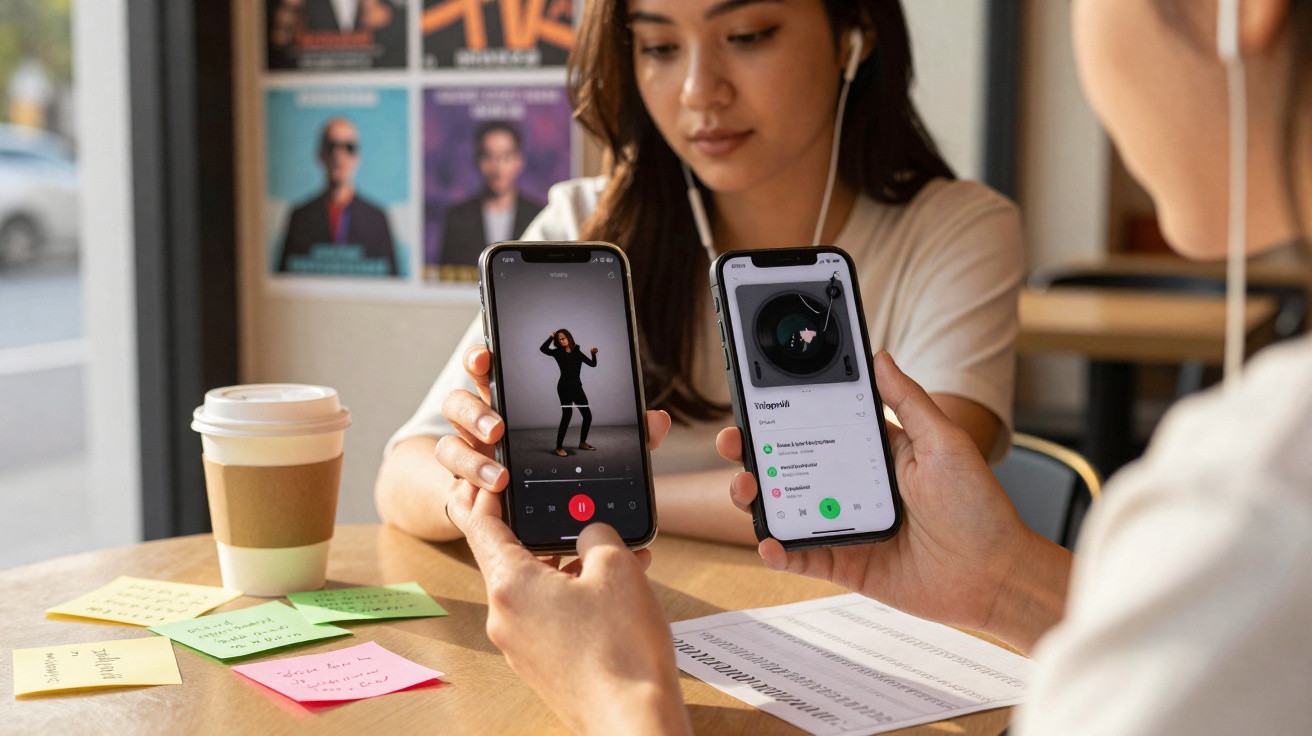
A hit song can now blow up online in a matter of hours. Yet the place where that surge begins can strongly influence the sort of music that ends up winning.
After examining two years of Top 100 chart data, researchers found that TikTok and Spotify tend to produce strikingly different kinds of hits. A track that performs brilliantly on one service may find it hard to gain traction on the other.
Overall, the findings point to something subtle: the way streaming and social platforms are built is steadily redefining what we recognise as a “hit”.
Platforms split the charts
Using that chart history, Cuihua (Cindy) Shen of the University of California, Davis (UC Davis) showed that each platform reliably rewarded a different kind of attention.
Across the period studied, just 68 songs managed to appear on both platforms, meaning the vast majority of hits stayed inside a single digital ecosystem.
That small overlap highlights how fragmented the charts have become, and why the distinct mechanics behind each platform’s hits need closer scrutiny.
TikTok keeps hits circulating
On TikTok, the same sounds can remain in rotation for much longer than on conventional music platforms. Even if users never play a track from beginning to end, its audio can still keep travelling.
That’s largely because creators lift short excerpts from songs and attach them to their own videos. Every time another user reuses that sound, the track earns another wave of exposure.
This continual recycling helps clarify why TikTok’s charts feature far fewer unique hits than Spotify’s, yet keep those hits around for longer runs. Rather than rapid turnover, a relatively small set of songs can sit on the chart for unusually long spells.
The tracks that succeed on TikTok share another common feature: they function well as raw material for video. In the study, dance music had the clearest edge. On TikTok, songs often take off because they give people something to move to, copy, or wrap a quick visual narrative around.
Dance challenges intensify the effect. One memorable snippet can quickly scale into thousands of connected posts as users replicate the same routine or put their own spin on it.
When music becomes a reusable component in videos, pulse and momentum can outweigh a song’s complete storyline or lyrical detail.
Spotify rewards full songs
Spotify, by contrast, displayed a different pattern-one that favours music made for complete listening rather than short, repeatable clips.
Themes about relationships appeared more frequently in Spotify’s charts, while songs focused on social conflict or politics were less common. Because listeners typically play the whole track, the lyrics and overall mood sit with them for longer, giving the words more opportunity to influence whether a song resonates.
Pop and hip-hop also turned up more often on Spotify, while dance and rhythm and blues accounted for a smaller proportion. Taken together, these trends suggest Spotify is more likely to reward music built for sustained attention rather than quick re-use inside other content.
The analysis also indicated that the traditional music industry still carries greater influence on Spotify. Over the study period, major record labels were dominant among Spotify’s hit songs.
Around three-quarters of tracks on Spotify’s charts were released by the biggest companies in recorded music, compared with roughly half of TikTok’s hits.
Short-form video culture has opened more doors for independent artists, partly because clips are less costly to create, distribute, and replicate.
Even so, the power of the major labels did not vanish-the platforms mostly shifted the way that advantage is reflected in the charts.
Hits rarely cross platforms
Although online music culture is often assumed to be one shared arena, only a small number of songs became hits on both platforms.
In the study window, only 68 songs appeared in both TikTok and Spotify’s Top 100. Among those, 50 arrived on Spotify first. In 56 instances, the songs fell off Spotify’s chart before they finally disappeared from TikTok.
That sequence suggests Spotify often captures a song early in its climb, while TikTok can keep the same track in circulation long after its initial peak because users continue to reuse the audio in fresh videos.
The researchers stress, however, that this wasn’t true in every case. The pattern does not imply that one platform reliably produces every breakout hit.
Platforms reshape music success
Behind these chart outcomes sit two very different business models, each encouraging a different kind of musical behaviour.
Spotify’s revenue depends on keeping people listening to complete songs, whereas TikTok thrives on participation-short videos, trends, and constant remixing. Those incentives naturally steer each platform towards a different type of hit.
The researchers refer to this kind of pressure as “platformization”, where digital platforms start to influence what gets made and what audiences are shown. Once this takes hold, success becomes partly engineered rather than purely discovered by listeners.
Artists and labels adjust quickly when particular hooks, atmospheres, or song structures are repeatedly rewarded.
Music aimed at TikTok often needs a short segment people can dance to or re-use, while Spotify is more likely to reward tracks with a fuller emotional arc that sustains attention.
TikTok has even introduced “Add to Music App”, allowing users to save a track they’ve discovered straight to their streaming service.
“Our study suggests that Spotify acts as a primary distribution channel while TikTok serves as a space for creative re-interpretation,” said Shen.
Charts influence our music choices
Listeners still decide what to play, but they are no longer choosing from a completely neutral list. Plays, likes, subscriptions, and shares continue to feed the ranking systems.
At the same time, those systems determine which songs stay prominent and which fade from view.
“Hit song charts represent both user feedback and selections curated by the platforms’ algorithms that also influence users’ choices,” Shen said.
When charts both rank tracks and keep them visible, they stop functioning as impartial snapshots of public taste. Instead, today’s hitmaking looks less like pure popularity and more like an ongoing negotiation between audience behaviour and platform design.
Further research will require longer timeframes and data from additional streaming services, but the study already clarifies why the same song can take very different routes across platforms.






Comments
No comments yet. Be the first to comment!
Leave a Comment