
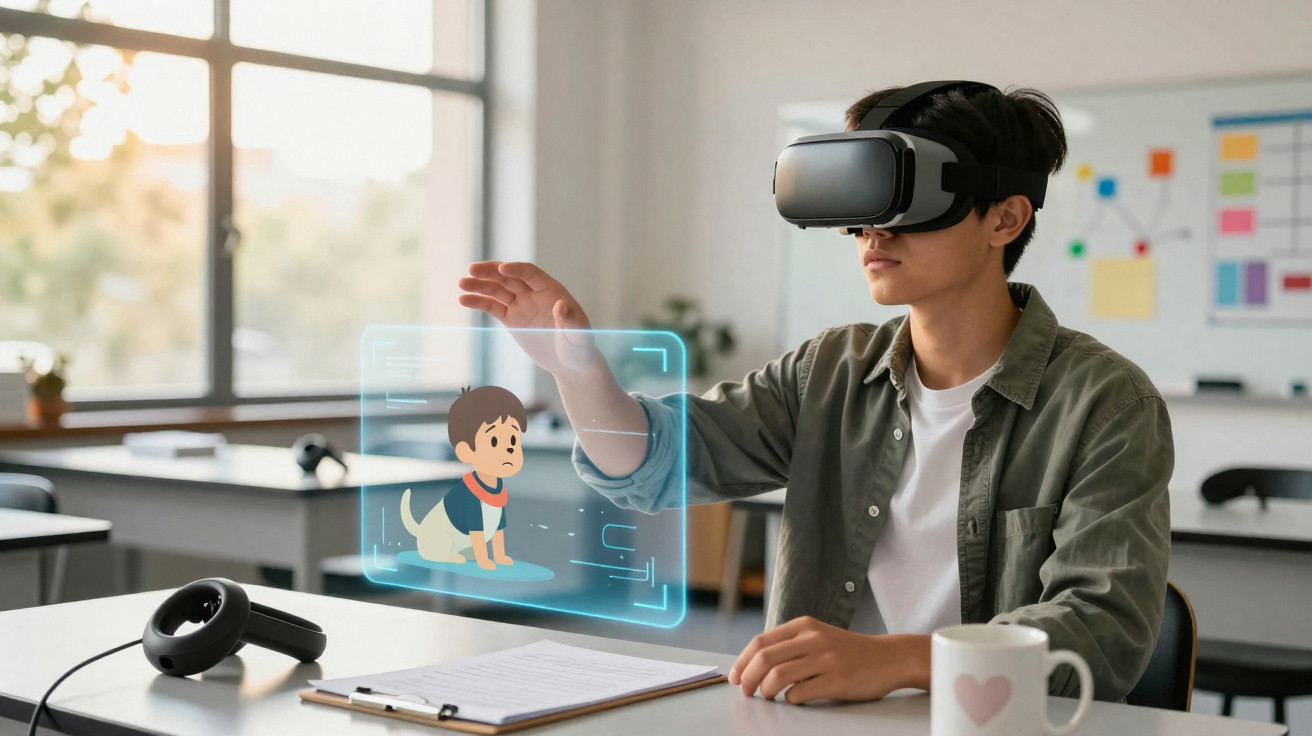
Many video games encourage players by rewarding them for victory, survival, or beating rivals. But imagine a game that offers a different kind of payoff - stepping in to support someone who needs help.
A research team at the University of Oregon set out to find out whether an immersive virtual reality (VR) story could shape how people think about kindness and helping others in everyday life.
To test this, they put players into a VR narrative in which they assist an anxious child looking for a lost dog. The findings indicate that taking part in the story can strengthen people’s motivation to help others, even when emotional empathy does not rise in the same way.
Virtual reality feels more real
Traditional video games usually unfold on a flat display. Players guide an on-screen character while remaining outside the world they are controlling. Virtual reality, by contrast, places the player inside a digital setting.
With a VR headset, the environment surrounds the player. People can look around, move through the space, and engage with characters as though they are standing within the narrative itself. Researchers refer to this strong sense of “being there” as immersion.
That immersion can make a VR scenario feel more intimate than a film scene or a standard game.
Rather than observing events from the outside, the player participates in them. This kind of involvement can influence how someone responds to the characters and what unfolds in the experience.
Can VR increase kindness
Samantha Lorenzo, a researcher at the University of Oregon, studies communication and media. Although she is not a frequent gamer, her work examines how narratives shape people’s thoughts and behaviours.
Stories can help people make sense of feelings, relationships, and social dynamics. Lorenzo started to consider whether a narrative experienced through virtual reality could affect responses such as empathy and altruism.
“I had an idea that VR might be an effective tool to influence people’s ability to want to help others and better understand other people’s perspectives,” Lorenzo said.
“I wanted to explore possible behavioral changes from immersive environments and the underlying mechanisms that foster altruistic engagement within, and beyond, the gaming world.”
Lorenzo collaborated with Danny Pimentel from the University of Oregon School of Journalism and Communication. Pimentel also helps lead the Oregon Reality Lab, where teams create and evaluate virtual and augmented reality experiences.
Game about helping others
Rather than adapting an existing title, the researchers developed a bespoke VR experience for the project. Graduate students at the University of Oregon supported the design work and helped produce the final build.
The experience is titled “Empathy in Action.” It is set in a fictional neighbourhood called Unity Springs.
Players take on the role of a community volunteer. A guide character, Sage, welcomes the player to the town and outlines what needs to be done. Shortly after arriving, the player meets a young boy named Alden.
Alden is distressed because his dog, Buddy, is missing. The player then works with Alden to search around the neighbourhood for clues, while also trying to reassure and comfort him.
Helping a boy find his dog
Some sequences are straightforward, such as walking through parks and investigating possible leads.
At other points, the player must choose how to respond to Alden’s emotions. Different dialogue and support options allow the player to speak with him in various ways or help him settle down.
The team selected the missing-dog plot because it feels realistic. For many people, it is easy to picture how painful and worrying such a situation could be.
Testing the experience
Sixty-four adults were recruited to participate in the study. Before playing, each person completed a questionnaire covering empathy, helping behaviour, and previous gaming experience.
Once the initial survey was finished, participants entered the VR game. After the experience, they completed a follow-up survey and discussed their reactions in a brief interview.
The aim was straightforward: to check whether the game shifted how people thought about helping other people.
Because most participants had minimal experience using virtual reality, the session felt both novel and highly immersive.
VR game increased helping
The outcomes were not what the researchers expected. After playing, participants expressed stronger altruistic attitudes - in other words, many reported feeling more driven to help others.
Empathy, however, did not rise in parallel. Instead, self-reported empathy scores fell slightly.
Initially, this seemed puzzling. Many models argue that empathy directly fuels helping behaviour. Yet the findings suggested that someone can still be motivated to assist without experiencing intense emotional empathy.
Participants frequently recognised that Alden was sad and anxious. That recognition appeared to prompt support for him, even when players did not feel the same sadness themselves.
Understanding feelings vs sharing
Researchers refer to this as cognitive empathy - the ability to notice and understand another person’s emotions.
A different form, affective empathy, is about actually sharing someone else’s feelings. During the VR experience, players leaned more on understanding Alden’s situation than on emotionally mirroring it.
“People knew that this was a sad situation and that’s why they wanted to help,” Lorenzo said.
Why the experience matters
Immersion produced another key insight. Participants who felt a stronger sense of presence in the virtual environment also reported a greater motivation to help others.
When players felt woven into the narrative, the situation seemed more significant. In general, a more intense feeling of immersion was linked to a more positive response once the game was over.
The researchers also found that personal impact outweighed factors such as age, gender, or gaming background. When players felt the story affected them personally, their willingness to help others rose.
How VR gaming could help society
Participants also offered suggestions for how comparable experiences might be used beyond entertainment.
Some thought immersive games could be introduced in schools so pupils can practise empathy and social skills. Others suggested possible uses in therapy, conflict resolution training, or rehabilitation programmes.
A virtual setting can provide a safe space to rehearse challenging situations. People can test different responses without fearing real-world consequences.
“This gaming technology is new and exciting, and there’s a lot of potential for researchers to keep exploring how immersive media can be leveraged for social good,” said Lorenzo.
Virtual reality is increasingly being used as a storytelling medium. The University of Oregon research indicates these kinds of experiences can prompt people to think more about kindness and supporting others.




Comments
No comments yet. Be the first to comment!
Leave a Comment