
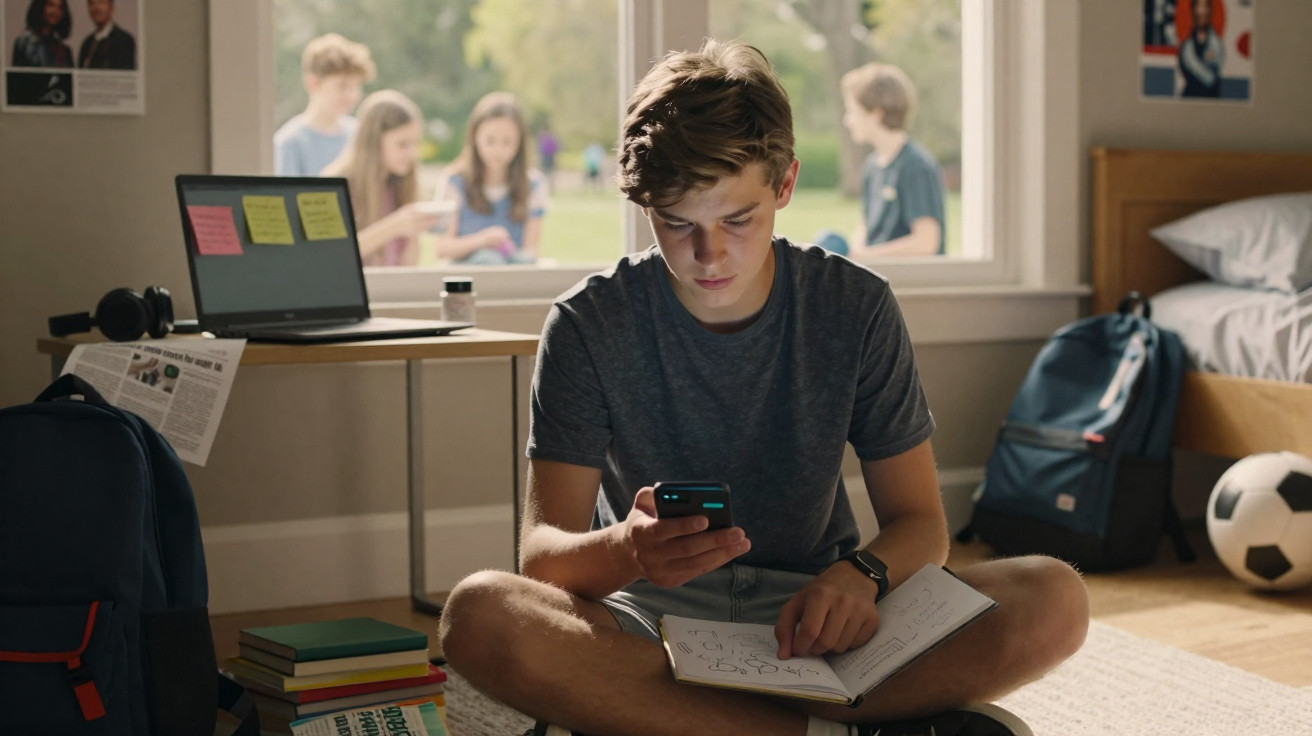
Preventing teenagers from using social media may not so much keep them safe as displace the dangers to less visible parts of the web, a fresh analysis cautions.
Measures like those already adopted in Australia and now being prepared in Britain could limit certain harms, yet they may also bring about new problems.
The caution comes as policymakers accelerate efforts to respond to worries about young people’s mental health.
A ban can look like decisive action, even if it fails to tackle the underlying drivers. It could also steer some teenagers towards online spaces that are much harder for anyone to monitor.
The bigger picture
The argument is set out by Dr Amrit Kaur Purba at the London School of Hygiene & Tropical Medicine (LSHTM).
Dr Purba produced the analysis alongside colleagues and a teenage co-author. Their key point is that a ban is not a neat, stand-alone fix.
Changing access to social media alters one part of a wider system that includes families, schools, social media platforms and teenagers themselves. Adjust one component and the consequences spread across the others.
A rule targeting accounts can reshape company responses, influence how parents oversee use, and determine where teenagers migrate when a familiar app blocks them.
The risk of unintended consequences
Dr Purba and her co-authors frame restrictions as an intervention affecting the whole system, not a simple tweak to individual behaviour. That perspective expands what should be counted as an outcome.
“A restriction may reduce some harms while shifting others, and it may also generate unintended consequences that only become visible over time,” Dr. Purba told Earth.com.
Without this wider lens, the authors argue, governments may introduce high-profile measures that are poorly understood in practice.
That can create harm while the true causes of online harms remain untouched. Britain intends to bar under-16s from the main platforms by 2027, following Australia’s example.
Data from Australia
Australia provides the earliest real-world trial. It was the first nation to introduce a national minimum age of 16 for social media accounts, with the law coming into force in December 2025.
An initial evaluation, following hundreds of Australian teenagers before and after the change, reported almost no reduction in use.
Three months later, more than eight in ten under-16s were still using the restricted platforms, and most were doing so via their own accounts, according to the study. In practical terms, little shifted.
The most frequent age check was simply being asked to enter a date of birth and then being allowed through. Only a small minority relied on fake accounts or private browsing to sidestep the restrictions.
This pattern closely matches the analysis: a ban in legislation did not translate into meaningful day-to-day behaviour change, because platform checks were weak and teenagers found straightforward workarounds.
In effect, the law mainly altered the impression of control rather than the everyday reality of who was scrolling.
A familiar playbook
To anticipate what might follow, the researchers draw comparisons with sectors that have long histories of regulation.
Tobacco and alcohol companies spent years learning how to dilute the impact of rules, and Dr Purba’s team suggests social media firms may adopt similar strategies once bans begin to bite.
Companies could reframe definitions of what qualifies as social media so that certain products fall outside the new requirements.
They might also invest heavily in adjacent or less tightly regulated spaces, while using lobbying, public communications and research funding to influence policy in their favour.
How bans can backfire
Rules may be introduced, but businesses often adjust around them. Teenagers, however, adapt as well.
If access to mainstream platforms is cut off, some young people may shift towards private or difficult-to-track channels such as encrypted messaging apps and AI chatbots, where oversight is limited and adults are less likely to follow.
Another paper argues that strict, heavy-handed bans can frequently backfire and lead to negative outcomes.
Teenagers may interpret them as controlling and respond by hiding their use, undermining trust between young people and the adults intended to keep them safe.
Who benefits the most
A ban will not affect all teenagers in the same way. In an email to Earth.com, Purba said, “A policy that is universal may not be experienced universally.”
The analysis indicates that teenagers with supportive families, strong digital skills and safe, appealing offline activities are best equipped to manage when their usual platforms are no longer available.
By contrast, those already dealing with loneliness or unstable home lives may stand to lose the most. For some, support is found primarily online.
Social media as a lifeline
The teenage co-author argues that social media can be “a place to escape difficult situations,” where friendships develop and people connect with others like them.
When access is removed without anything meaningful offered in its place, the teenagers who depended on it most can be left with even less. That quieter danger is a repeated theme in the analysis.
A policy intended to protect vulnerable teenagers could instead cut off a lifeline for those with few alternatives, while better-supported peers notice little difference.
Rather than vanishing, the harm may simply settle most heavily on the people least able to bear it.
Measuring what counts
If bans are going to be introduced regardless, the researchers argue they must be assessed in a more robust way.
They contend that evaluations often rely too much on narrow indicators such as screen time or short-term mood, overlooking the broader chain of effects that a ban can set in motion across a teenager’s life.
A more complete assessment would measure additional outcomes, including engagement at school, friendships, how platforms and companies respond, and what unfolds over years rather than weeks.
The team recommends mapping the whole system first, so policymakers can understand how its parts interact and where change in one area triggers effects elsewhere.
Policymaking and success
This does not mean delaying action until evidence is flawless. The central point is that a ban on its own is likely to appear more effective than it proves to be.
Asked by Earth.com how success should be judged, Dr. Purba said, “Ultimately, the most meaningful measure of success may not simply be changes in young people’s behaviour, but whether regulation incentivises technology companies to design safer digital environments in the first place.”
By that standard, the toughest challenge is not passing legislation, but compelling platforms to build in a fundamentally safer way.





Comments
No comments yet. Be the first to comment!
Leave a Comment