
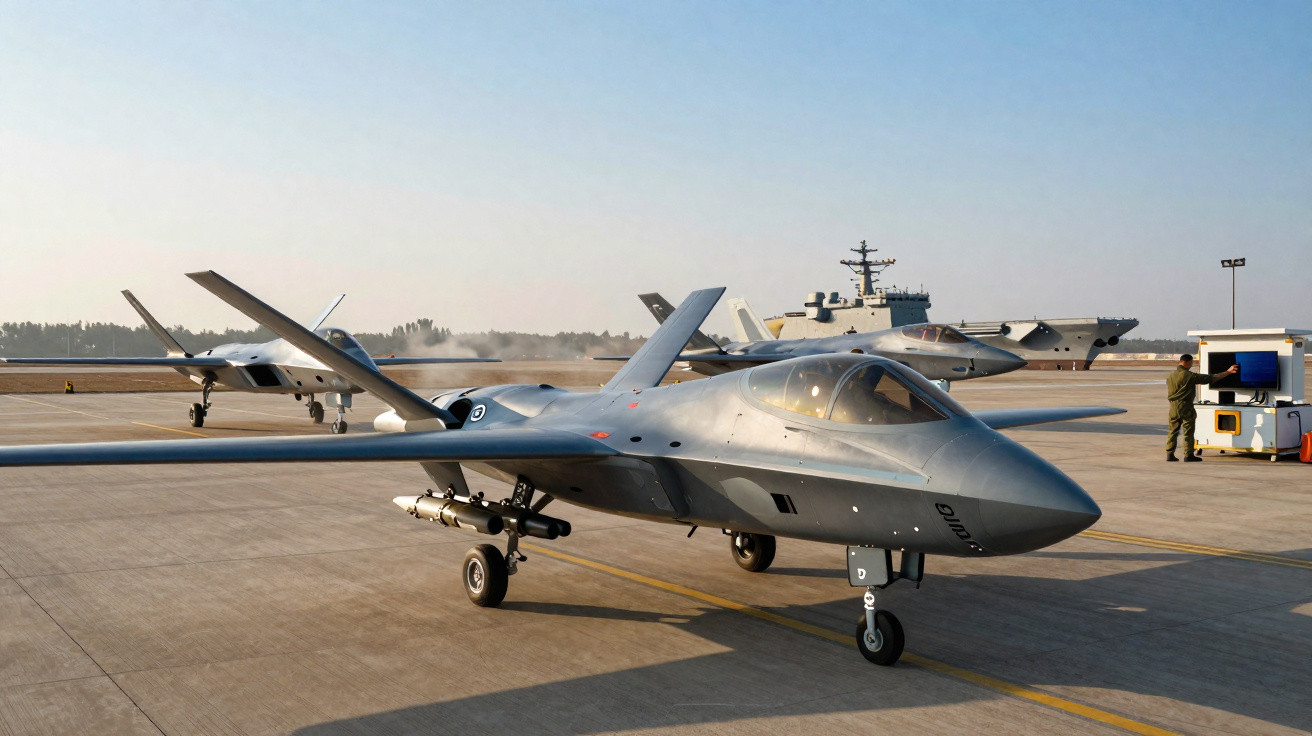
PLAAF anniversary clip showcases the GJ-11 Xuanlong
During this morning’s anniversary celebrations for the service, the People’s Liberation Army Air Force (PLAAF) released a short video featuring fresh scenes of its stealth unmanned combat aerial vehicle (UCAV), the GJ-11, seen flying in formation with other combat aircraft. Titled “Dreams of Great Reach”, the newly revealed material is intended to highlight how far the force has come in modernising and strengthening itself over the years, both in quality and in overall numbers.
In the footage, the GJ-11 appears under the name Xuanlong (previously also known as Sharp Sword). It is shown leaving its hangar, taxiing out to the runway and beginning its take-off run. In a later sequence, the drone is depicted as part of a mixed formation alongside the fifth-generation J-20 stealth fighter and the J-16D electronic warfare aircraft.
GJ-11, J-20 and J-16D: a potential combined package
It is worth recalling that the unmanned platform was first presented during the military parade marking China’s National Day in 2019. At the time, experts cited by local media suggested that only around now would it be reaching the operational maturity required to deploy in tandem with the manned aircraft shown in the new video.
Once that level of integration is fully validated, the three-aircraft grouping of GJ-11, J-20 and J-16D could become a highly dangerous combination against hostile air-defence networks-bringing together radar-jamming capabilities with the option of conducting stealthy penetrations to strike strategically important, heavily protected targets.
Following this line of thinking, analysts in China have speculated that the GJ-11 could serve as the “spearhead” for such missions. In practice, that would mean leading the package during the attack, carrying out reconnaissance tasks and then degrading enemy capabilities while the other two platforms remain at a safer stand-off distance. At later stages, the J-20 would be expected to deliver the decisive strike on the targets, with the stealth drone potentially shifting into an escort role.
Manned–unmanned teaming and possible naval use
Although there is currently little additional data or operational background available, this concept is presented as part of a broader approach the PLAAF is seeking to adopt, prioritising the combination of manned and unmanned assets for future operations. In that context, the GJ-11 is one of several developments Beijing is pursuing to complement its current combat aircraft, alongside support and air-superiority drones such as those displayed on Victory Day on 3 September.
Finally, it is important to note that China’s new stealth drones would not be limited to PLAAF formations: they are also expected to be integrated into naval aviation. In particular, a variant known as the GJ-21 is among the leading candidates to join the embarked air wing of the new Type 076 amphibious assault ships, whose flight deck is set to feature electromagnetic catapults drawing on lessons learned during the construction of the aircraft carrier Fujian.





Comments
No comments yet. Be the first to comment!
Leave a Comment