
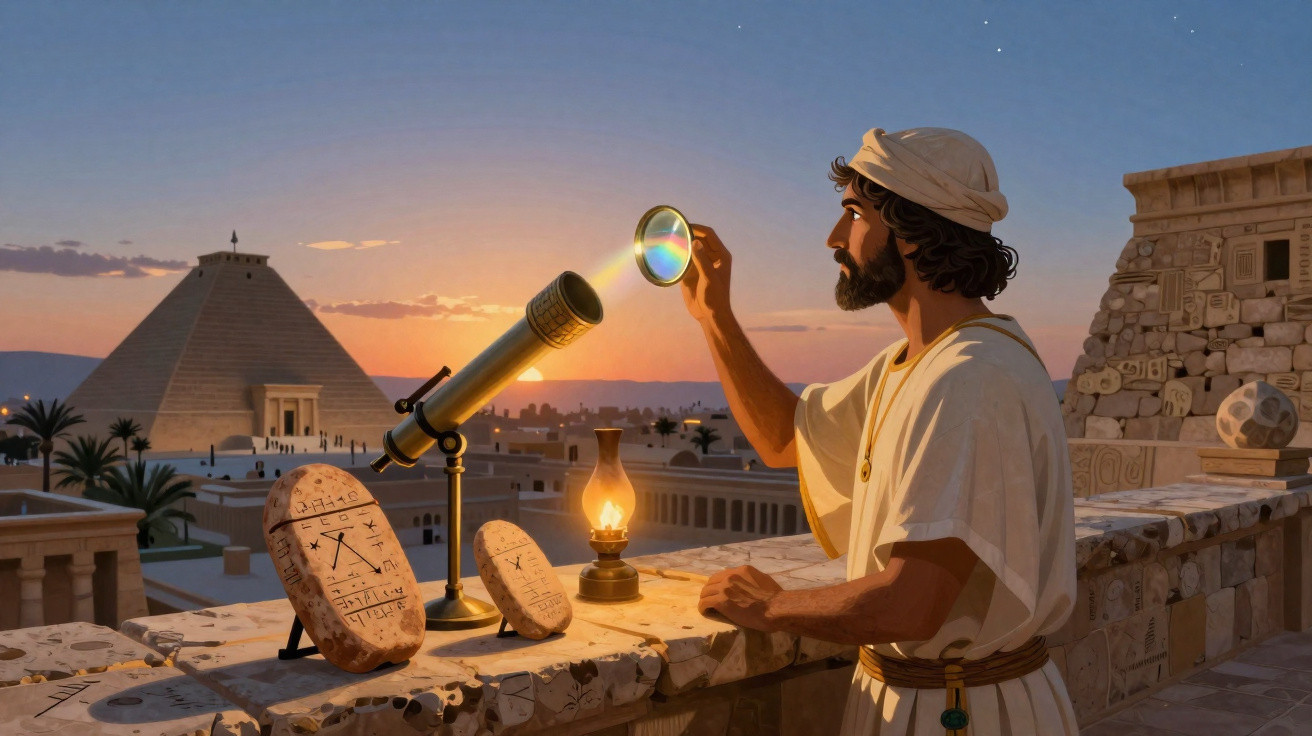
The famous Nimrud Lens, uncovered among the ruins of ancient Assyria, is a piece of rock crystal that has puzzled archaeologists for decades because it raises the possibility that advanced optical instruments-such as telescopes-may have been known around 3,000 years ago, long before the breakthroughs commonly linked to Galileo.
What is the Nimrud Lens?
The Nimrud Lens was found in 1850 during excavations of the ancient palace at Nimrud, in what is now Iraq. The object is roughly 4 centimetres across and was carved from carefully polished rock crystal.
Dated to around the 8th century BC, during the Assyrian Empire, the piece continues to spark debate among experts due to its ability to magnify objects and focus light.
Could the artefact really have been a primitive telescope?
One of the best-known ideas is that the lens may have formed part of a basic optical device. If that were the case, it would point to technological understanding that predates modern telescopes by a very long time.
Even though the suggestion attracts attention, most researchers consider it unlikely that the Assyrians possessed a complete telescope. Even so, the artefact shows they had mastered sophisticated techniques in cutting and polishing-and an impressive grasp of optics.
Why does the Nimrud Lens continue to fascinate researchers?
Because there are no definitive documents, the object remains surrounded by mystery. Each new investigation draws on modern technology to examine flaws, curvature, and the crystal’s magnifying power.
Although there is still no consensus, the lens indicates that ancient civilisations possessed technical knowledge far more advanced than was assumed a few decades ago, increasing interest in Assyrian engineering.
What are the main hypotheses about how the lens was used?
Since there are no written records explaining its purpose, archaeologists weigh different possibilities to understand how the object may have been used in ancient Mesopotamia.
Among the explanations most widely accepted by researchers are:
- A magnifying glass for reading or inspecting small details.
- A tool for highly precise craft work.
- An instrument to concentrate sunlight and start a fire.
- Part of some optical apparatus that is still unknown.
- An object with a possible ritual or ceremonial role.
What does this object reveal about Assyrian technology?
Whatever its original use, the Nimrud Lens highlights the high level of development achieved by Assyrian craftspeople. Producing a lens of this kind required skill, accuracy, and strong command of the materials available.
For that reason, this small crystal remains one of archaeology’s most intriguing artefacts. As further studies continue, it underlines that many aspects of ancient civilisations still await clear answers.






Comments
No comments yet. Be the first to comment!
Leave a Comment