
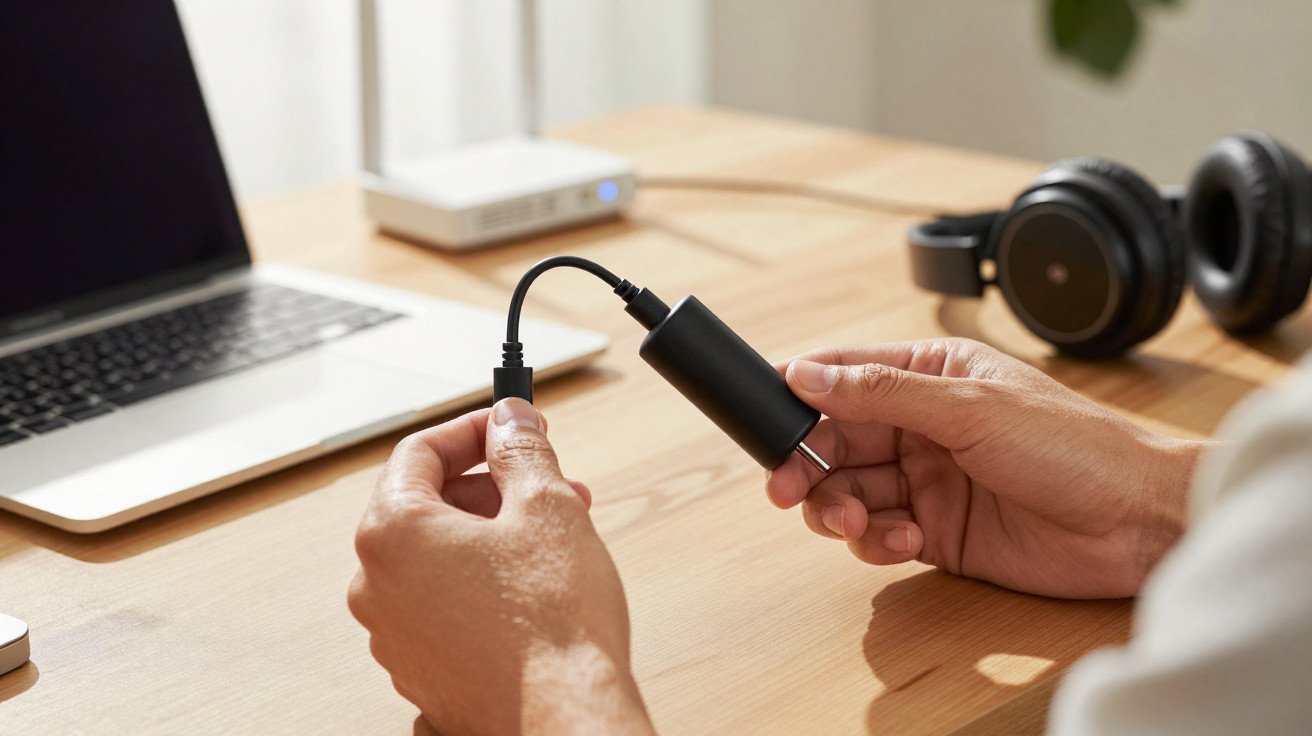
Have you ever noticed that your laptop charger lead has a strange bulge, almost halfway along the cable? That ferrite cylinder is neither a decorative flourish nor a manufacturing fault. It’s there to do a very specific job inside your electronic setup.
That bulge on the cable has a name and a purpose
What you’re seeing is a ferrite core: a ceramic material with magnetic properties, fitted around the cable at a deliberate point. In practice, it acts as an invisible filter that tackles unwanted electrical noise.
As electrical current flows through the charger cable, it can produce small electromagnetic waves. The ferrite core absorbs these high-frequency waves before they can spread into the surrounding environment.
- Magnetic filter: blocks high-frequency noise travelling along the charger cable.
- Less interference: helps stop the charger disrupting radio signals, Wi‑Fi and other nearby devices.
- Used on many cables: it also shows up on monitor leads, HDMI cables and USB peripherals.
- Simple material: made from iron oxide, a low-cost compound that’s highly effective.
When electrical “silence” becomes a problem
Picture plugging in your laptop charger next to a speaker or an old radio. Without this filter, the electrical noise created by the cable can bleed into the signal those devices are trying to play, producing an irritating hiss or buzz.
That’s why manufacturers include a ferrite core as an almost standard feature. It allows the charger to do its job properly without degrading the signal quality of other electronics around it.
The detail few people stop to notice
The ferrite cylinder’s position on the cable isn’t random. It’s usually placed closer to the end that connects to the laptop, because that’s where electromagnetic interference tends to build up.
Technical curiosity
It is not decorative
The cable will still work without the ferrite cylinder, but it will transmit more electromagnetic interference into the surrounding area.
In laboratory tests, cables without this filter typically generate more radio-frequency noise than those fitted with a core.
It’s worth stressing that removing the cylinder won’t stop the charger working. What changes is how much electrical noise it ends up broadcasting into the space around you.
Your laptop benefits from this small precaution
This small component helps preserve the signal quality of Bluetooth headphones, wireless networks and other devices that sit close to the charger during everyday use.
On top of that, by reducing the electrical noise circulating along the cable, the ferrite core contributes to more stable operation of the charger itself over time.
Thinner and thinner cables bring their own challenge
As GaN charger technology becomes more compact and more powerful, electrical engineering has to find new ways to filter interference without making the lead thicker than it needs to be.
In the end, that cylinder many people ignore contains discreet but essential engineering that keeps your electronics working in harmony.
If this little fact has made you look differently at your charger cable, share it with someone else who’d also enjoy understanding this everyday detail.






Comments
No comments yet. Be the first to comment!
Leave a Comment