
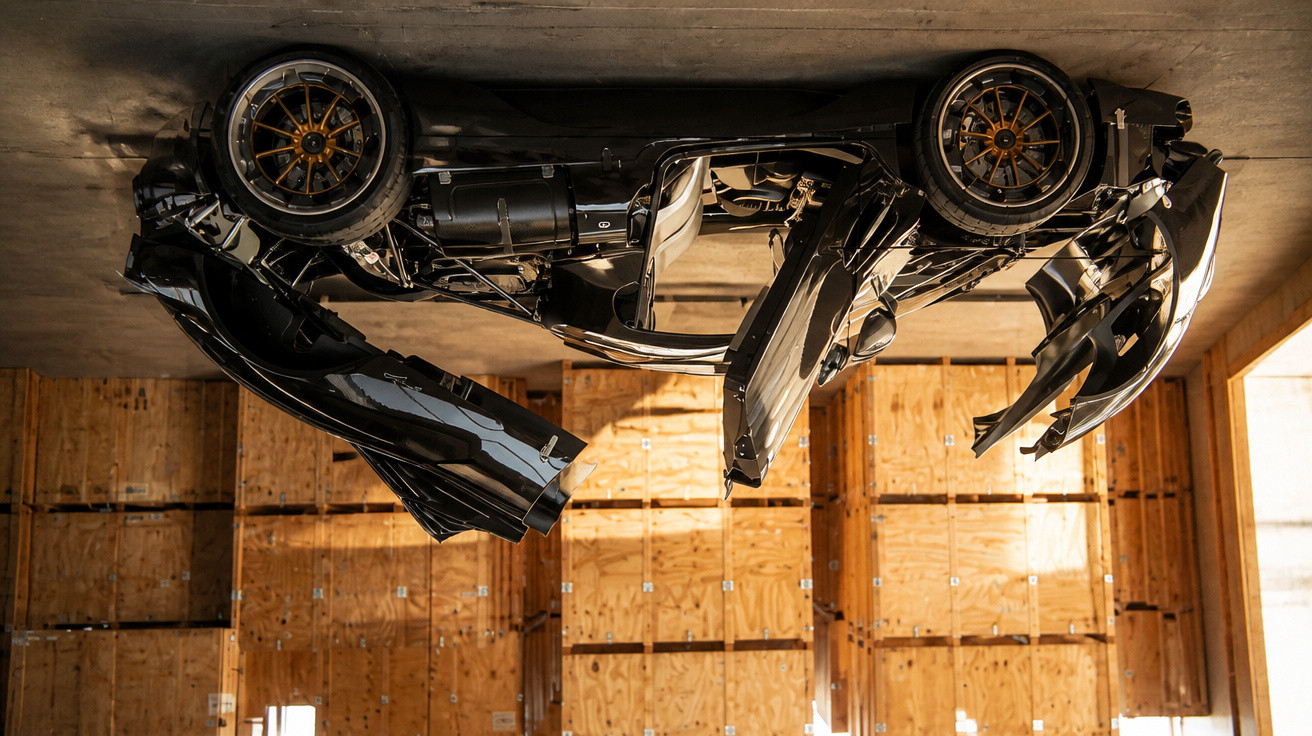
Six exposures, one painstaking process
Tom Salt makes six photographs today. That is all: six almost soundless, exact shutter releases through the lens of a frankly eccentric camera. Between each frame he has to perform a careful routine to keep a huge 8×10-inch negative (about 20×25 cm) completely light-tight, then replace the film holder with a fresh one.
Each picture demands more than an hour of inch-perfect positioning of car and camera, along with slow, deliberate decisions on framing, focus and light metering. Every reflection and shadow needs taming; any stray rubbish or visual interruption has to be removed by hand. Digital tidying-up is off the table.
Plenty of electric SUVs will sprint like a Pagani Utopia, effortlessly. Yet none carries the theatre of a 6.0-litre V12, nor the intimacy of a manual gearbox. Analogue hasn’t vanished-nor will it. In the same way streaming never fully displaced vinyl, and the PDF never truly pushed out calligraphy, digital photography has not entirely dethroned film.
Image carousel (themed)
Photography: Tom Salt
If you are willing to put in the work, the payoff from large-format film can be astonishing. Even after the softening that comes with magazine pages and web compression, the images still deliver hypnotic detail and a radiant, luminous tonal range. They feel like prints you could dive into.
Large-format film photography: control, movements and the ground glass
That’s only the opening act. With large-format optics, the photographer can dictate depth of focus in ways smaller formats simply cannot. Ansel Adams and Group f/64 would stop right down-almost like a pinhole-to render everything crisp; open the aperture and the subject snaps into focus against surroundings that dissolve into a soft haze.
Then there are the camera movements. With a bellows-mounted lens, vertical and sideways shifts let you correct perspective and avoid keystoning-the tapering you get when you aim upwards at buildings. Yes, phone cameras now offer digital keystone fixes and a pretend “portrait mode” that (most of the time) finds a face and blurs what’s behind it. But they are so not the same.
Better still, lens tilt allows you to rotate the plane of focus itself, keeping sharpness running through something that falls away diagonally into the distance. The result is a level of creative control that feels almost limitless.
Alessandro Gibellini’s first training was as a civil engineer. Then his father handed him a film camera one day, and that was that. He started testing bigger and bigger formats, before building his own view camera and-ironically-sharing his take on this 170-year-old device on social media.
His engineering instincts pulled him away from traditional hardwood frames towards titanium and aluminium alloys, and even carbon fibre. Greater rigidity matters when you are dealing with precision optics. He also set out to make every bracket, arm and control knob beautiful in its own right.
His small workshop sits in a hillside village just south of Modena. I’ve almost certainly driven past it, unknowing, countless times while road-testing Ferraris, Lamborghinis… and Paganis.
Although he’s younger, Alessandro has plenty in common with Horacio Pagani: technologist and artist, materials obsessive, entrepreneur-someone who makes functional objects that are beautiful all the way through. A supplier who provides metal parts to both companies introduced them a few years ago. From there, the notion took shape: a Pagani interpretation of the Gibellini camera. That collaboration became the GP810HP.
This is not a simple rebadge. Pagani’s designers reworked many of the moving components and added their own touches, including a large control knob finished with their four-tailpipe motif. It arrives with a leather-bound carbon-fibre tripod and matching cases-very Pagani, naturally.
The price also feels thoroughly Pagani: £70,000. (Gibellini’s 3D-printed educational cameras, by contrast, start at under £1,000.) Roughly half of the limited production has been set aside for Pagani car customers. I’m told most of those buyers genuinely plan to use it-and broadly know how. This isn’t merely a trophy for the sitting-room corner. Or at least, it isn’t only that.
As an object, it is a collection of exquisite pieces: mostly solid metal milled into strong, lightweight arms that resemble a bird’s rib cage, plus fluted controls and locking knobs. Everything moves with jewel-like accuracy. That makes it pleasing to handle, but the real difference lies in the working method.
On a view camera, the lens projects onto a removable ground-glass screen, standing in for the film while you compose and focus. The image is dim, so you shut out the world by slipping beneath a lightproof cloth. Under there, you are completely alone. Is it too romantic to liken that to being by yourself in a car on an empty road?
Except this solitude is slow work. The ground-glass image is inverted. Minute adjustments to the lens become dramatic changes on the screen. You need a magnifying loupe to confirm focus. Shift one part of the frame and the rest of the scene transforms with it. After that, you are pacing around with a light meter.
Tom calls it both a physical task and a philosophical one. He is exactly the right person to do it. In the Nineties he spent three years assisting James Hedrich at Hedrich-Blessing, Chicago’s leading architectural photography studio-the image-makers favoured by Frank Lloyd Wright, Ludwig Mies van der Rohe, Buckminster Fuller, Eero Saarinen and other modernist titans. Tom would haul 17 flight cases of cameras and lighting across the US, then spend evenings in hotel bathrooms, taping up the door to block light so he could load film into holders.
Later, Tom returned to Britain and moved into car photography. We first worked together around the turn of the century-him behind the camera, me behind the wheel. We first visited this factory in May 2002 to test a then-new Zonda S. That day he shot with a Hasselblad, wonderfully convenient beside a bellows camera, but laughably awkward compared with the digital equipment and techniques that have since become dominant for him, as for nearly everyone.
Digital simply works faster on location. “Today’s shoot just made me realise how much leeway we now have,” he says. “It’s a completely different approach to get it right in camera versus patch it together afterwards. Analogue is way more honest and more of a craft.”
Pagani Utopia: Horacio Pagani’s weekend-analogue hypercar
While the warehouse shoot grinds on, I’m back on the main floor with Horacio Pagani-builder of peak analogue supercars. Utopia follows the Pagani principle that every component, even the hidden ones, should be beautiful: partly because beauty gives pleasure, and partly because it often improves function too.
Yet Horacio, speaking softly as ever, insists it is not his own idea at all. Instead he points you to Leonardo da Vinci’s dictum: “Art and science are disciplines that must walk together hand in hand.”
After spending a morning circling the car, I don’t need persuading that Utopia is visually extraordinary. Even if you feel the design language edges towards the ornate-though, to my eyes, less so than the Huayra-it is still impossible not to be impressed by how unified it is. Every small element belongs. Nothing feels generic or borrowed.
Lift the huge rear clamshell and the tidiness is as obsessive as the sculpting. No hose or wire disrupts the arrangement. This has been Horacio’s credo from the beginning with the Zonda, and it carried straight through the Huayra.
And then there’s the monolithic V12. Among hypercars, plug-in hybrid power has become close to standard. Horacio’s own 918 sits beneath a dustsheet near where Tom is photographing-and yet… “I’m not a pro driver, but I have driven lots of other supercars. Once a car is more than 1,500kg the electronics make it a filtered experience. It’s artificial. Our cars aren’t for the week, for taking your child to school. They’re for the weekend. Our customers want a car that isn’t complicated, they want one that is close to you and has a connection with you. That was what made the Zonda magical.”
He’s right about that. That spring day in 2002 is still etched into me. In its time the Zonda felt almost absurdly powerful, made even more intimidating by its alien styling-and yet it was also warm, approachable and ferociously thrilling once you drove it. If Utopia can recreate that, it will be another triumph.
Its bespoke 852bhp twin-turbo V12 from AMG, along with Pagani’s own carbo-titanium structure, keeps kerbweight under 1,400kg, giving it every chance.
This “unfiltered” approach rules out four-wheel drive, four-wheel steering and active roll control. A manual gearbox is available and 70 per cent of buyers choose it. Most importantly, there is no hybrid system.
Pagani tells me AMG proposed an alternative: a V8 paired with plug-in hybrid assistance and four-wheel drive. “It was 1,000 horsepower, and it would have been easier to homologate worldwide. But it would have added 350 to 400kg. Our customers want a V12 and no hybrid.” So that is what they get.
To build Utopia, Pagani created around 40 new varieties of carbon-fibre composite, each tuned for a specific role across the car. They do not need dressing or trimming, trimming yet more weight. In the cabin, it shows.
The seven-speed manual’s exposed shift gate and linkage is a skeletal sculpture. The steering wheel starts life as a 30kg aluminium billet, machined down to a 2.5kg solid piece that will not flex or buzz. The instruments resemble chronograph watches. There is no central touchscreen; Horacio considers screens a distraction (hard to argue) and thinks they age quickly. He wants the car to outlast fashion.
That is also why he pushed for an exterior that is comparatively clean and organic, with no bolt-on wings or spoilers. Air management through the body was refined through heavy CFD and wind-tunnel work.
On the Huayra, Pagani introduced movable flaps at the nose and tail to alter downforce and drag. Left and right sides operate independently, generating variable lateral aerodynamic load in corners and helping counter roll. It was the first car worldwide with that capability.
On Utopia, the active aero appears only at the rear. Those surfaces form the upper part of Pagani’s signature oval that wraps around the exhausts, with tail-lights at the pointed ends. They are more effective because airflow can pass beneath as well as over them; on the Huayra’s flaps, air travelled only over the top.
Rather than fitting moving aero at the front, the front suspension changes height, adjusting the body’s angle of attack to balance aerodynamic forces. Achieving this requires exceptionally complex electronic control, developed in-house by Horacio’s young, trusted team.
The Utopia’s 6.0-litre twin-turbo V12 is now a rarer thing than ever. AMG no longer sells a V12 in any of its own cars, and the Maybach unit is clearly a different kind of engine altogether. Pagani’s version spins to 6,700rpm and produces a bewildering 811lb ft of torque.
Its transmission is mounted transversely, placing weight further forward than a longitudinal layout would-an advantage for handling.
When the film goes black-and the magic still wins
Even so, in an analogue hypercar, switching off the ESP would surely allow you to spin into the scenery. With analogue photography, you can have the same sinking moment: you don’t get the ESP-like reassurance of checking a screen after every exposure.
After the day’s work, Tom and Alessandro develop the sheets. Catastrophe-we have our spin. Every sheet comes out an even, featureless black. Because it’s negative stock, that means the film saw light earlier.
It doesn’t resemble a camera or tank light leak, which would create edge streaks. We go over possibilities again and again. The most likely explanation is that someone, during set-up or transport, opened the lightproof film packet without understanding what it was. Either way, the day is gone.
So the shoot is repeated through the night, this time using borrowed lamps in place of the warehouse window’s daylight. And in the end the special character of film delivers.
Under direct electric light, the large-format resolving power makes the car’s carbon fibre snap into life, sharpening the surface and energising the curves even more. Tom had also made safety shots on his digital Nikon, later admitting he’d toyed with printing them with fake film borders.
Then the night-shot negatives came out of the chemistry and it was obvious that idea wouldn’t have worked. “There is a real quality to the 8x10 that’s hard to replicate. I think it’s mostly in the focus but also something about the formality.”
If anything, the painful lesson reinforced what “progress” really means. “For work, under pressure, I wouldn’t go back,” Tom says. “There’s no time for it any longer. Digital offers so much flexibility.”
Still, “Given time shooting a subject of my own choosing, I’d still go analogue. I do miss it. The ground glass experience is unmatched.”
Which, I suspect, is exactly Horacio’s argument for his weekend hypercars.



Comments
No comments yet. Be the first to comment!
Leave a Comment