
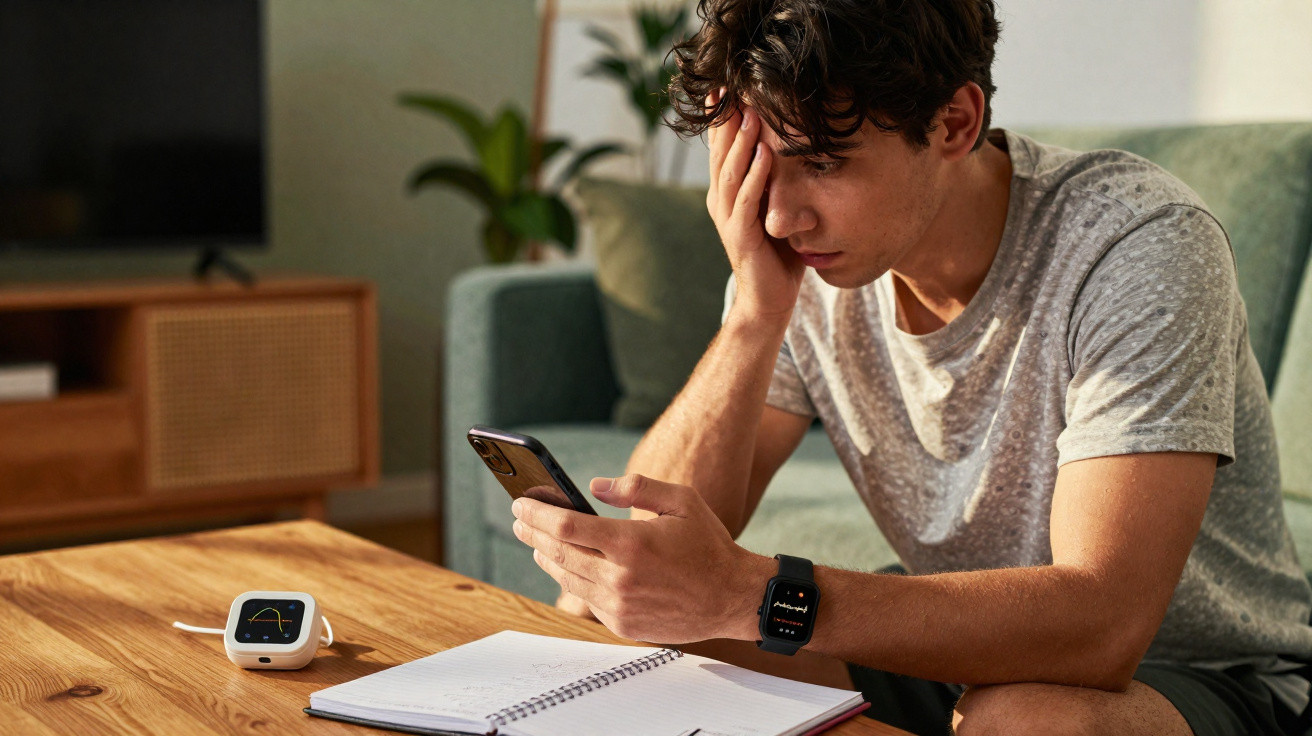
The average adult in the UK now spends close to two hours a day on social media. Among younger users, that figure can easily rise to five hours. Apps such as Instagram and TikTok pull people into constantly refreshed feeds, and it can be surprisingly hard to step away.
Our most recent study suggests that this “stuck to the screen” state shows up in the body as well when people use social media.
What our Instagram experiment measured
We invited 54 young adults to use Instagram on their phone for 15 minutes, in the same way they typically would in everyday life. During the session, we fitted electrodes to their chest and fingers so we could track their heart rate and record "skin conductance"-a measure linked to sweating.
These physiological signals are often used by psychologists to infer subtle shifts in mental state and emotion. To make sure we were not simply measuring the effects of being on a phone or reading text, we also included a control condition: participants read a news article on their phone immediately before logging into Instagram.
Compared with the news-reading condition, scrolling through Instagram produced a clear pattern: participants’ heart rates slowed down noticeably, while their sweating response increased at the same time.
Evidence from other studies indicates that this combination of bodily changes occurs when attention becomes fully captured by something personally significant or emotionally engaging. In other words, it reflects deep immersion alongside heightened excitement-being absorbed in something that feels meaningful.
Crucially, because we had the control condition, we could see that the effect was not explained by phone use or reading alone. Something about social media itself appears particularly effective at drawing people in.
What happens when Instagram use is interrupted
The most striking result appeared when we stopped participants at the end of their Instagram session and asked them to return to reading another news article.
Instead of quickly leaving that engaged state and settling into something calmer, participants’ sweating increased even more. Their heart rate also rose, rather than continuing to slow.
Is it addiction?
So what was happening? Participants’ own emotion ratings helped us make sense of these effects. We gathered these ratings before the social media session and again at the moment we asked them to log off.
When they had to disconnect from their feed, participants reported feeling stressed and anxious. They also said they experienced social media cravings at that point.
This suggests that the physiological reaction we recorded during the forced log-off reflected a different kind of arousal-one that was more negative and linked to stress.
Comparable bodily and psychological stress responses can also be seen when someone with a substance addiction experiences withdrawal during abstinence, or after quitting "cold turkey".
Does that mean the signs we observed were Instagram "withdrawal"?
There is no simple answer. That said, our study offers some pointers. After the experiment, every participant completed a questionnaire designed to assess symptoms of "social media addiction".
Although this idea is disputed and is not currently recognised as a mental health disorder, the questionnaire sheds light on the ways social media use can harm day-to-day functioning. For example, it may affect performance at work or school, or contribute to conflict with partners.
Importantly, we did not find differences in heart rate or sweating between those who scored higher versus lower on these addiction measures. In other words, across our sample, participants showed the same pattern: excited immersion while using Instagram, followed by stress-related arousal when the experience was interrupted.
We do not interpret this as evidence that everyone is addicted to social media. Rather, our view is that social media delivers exceptionally powerful rewards.
Some features may also have an addictive dimension-such as personalised short-video streams that keep people locked into an endless cycle of entertaining clips.
However, our earlier study indicates that it is mainly the social element of social media that leads most people to use it so intensely. That matters because, unlike drugs, social media connects with basic human needs: people want to belong, and they want to be liked.
If we decide to accept the notion of "social media addiction", we might also have to accept the idea of a "friendship addiction". That is why caution is needed when using the term addiction in relation to social media: the danger is that ordinary behaviour becomes "pathologised", with stigma as a result.
And, as our previous research suggests, many people may cope perfectly well with abstaining from social media-or simply cutting back-for a period, without major changes to wellbeing (whether positive or negative).
One reason is that, unlike drugs, these needs can be met in other ways-for example, by talking to people.
Niklas Ihssen, Associate Professor, Department of Psychology, Durham University
This article is republished from The Conversation under a Creative Commons licence. Read the original article.




Comments
Компания «Count Capital» осуществляет продажу действующих интернет-магазинов под ключ https://bayra.market/zhenschinam-ru/page-40/
Преимущества подобного решения:
Сибирские города опять в пятерке лидеров:
Согласно весеннему опросу Wildberries, который проводился в 70 регионах России, более половины россиян — 54 % — каждый месяц покупают товары в интернете на сумму от 5 до 20 тысяч рублей https://bayra.market/odezhda-ru-5/detyam/novorozhdennym/shapochki-i-rukavichki/shapochka-detskaya-v-stile-bini-polusherst-pudra-r-38-40/
У 63 % опрашиваемых за последние три года увеличились траты в категории онлайн-покупок на 30 % и более https://bayra.market/ip-klimenko/?amp
И почти половина покупателей — 48 % — заказывают товары в интернете каждую неделю https://bayra.market/galantereya-i-ukrasheniya/zhenschinam-ru/bizhuteriya/sergu/sergi-k1-00015078/?select_warehouse=56
Бывает обидно, когда вы вложили силы и бюджет в новый регион, а товар там «не пошел» https://bayra.market/ip-klimenko/?category_id=24702&page=2
Не стоит отчаиваться https://bayra.market/galantereya-i-ukrasheniya/zhenschinam-ru/bizhuteriya/broshi-i-znachki/brosh-k1-00018455/
Ситуация поправима, если действовать по продуманному плану https://bayra.market/galantereya-i-ukrasheniya/zhenschinam-ru/bizhuteriya/broshi-i-znachki/brosh-k1-00011190/
Фото: Роман Яровицын, Коммерсантъ https://bayra.market/galantereya-i-ukrasheniya/zhenschinam-ru/bizhuteriya/sergu/sergi-k1-00015942/
«Лучше всего вкладываться в продвижение внутри маркетплейсов»
гармоничность, то есть все элементы образуют единое целое;
Флористическая губка https://artcraftbouquet.ru/articles/tag/morskie-cvety
Она служит основой для композиций https://artcraftbouquet.ru/magazin/folder/bukety-v-blagodarnost/p/2
Ее кладут на дно какой-либо емкости – корзинки, шляпной коробки, вазочки, для фиксации цветов и других элементов https://artcraftbouquet.ru/articles/post/den-smeha
Воткнутые в нее цветы дольше сохраняют свежесть, их можно поливать https://artcraftbouquet.ru/articles/post/tajnyj-santa
для деловых подарков
? Ботаника и агротехника – знание особенностей растений, их жизненного цикла, требований к уходу, хранения и транспортировки https://artcraftbouquet.ru/magazin/folder/cvety-dlya-zheny/p/3
секатор,
Во флористике, как и в любом другом искусстве, существуют свои правила и принципы, которым необходимо строго следовать, чтобы создать красивую композицию, радующую глаз https://artcraftbouquet.ru/magazin/vendor/tuleneva/p/1
На авось не составляют букеты даже очень опытные флористы https://artcraftbouquet.ru/magazin/product/buket-108
?
А природа – это способ переключиться от насущных дел, которыми полон каждый наш день https://artcraftbouquet.ru/magazin/folder/bukety-pionovidnyh-roz-v-korobke
Leave a Comment