
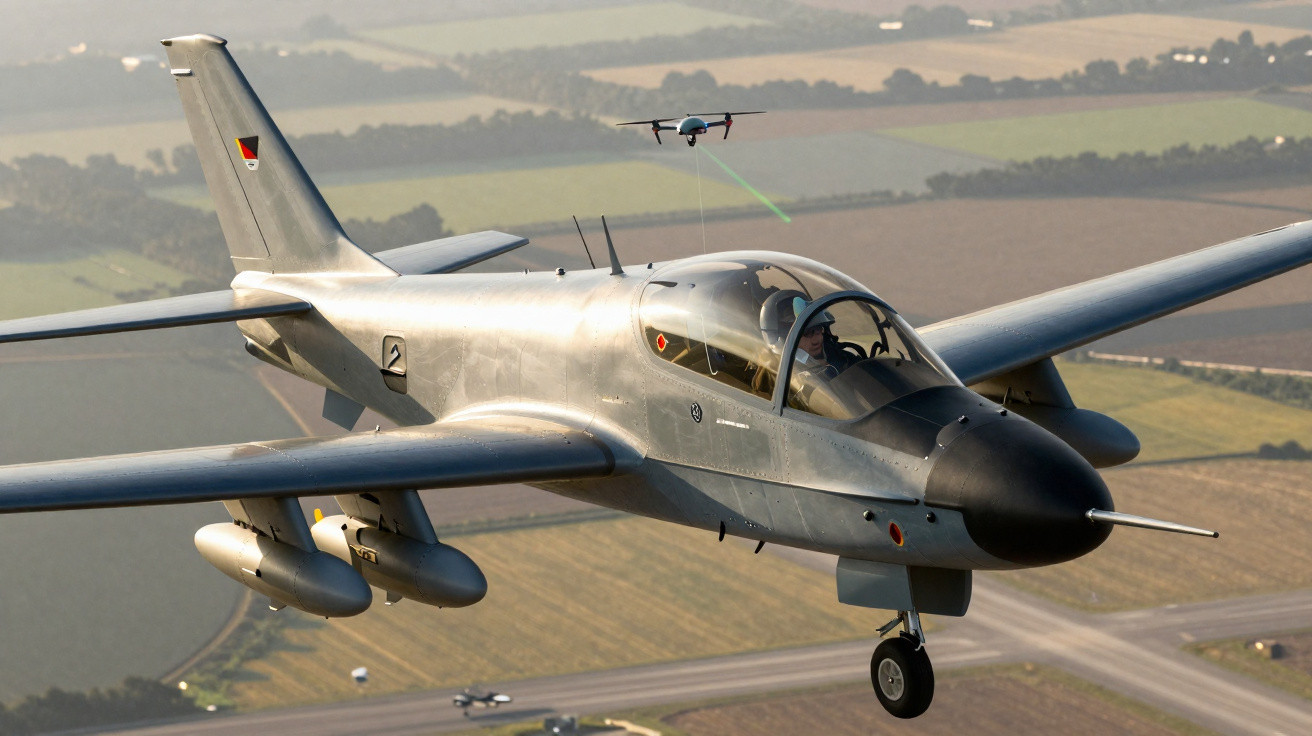
By the end of yesterday’s day, Brazilian manufacturer Embraer announced it is developing a set of upgrades for its A-29 Super Tucano light attack aircraft, aimed at broadening its counter-drone capabilities. The company intends to integrate solutions built around sensors and systems already available for the platform, with the option to retrofit aircraft currently in service with various air forces across the region and worldwide.
Embraer’s counter-drone plan for the A-29 Super Tucano
Embraer’s defined operating concept would enable A-29 Super Tucano users to add mission capabilities focused on fighting and intercepting unmanned aerial vehicles. According to the company, this would be achieved by “...taking advantage of the A-29’s operational characteristics and new sensors, including specific data links to receive initial target coordinates, the electro-optical/infrared (EO/IR) sensor for tracking and laser designation, as well as laser-guided rockets and the wing-mounted .50 calibre machine guns to neutralise unmanned aerial systems (UAS)...”.
Sensors and weapons for intercepting UAS
Among the capabilities cited, it is worth noting that A-29 Super Tucano aircraft operate with a range of electro-optical sensors from the FLIR family, among other systems. As is already the case on other platforms, these systems are well suited to detecting, tracking and marking drones, particularly at night.
When paired with laser-guided rockets of the APWKS/APKWS II type, the light attack aircraft could deliver an optimised, battlefield-proven drone interception capability-mirroring the kind of employment seen in the Middle East by United States Air Force (USAF) F-16 and F-15 fighters.
Embraer’s view on the growing drone threat
Addressing the new mission envisaged for the Super Tucano, Bosco da Costa Junior, President and Chief Executive Officer of Embraer Defense & Security, stated: “...we continue expanding the A-29’s capabilities to address the most recent challenges faced by many nations around the world...”.
Embraer also emphasised that recent conflicts worldwide “...have highlighted the urgent need for solutions to combat drones. The A-29 is the ideal tool to counter unmanned aerial systems (UAS) effectively and at low cost...”.
With the threat posed by unmanned systems of various types growing in both complexity and numbers, countries are assessing new solutions and countermeasures to strike a balance between capability and cost for military use. The war in Ukraine and the conflict in the Middle East have underlined the need for flexible, affordable platforms that still offer the required capabilities to meet the new challenges posed by drones.
In that context, the Embraer A-29 Super Tucano has, in recent years, become the light attack aircraft of choice for many air forces, with more than 20 users and a presence on every continent except Oceania. Its evolution into a “drone hunter” could help it continue opening doors with new customers, amid an environment where the unmanned-vehicle threat shows a sustained upward trend.





Comments
No comments yet. Be the first to comment!
Leave a Comment