
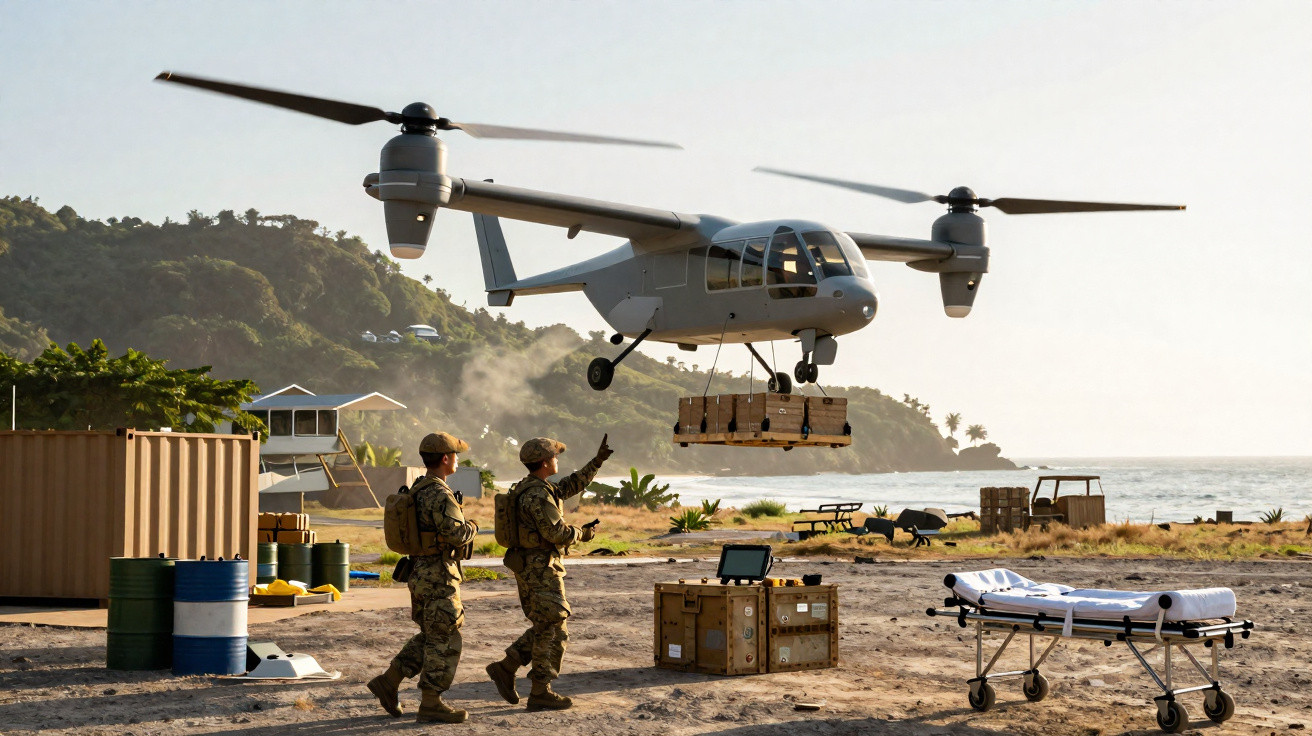
Airbus, the defence company, is working on the new MQ-72C Logistics Connector for the US Marine Corps (USMC). In practical terms, the Logistics Connector is an autonomous helicopter drone: a vertical take-off and landing (VTOL) uncrewed aerial system (UAS) designed to move large volumes of cargo. That kind of lift can be crucial for armed forces that must shift equipment into contested areas or places where overland resupply is difficult.
Military Zone spoke with Carl Forsling, Senior Manager for Business Development at Airbus U.S. Space & Defense, about where the programme is heading and why Latin American militaries should be paying attention.
Programme timeline and procurement route
Although the effort is still at an early stage, it is progressing quickly. In May 2024, the Naval Air Systems Command (NAVAIR) awarded Airbus a Phase I Other Transaction Authority (OTA) agreement via the Naval Aviation Systems Consortium. The award is based on Airbus’s uncrewed UH-72 Logistics Connector concept, derived from the UH-72 Lakota helicopter.
Forsling said Airbus was chosen through a rapid prototyping approach for military acquisition: “the aim is to develop, in 60 months or less, a mature capability and turn it into a deployable capability”.
Airbus has already carried out demonstrations and intends to continue throughout next year. The first took place in October 2024 at Marine Corps Air Station New River and Marine Corps Base Camp Lejeune. A more recent demonstration was held at Marine Corps Air Station Yuma this past May.
Industry team and autonomy work
The programme is being delivered as a joint effort. Airbus is supplying the Logistics Connector airframe, built around its H145/UH-72 helicopter platform. For autonomy and additional mission equipment, the company is working with established defence partners: L3Harris, Shield AI and Parry Labs.
A couple of months ago, Team Lakota Connector completed the first autonomous helicopter flight using Shield AI’s Hivemind autonomy package. The test took place in Grand Prairie, Texas. A second autonomous trial has already been conducted.
MQ-72C Logistics Connector multi-mission capabilities
The Connector is primarily intended to move supplies across a range of operating scenarios: ship-to-ship, ship-to-shore, and into contested parts of the battlespace. The baseline design shown at recent defence exhibitions in Washington, D.C. can be opened from the nose, the sides, or the rear, and it includes internal rollers to speed up cargo retrieval.
Forsling said the aircraft can carry “a couple of thousand pounds of whatever you want to bring into the battlespace”, including ammunition, food, and general stores, as well as loitering munitions, missiles, and other systems (a couple of thousand pounds is roughly 900 kg). He also told MZ that, during one of the demonstrations, “we provided a mock-up load with the basic frame that mimics the Lakota load mechanism, so the Marines could practise loading and unloading”.
He added that Airbus is also exploring further roles for the Connector, such as search and rescue and medical evacuation. According to the Airbus executive, a fleet of Connectors could carry command-and-control (C2) systems, or sensors and radars, expanding network coverage and supporting surveillance operations.
“Transporting cargo is the driving force, but as the capability matures, the opportunities will grow. We have the digital backbone to take on new missions we haven’t even imagined yet,” Forsling said. “The limit is the creativity of the Navy, the Marine Corps and the operational commander,” he concluded.
A technology Latin American armed forces should track closely
Even though the capability is still in its early phase, Forsling believes Latin American armed forces should keep an eye on it. South America’s geography is especially demanding-deserts, mountain ranges such as the Andes, and the Amazon rainforest-and a system like the Connector could move supplies (food, water, equipment, ammunition) to forward positions faster and more safely than using rivers or hazardous air routes.
Forsling argued that sustained US military interest is key for this type of capability to mature and for unit costs to fall. However, with Latin American forces continuing to show growing interest in drone technology (the Ecuadorian Air Force has recently launched its own drone squadron, while the Colombian Army now has a drone battalion), the Logistics Connector could be viewed as a long-term acquisition prospect for the next decade. “The mission applicability is broad, not only for the U.S. Marines, the U.S. Navy or U.S. forces in the Pacific,” Forsling emphasised. In his view, the system’s potential uses and applications are extensive.
A decision from the US Marines on the programme’s future is expected soon. Airbus says it remains hopeful it will be chosen to continue developing the system. “Next year we would like to start making significant modifications to the aircraft and deliver a configuration that is more fully tailored to the mission,” Forsling concluded, alongside integrating sensors and the ground-control element.






Comments
No comments yet. Be the first to comment!
Leave a Comment