
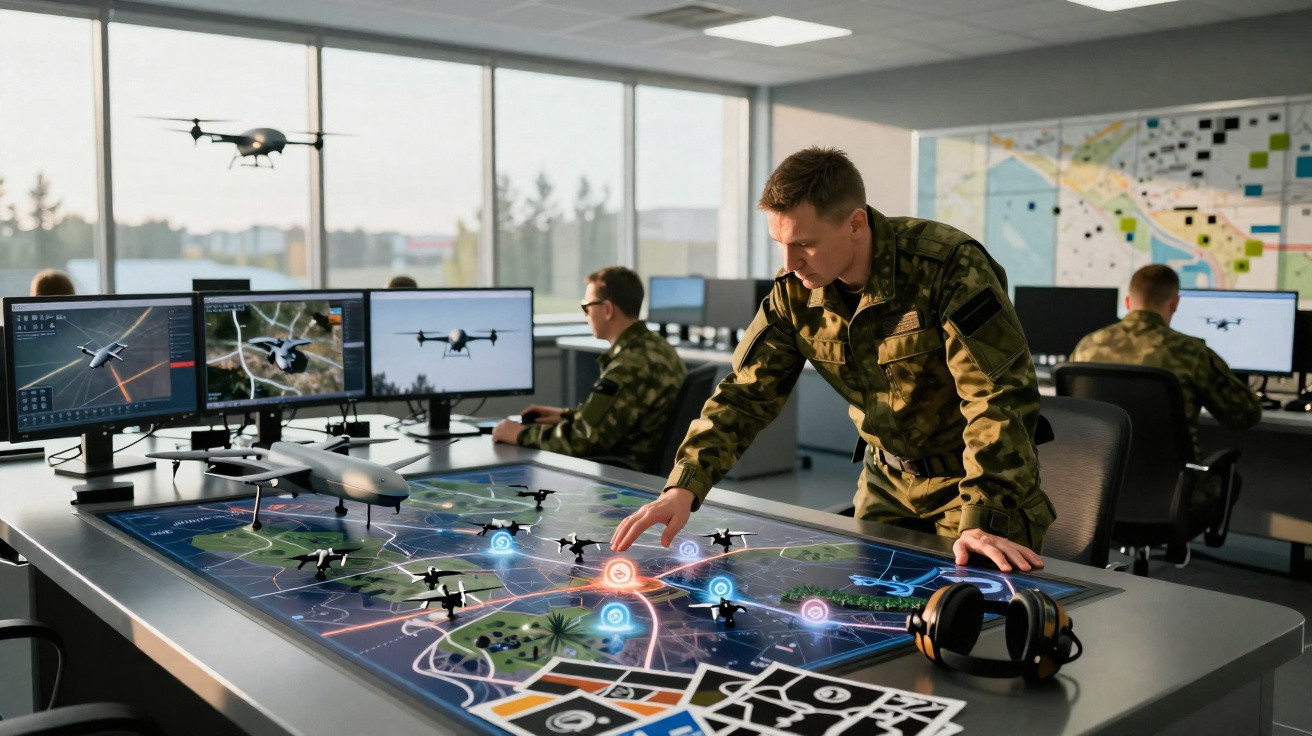
Russia has confirmed the launch of a new service branch within its Armed Forces intended to centralise the production, operation, testing and employment doctrine for unmanned systems. The new structure, named the Unmanned Systems Forces (USF), is already active, with regiments, battalions and other units formed and deployed.
Colonel Sergey Ishtuganov, deputy commander of the USF, explained that “the Unmanned Systems Forces of the Russian Armed Forces have been established. The structure of this new branch of the armed forces has been determined, the head of the Unmanned Systems Forces has been appointed, and military administration units have been created at all levels”. He added that the units “are conducting combat work under a single plan and in cooperation with other units of the battle groups”.
The move had been trailed by Russia’s Defence Minister, Andrey Belousov, in December 2024, when he said the process could be completed by the third quarter of 2025. The initiative follows direct instructions from Russian President Vladimir Putin.
A structure designed for a battlefield dominated by drones
The establishment of the USF mirrors a model Ukraine adopted in 2024 under the same name. Its remit spans aerial, ground and surface drones, with the aim of bringing resource management, tactics and technology under one umbrella in an environment where unmanned systems have become central to operations.
Ishtuganov confirmed that “regiments, battalions and other units have already been formed. Their combat operations are carried out in accordance with a unified plan and in coordination with other units of the troop groups”. He also described the intake of operators, engineers, technicians and support specialists.
He argued that the new structure is already producing effects in areas such as Pokrovsk, where the presence of Russian drones has shaped operations. “Have you noticed what the enemy complains about most when it is encircled in the Pokrovsk–Myrnohrad agglomeration? Drones,” he said. He added that, compared with a year ago, Russian units have significantly increased the availability of unmanned systems.
Alongside combat employment, the USF is also testing drones and electronic warfare systems in cooperation with Russian industry. Ishtuganov said protection measures and countermeasures shift quickly: “The enemy plays with the frequencies; we reconfigure our electronic warfare systems. The enemy starts suppressing us with electronic warfare; we move to other frequencies. And this is a continuous process”.
Drone production and supply
Russia has stated it will expand unmanned-system output. Announced projects include a plant able to produce 6,000 Shahed-type drones per month and an annual plan to manufacture 2 million FPV drones. Moscow also receives support from China in sourcing components.
Even so, a range of Russian voices have pointed to current constraints. The Telegram channel Forces Group “Zapad” said that “in combat conditions, losing a drone is very easy, and if you have a strict limit on the number of drones, you are limited in capabilities”. It also highlighted shortages of night-capable units and platforms comparable to the Baba Yaga drones.
On tactical employment, the channel stressed: “Drone operators should not be sent as assault troops, as some commanders do. Otherwise, the whole process loses its meaning”. It added that the intent is for the new USF to help resolve deployment and resupply problems.
Western analysts echo parts of this assessment. Samuel Bendett, a researcher at the Center for Naval Analyses, said that “there are no official standards today for much of the tactical development and use of drones in the Russian army”. He also pointed to difficulties in supply and in the availability of trained pilots.
Reactions from Ukraine
Ukraine, which has built its own branch dedicated to unmanned systems, views Russia’s decision as an additional challenge. The Commander-in-Chief of the Armed Forces of Ukraine, Oleksandr Syrskyi, said: “I heard a detailed intelligence report on the development of the enemy’s unmanned forces. The occupiers are following our experience… and are allocating significant resources to this”.
Andrii Kovalenko, head of Ukraine’s Centre for Countering Disinformation, said that “they copied our successful solutions”. He noted that establishing attack UAV companies in 2023 had given Ukraine advantages, but that Russia is now seeking to scale those capabilities.





Comments
No comments yet. Be the first to comment!
Leave a Comment