
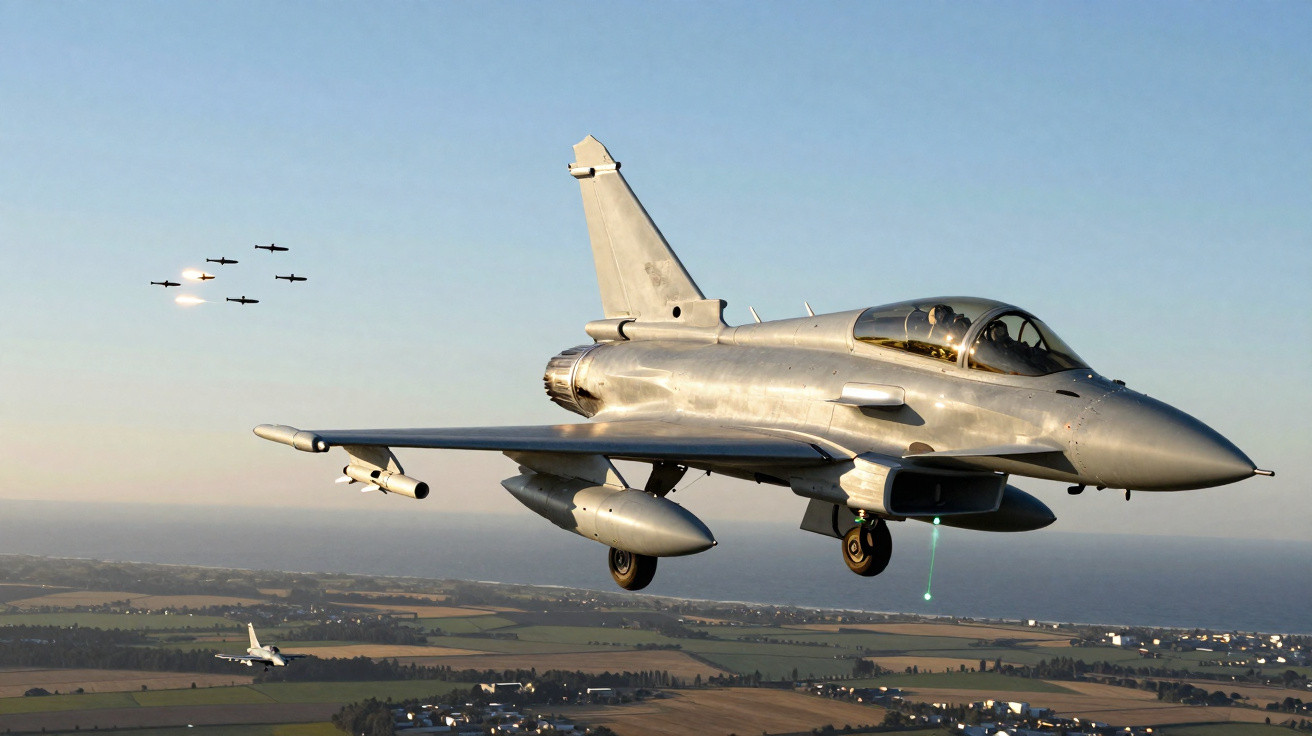
Fitting low-cost guided weapons to the UK’s Eurofighter marks another stage in how the Royal Air Force (RAF) is adapting to the growing drone threat. With the integration of the Advanced Precision Kill Weapon System (APKWS), Typhoon jets gain an extra way to engage air and ground targets using an option that is less expensive than conventional air-to-air missiles.
APKWS upgrades unguided Hydra 70 rockets into precision-guided munitions by adding a laser guidance kit. This allows pilots to strike with greater accuracy and make better use of the weapons already available. In doing so, the RAF aims to widen its operational choices against emerging threats without relying solely on more complex, higher-cost missiles.
A Response to the Growing Drone Threat
Recent operations have underlined the challenge posed by low-cost unmanned aerial vehicles (UAVs). In response, armed forces are looking for approaches that can sustain prolonged operations without sharply increasing the costs associated with using advanced weapons.
Within that context, APKWS enables Typhoon pilots to intercept targets at a fraction of the cost of a traditional air-to-air missile. Its lower-yield warhead also helps limit the risk of collateral damage-an important advantage when operating in complex environments. The laser guidance system deploys control fins after launch and tracks an illuminated target, supporting accurate strikes in both air-to-ground and air-to-air missions.
From Trials to Operational Capability
The APKWS integration was delivered through a joint effort involving the UK Ministry of Defence, the RAF (Royal Air Force), and the domestic companies BAE Systems and QinetiQ. The programme moved forward quickly, driven by the requirement to field effective, low-cost tools for neutralising aerial threats.
Assessments included trials flown by Typhoon aircraft from the 41st Test and Evaluation Squadron. During these events, the fighters successfully intercepted ground targets as well as aerial threats. The trials also showed the system’s ability to defeat drones via specific changes to its fuzing systems, making it possible to destroy airborne targets at a markedly lower cost than traditional methods.
The Cost–Benefit Equation in Modern Warfare
The UK decision aligns with a trend seen across several recent conflicts. Systems such as the Iranian-made Shahed drones have shown that relatively inexpensive platforms can still produce significant effects against infrastructure and military targets, pushing armed forces to rethink the balance between the cost of an interceptor and the value of the threat.
When set against missiles such as the AIM-9 Sidewinder, ASRAAM, or the AIM-120 AMRAAM, APKWS provides a more economical alternative for engaging certain categories of target. Experience gained in the Middle East and in the war in Ukraine has reinforced the need for low-cost guided weapons-a capability that now expands the combat options of the British Eurofighter Typhoon as drones play an increasingly central role.





Comments
No comments yet. Be the first to comment!
Leave a Comment