
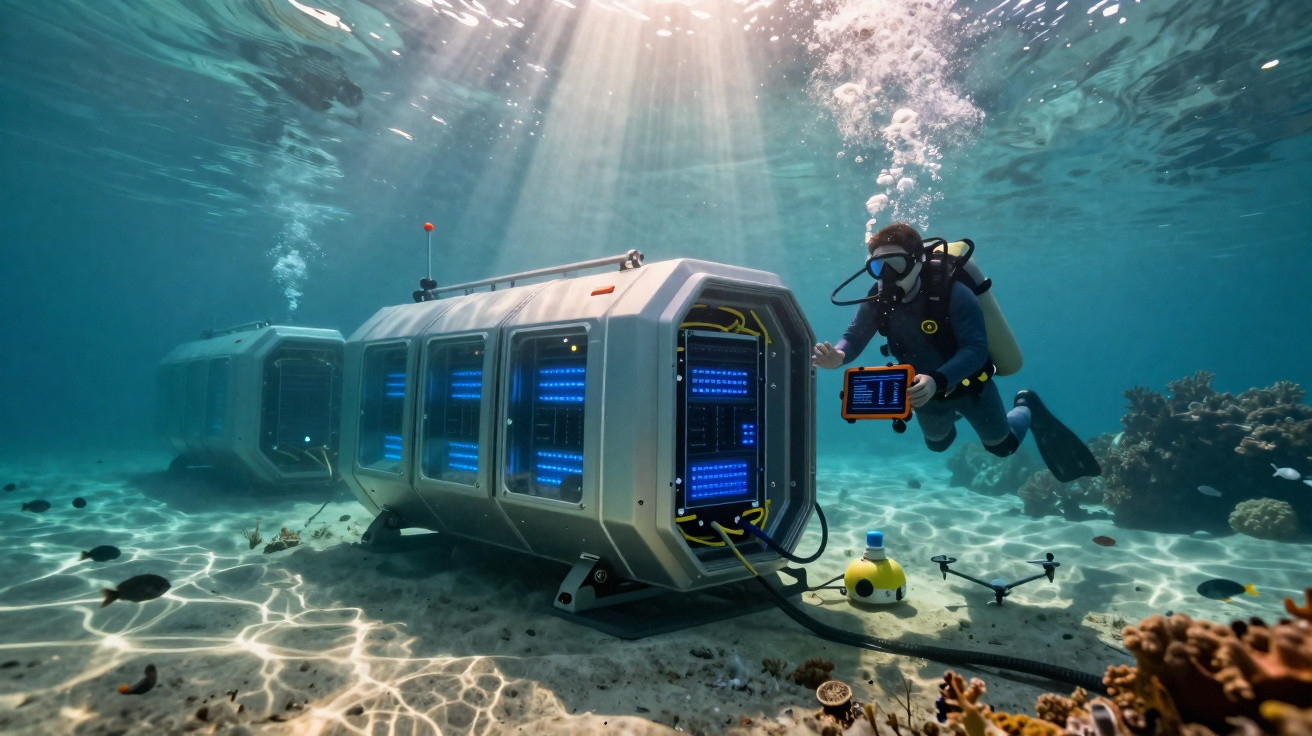
Power-hungry data centres generate huge amounts of heat, and a Chinese firm is betting that the sea could help: it plans to lower a capsule of servers into waters off Shanghai in an effort to ease computing’s energy demands.
At a wharf close to the city, workers were putting the finishing touches to a large yellow pod - an experiment in alternative technology infrastructure that is already prompting questions about environmental effects and whether it can pay its way.
The world’s websites and apps depend on physical data centres to hold and process information, and surging use of artificial intelligence is pushing demand for these facilities sharply upwards.
A commercial underwater data centre pod planned off Shanghai
"Underwater operations have inherent advantages," said Yang Ye of maritime equipment company Highlander, which is developing the Shanghai pod alongside state-owned construction firms.
By placing servers underwater, the system can stay cool thanks to ocean currents, avoiding the energy-hungry air conditioning or water-evaporation cooling typically used by land-based centres.
Microsoft tested a similar approach off Scotland in 2018, but the Chinese installation - due to be sunk in mid-October - is among the first commercial services of its type worldwide.
The project is expected to support customers including China Telecom and a state-owned AI computing company, and it sits within a wider government drive to cut the carbon footprint of data centres.
"Underwater facilities can save approximately 90 percent of energy consumption for cooling," Yang, Highlander’s vice president, told AFP.
For now, initiatives like this are mainly aimed at proving "technological feasibility", said Shaolei Ren, an expert at the University of California, Riverside.
Microsoft did not turn its trial into a commercial offering; after the pod was recovered in 2020, the company said the project had been successfully completed.
Ren said major engineering obstacles and environmental worries still need resolving before underwater data centres can be rolled out widely.
In China, state support is helping to move such projects forward - Highlander received 40 million yuan ($5.62 million) for a similar project launched in 2022 in Hainan province, which continues to operate.
Technical challenges
"The actual completion of the underwater data center involved greater construction challenges than initially expected," said Zhou Jun, an engineer on Highlander’s Shanghai project.
The system is being assembled onshore in separate modules and then installed at sea, and it will draw almost all of its electricity from nearby offshore wind farms.
Highlander says over 95 per cent of the energy it uses will come from renewable sources.
Power, access and security issues
A central difficulty in putting a structure beneath the waves is ensuring everything inside stays dry, while also preventing salt-water corrosion.
To tackle this, the project uses a steel capsule coated with a protective layer that includes glass flakes.
Maintenance access is planned via an elevator linking the main pod to a section that will remain above the waterline.
Ren said that connecting an offshore data centre to the mainland internet network is more complicated than doing so for conventional land-based servers.
Researchers at the University of Florida and Japan’s University of Electro-Communications have also found submarine data centres may be susceptible to attacks using sound waves transmitted through water.
Ecological unknowns
Beyond the technical barriers, the heat released by underwater data centres into nearby waters has raised concerns about potential effects on marine ecosystems.
Heat and marine ecosystems
Andrew Want, a marine ecologist at the University of Hull, said the warmth discharged could sometimes draw certain species in while pushing others away.
"These are unknowns at this point – there's not sufficient research being conducted yet," he said.
Highlander told AFP that a 2020 independent evaluation of the company’s test project near Zhuhai in southern China found the surrounding water remained well below acceptable temperature thresholds.
Even so, Ren cautioned that larger deployments would also mean more heat being released.
He stressed that "for megawatt-scale data centers underwater, the thermal pollution problem needs to be studied more carefully".
Ren suggested offshore installations could sit alongside standard data centres.
"They're probably not going to replace existing traditional data centers, but can provide service to some niche segments."
© Agence France-Presse






Comments
No comments yet. Be the first to comment!
Leave a Comment