
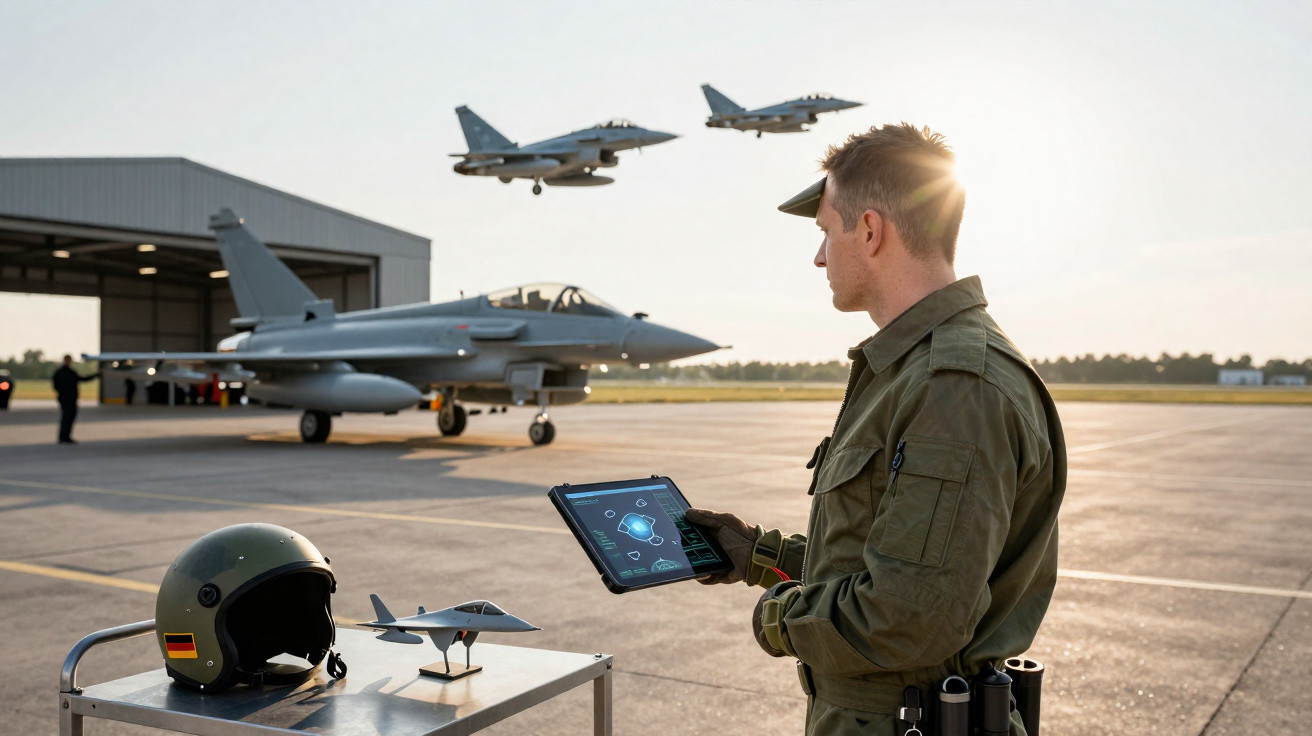
Airbus adapts the Kratos Valkyrie UCCA with MARS for the German Air Force
Airbus is pressing ahead with how it presents and modifies the Valkyrie, a collaborative combat drone it wants to supply to the German Air Force as Berlin looks to bolster its airpower. The European group says it is aiming to field an operational unmanned collaborative combat aircraft system (UCCA) by 2029, pairing a platform that has already demonstrated flight performance with a mission system developed in Europe.
At Airbus’s site in Manching, near Munich, teams are now readying the first two Valkyrie air vehicles bought from US partner Kratos Defense & Security Solutions. The objective is to conduct their first flights using a sovereign European mission system. Airbus says those sorties are planned for this year, as the two companies progress with integrating industrial capabilities to adapt, configure, and later manufacture and deliver the UCCA solution being offered to Germany.
Central to the bid is Airbus’s sovereign European mission system, Multi-Platform Autonomous, Reconfigurable and Secure (MARS), designed to run across crewed and uncrewed platforms. The package also brings in an AI-backed software layer called MindShare, intended to stand in for functions normally carried out by the pilot and to orchestrate whole mission packages by being distributed across multiple crewed and uncrewed aircraft.
Marco Gumbrecht, Key Account Manager for Germany at Airbus Defence and Space, said the approach is meant to meet Europe’s urgent defence requirements without embarking on a clean-sheet programme. “By combining the Kratos Valkyrie with our MARS mission system, we are offering the German customer exactly what Germany and Europe urgently need in the current geopolitical situation: an unmanned combat aircraft, already proven in flight, with a sovereign European mission system that does not have to be developed from scratch in a costly and time-consuming way,” he stated.
He also argued that the goal is to deliver a credible combat capability on a timetable that matches today’s strategic pressures, while keeping key elements sovereign. In the same context, he stressed that Airbus believes the outcome can be achieved at a comparatively affordable cost-an issue that is increasingly central to the development and future adoption of collaborative uncrewed combat aircraft.
From Kratos, Steve Fendley, president of the unmanned systems division, underscored both the breadth of cooperation with Airbus and the operational proposition of the air vehicle. “We could not be more excited about the opportunity, the capability we are providing and the cooperative relationship with Airbus. By taking the Valkyrie, proven in flight and already in production, and integrating Airbus’s MARS mission system, the Airbus-adapted Valkyrie UCCA becomes an affordable and multi-mission system that can operate independently, in teams of unmanned aerial systems or in combined operations between manned and unmanned aircraft,” he noted.
Fendley added that Kratos and Airbus are combining their technical depth and industrial capacity to deliver a system that can be bought and fielded in large numbers at a relatively low cost. This reflects a growing pattern seen in exercises and simulations between peer forces, where having substantial numbers of platforms able to operate in coordination is taking on greater importance in modern air-combat concepts.
Technical capabilities and operational profile of the Valkyrie
Based on programme information released so far, the Kratos Valkyrie measures 9.1 metres in length with an 8.2-metre wingspan, and offers a range greater than 5,000 kilometres. It is described as having a maximum take-off weight close to three tonnes and an operating ceiling of up to 45,000 feet (13,715 metres). The platform’s first flight took place in the United States in 2019, and further air vehicles have continued to fly regularly since then, while the first flight of the Airbus-adapted variant is scheduled for 2026.
Separately, the aircraft’s general characteristics are also described as an uncrewed system 8.8 metres long with a 6.7-metre wingspan, capable of a maximum operating speed of 2,471.5 kilometres per hour, a range of 3,941 kilometres, and a flight ceiling of 13,715 metres. For weapons carriage, it is said to have eight hardpoints for combinations of JDAM and GBU-39 bombs, plus two internal bays able to carry up to 4,400 pounds-equivalent to 2,000 kilograms-of explosives.
Eurofighter integration, autonomy and the Litening 5 upgrade
Airbus states that Valkyrie will be able to fly fully autonomously or be controlled by a Eurofighter, broadening its usefulness for missions where sensitivity and risk are particularly high. The company says the aircraft could take on kinetic and non-kinetic tasks across multiple roles, especially in situations where exposing a human pilot would entail an unacceptably high level of danger.
Within that concept, Airbus and Rafael are also working to enhance the advanced Litening 5 targeting pod-already contracted for the Eurofighter fleet-by adding connectivity between platforms. Alongside smaller updates to the European fighter’s avionics, the aim is to position the Eurofighter as a command aircraft able to coordinate other assets, deepen its integration with uncrewed systems, and increase overall combat effectiveness.
How the German Air Force is being strengthened
A potential Valkyrie introduction sits within a wider drive to reinforce the German Air Force during 2025, with progress spanning weapons acquisition, fleet modernisation and industrial consolidation. One of the key milestones cited is US government authorisation for a possible sale of AIM-120D-3 AMRAAM air-to-air missiles for the German Air Force’s future F-35A stealth fighters, valued at 1.23 billion dollars under the Foreign Military Sales (FMS) programme.
This effort is being reinforced by the build-out of industrial support for the F-35A programme, following Germany’s December 2022 confirmation that it would buy 35 fifth-generation aircraft to replace the Panavia Tornado. In the same vein, Lockheed Martin has also announced that test flights of the first F-35A built for the Luftwaffe will begin in 2026, after German State Secretary Nils Hilmer visited the Fort Worth plant. Meanwhile, Rheinmetall has opened a new facility in Weeze to manufacture fuselages for German jets, allied fleets and future operators.






Comments
No comments yet. Be the first to comment!
Leave a Comment