
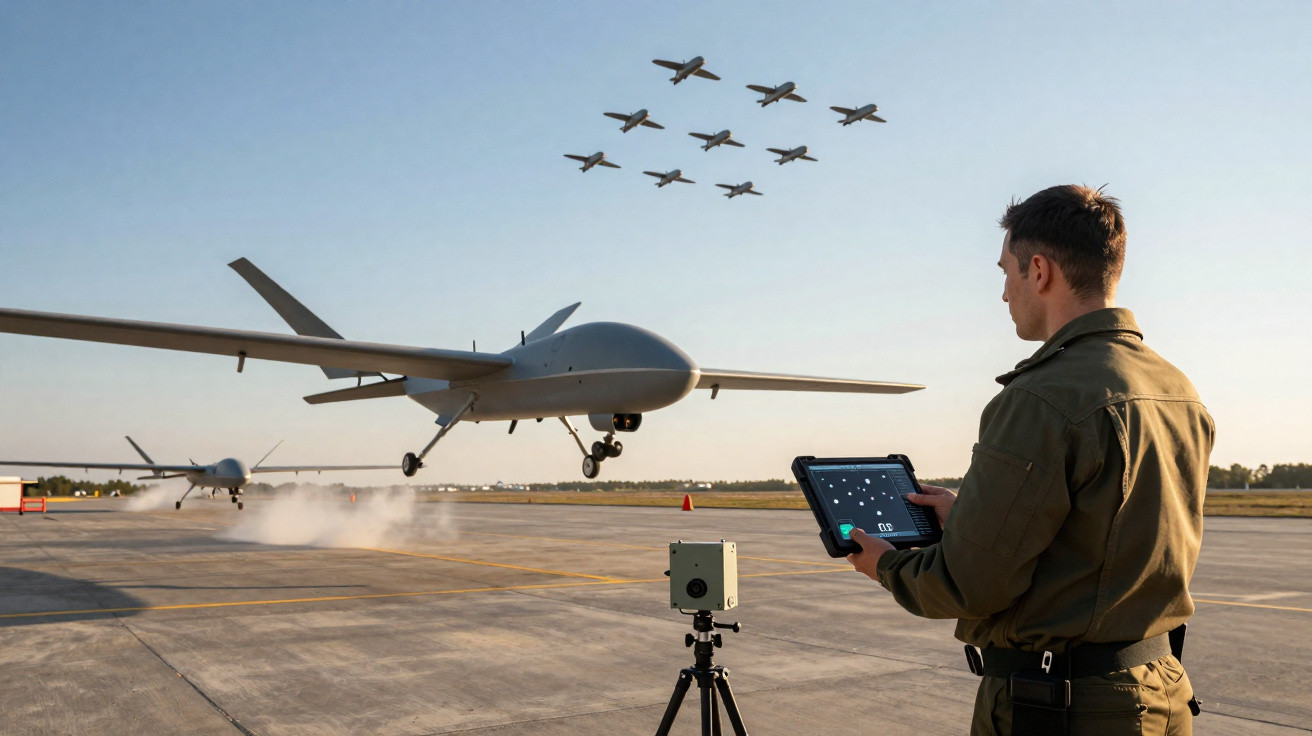
A few days ago, Baykar - Turkey’s leading drone manufacturer - introduced its new K2 loitering munition assisted by artificial intelligence. The unmanned system has been trialled in Turkey in a series of tests focused on autonomy, formation flying and swarm operations. Baykar refers to the development as the K2 kamikaze unmanned aerial vehicle, and positions it within a wider push to field lower-cost defence solutions designed for serial production.
Flight trials for the Baykar K2 AI-assisted loitering munition
According to information released by the company, the platform carried out flight testing yesterday and today with five K2 aircraft. The sorties were flown after take-off from the Keşan Flight Training and Test Centre, with the aim of demonstrating the performance of its advanced AI algorithms, autonomous functions and multi-aircraft coordination.
Over Saros Gulf, the five systems conducted formation flights across multiple runs in “right echelon”, “line” and “V” configurations. Baykar said the aircraft relied on sensors, software and artificial intelligence to establish their position relative to other members of the swarm, hold their assigned station and complete the planned tasks in each scenario without errors.
The manufacturer added that the K2 can also operate in other arrangements, including the “Turan” and “wall” formations, under an AI-assisted swarm-synergy concept. Within that framework, Baykar noted that its research and development roadmap includes a next phase aimed at variants able to return to base after releasing their munition on the target, allowing the platform to be reused.
The overall objective is to deploy high-impact systems that can be produced at low cost and in large quantities, thereby reducing reliance on more expensive munitions. Under this approach, the company aims to offer an option for striking an adversary’s critical targets with a more favourable cost-effectiveness ratio in demanding, high-intensity combat scenarios.
Navigation and attack in GNSS-denied electronic warfare environments
Another feature highlighted by the manufacturer is the K2’s navigation architecture for operating in electronic warfare conditions where there is no Global Navigation Satellite System (GNSS) signal, or where it is heavily jammed. To address this, the platform can estimate its position by visually scanning the terrain using its gimbal camera and an underside camera system with night-vision capability. This would enable it to continue navigating and autonomously proceed towards the target even in a complete GNSS outage.
In terms of identification and engagement, the system integrates a gimbal-mounted electro-optical/infrared (EO/IR) camera, providing reconnaissance and surveillance capabilities as well as visual target fixation. Baykar stated that the K2 also offers coordinate-based precision strike capability, alongside line-of-sight (LOS) and beyond-line-of-sight (BLOS) satellite data links, broadening its operational flexibility.
Size, performance figures and recent Baykar developments
Baykar described the K2 as the largest kamikaze platform in its class, and said it can take off and land on short runways, improving logistical flexibility in the field. Based on the specifications published, the system has a maximum take-off weight of 800 kilograms, can carry a 200-kilogram warhead, exceeds 2,000 kilometres of range, flies at more than 200 kilometres per hour, and has endurance of over 13 hours - figures with which Baykar is seeking to position it for long-range strategic missions.
The K2’s unveiling follows other recent Baykar progress in unmanned systems. After signing a Memorandum of Understanding (MoU) with Italy’s Leonardo on 6 March 2025, the two companies moved forward with the creation of a joint venture to produce Turkish combat drones in Italy for the European market. In addition, from Keşan came confirmation of the first flight of a new AI-assisted version of the Bayraktar TB2 combat drone, carried out in February last year, also fitted with a turbo engine to improve performance and capabilities.




Comments
No comments yet. Be the first to comment!
Leave a Comment