
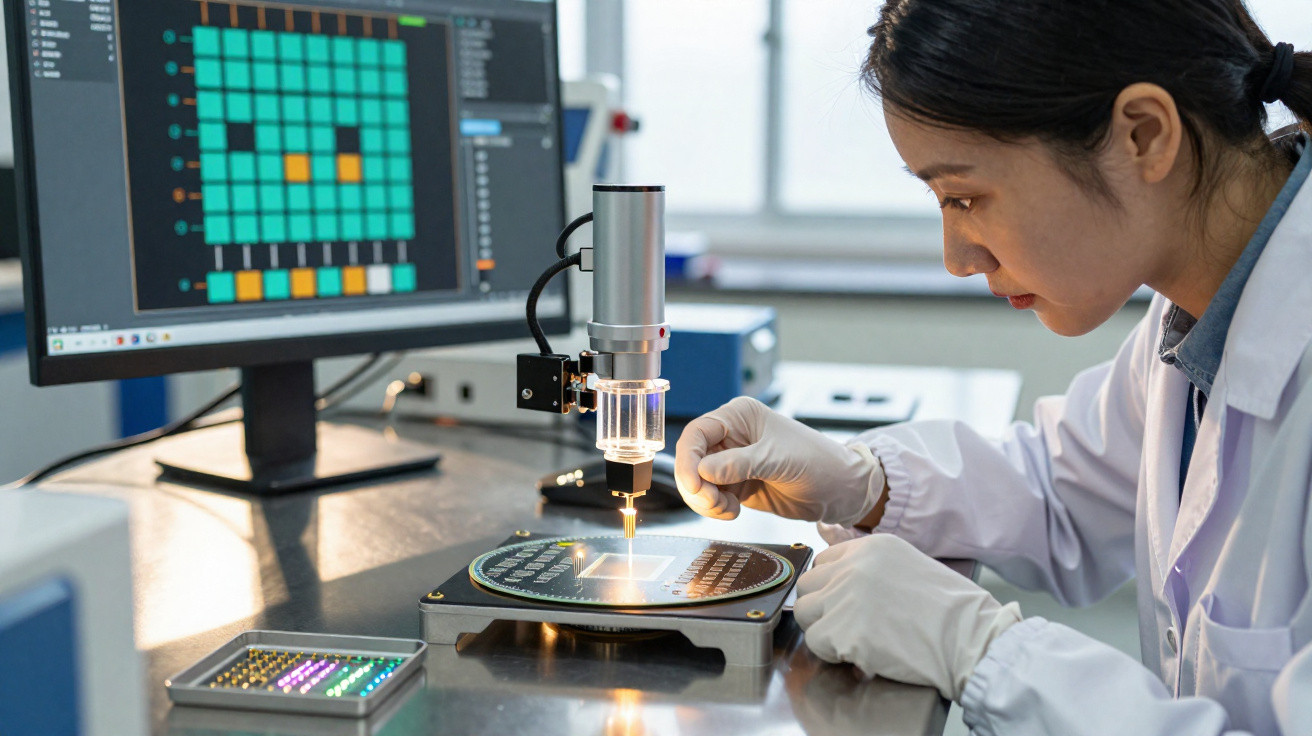
C12 has just reached a discreet but pivotal milestone. The Paris-based start-up can now assemble its quantum chips 12 times faster than it could a year ago, effectively validating a one-of-a-kind patented technology.
Picture placing a single hair onto an area the size of Paris, give or take a few streets. At the nanoscale, that is the sort of positioning challenge C12 faces each time it builds one of its quantum processors. In June, the company unveiled Pick & Place, a patented nano-assembly method designed and developed entirely in-house, which is reshaping how it manufactures its chips.
Carbon nanotube qubits: C12’s technical bet
While many quantum players focus on superconducting qubits or trapped atoms, C12 chose a different path from the outset in 2020: making its qubits from carbon nanotubes-molecular cylinders around 100,000 times thinner than a human hair. This approach, originating from laboratories at the École normale supérieure, is unique worldwide and, in theory, delivers more stable qubits and therefore fewer computation errors.
Pick & Place: a patented nano-assembly breakthrough
Scaling up the manufacture of these chips, however, had been a major challenge. Pick & Place provides a practical answer: it transfers individual carbon nanotubes onto silicon chips with micrometre precision, either under vacuum or in an inert atmosphere. Crucially, it adds a pre-selection stage, with each nanotube electrically qualified before integration. C12 says it is currently the only company in the world able to carry out this operation at qubit scale.
The early results are particularly encouraging. In four weeks, C12 assembled 50 devices-something that previously would have taken it the whole of 2025 to produce.
Subscribe to Presse-citron
A major industrial leap
Until now, nanotube growth and chip fabrication were tightly coupled, limiting flexibility. By separating the two steps, C12 gains modularity and can now pick the best nanotubes before they are integrated, rather than selecting them afterwards.
The so-called High Density chip demonstrates this progress. It packs 17 quantum devices onto a single chip-a record for C12-and shows that assembling multiple nanotubes with both precision and repeatability can now be done in series. The process is also partly automated, pointing towards a gradual ramp-up in throughput.
Even if C12 is not yet producing quantum processors at mass scale, neither is anyone else; the company is laying the industrial groundwork to make that possible.
A clearly defined roadmap
This step forward fits within a technology roadmap spanning four processor generations. The end goal is to exceed 100,000 physical qubits, directly deployable in a data centre. It is an ambitious target whose credibility depends on a non-negotiable requirement: being able to manufacture these chips reliably and reproducibly. Pick & Place moves the company in that direction.
Founded in 2020, C12 now employs more than 60 people and has raised over €25 million. It recently recruited Julien Sarry, formerly of Apple, specifically to accelerate its industrialisation.





Comments
No comments yet. Be the first to comment!
Leave a Comment