
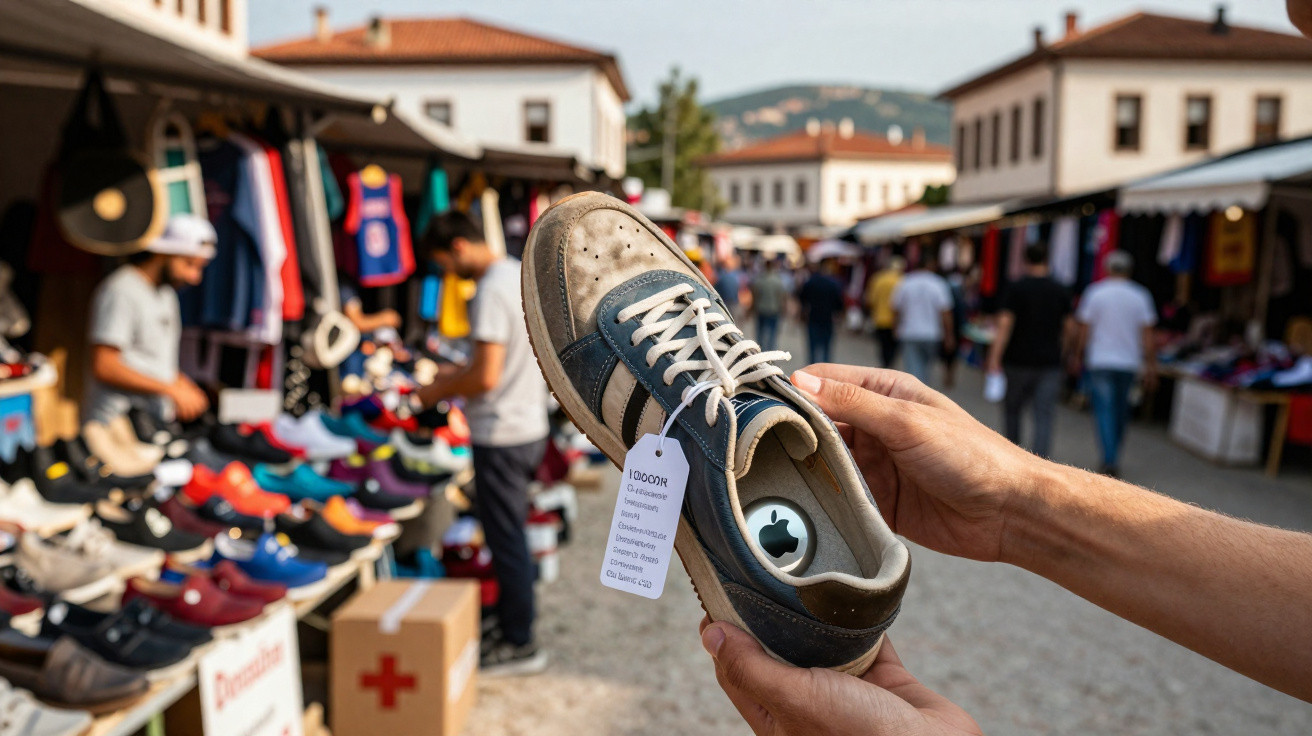
A German influencer wanted to find out what really happens to his clothing donations. So he hid an Apple AirTag inside a pair of trainers and dropped them into a German Red Cross collection container. What followed did not only surprise him; it also sparked a fierce debate about transparency and trust in charities.
The test with the hidden tracker
Standing by a Red Cross clothing container in Starnberg, near Munich, the German influencer Moe asked a straightforward question: where do these items actually end up? Are they passed on locally - or do they disappear abroad?
To get an answer, he slipped an Apple AirTag into a pair of trainers and posted them through the container flap. Using Apple’s “Find My” app, he was able to track every movement in real time, with pinpoint accuracy on the map.
What began as an ordinary clothing donation turned into an involuntary stress test of the Red Cross’s donation practices.
What looked like a local process quickly became a trip across Europe. The shoes travelled more than 800 kilometres before surfacing somewhere nobody expected.
Through five countries to a market in Bosnia
At first, the AirTag showed activity around Munich. Then the trainers left Germany. According to the tracking data, the route ran through several countries:
- Start in Starnberg near Munich (Germany)
- Onwards to Austria
- Through Slovenia
- Transit via Croatia
- Arrival in Bosnia and Herzegovina
The journey took several weeks. The AirTag’s location updated repeatedly - sometimes in car parks, sometimes in warehouses, sometimes near border areas - a pattern typical of goods moving through the international second-hand trade.
When the signal finally stayed in one place in Bosnia, Moe travelled there himself. He went to the location shown by the tracker: a market with stalls piled high with used clothing.
The donated trainers sold as goods on the bazaar
At the market, he eventually found his trainers - with a price tag. The pair was listed at around €10. Any warm sense of having donated them was gone; they looked like a standard retail item.
Moe bought the shoes back and spoke to the seller. The seller said the stock came from Germany and was purchased in bulk. He claimed he knew nothing about donations, charities or the Red Cross. To him, it was simply imported second-hand clothing.
The shoes intended for people in need were sitting on a market stall as commercial goods - legally permitted, but morally questionable for many donors.
Moe recorded the entire story in videos and posts and shared it on social media. The reaction was swift - and put the German Red Cross under significant pressure.
The Red Cross faces difficult questions
After the tracking story went public, the German Red Cross issued a detailed statement. The key point: it confirmed that a portion of donated clothing is sold - partly in Germany and partly abroad.
According to the Red Cross, donated clothing can take different routes depending on condition, season and local demand. It set out the main pathways openly:
- Direct distribution to people in acute need, for example after house fires or sudden financial hardship
- Sale through its own second-hand shops to fund aid projects
- Export to countries where demand for used clothing is high
- Transfer to textile recyclers when items are no longer wearable
The Red Cross stressed that revenue from selling donated clothing goes directly into its support work: disaster response, care for older people, support for refugees, youth services and much more. It also stated that this approach is common practice within the aid sector and is lawful.
Many donors took a different view. In the comments under Moe’s video, numerous users sounded unsettled and some were angry. Many had assumed their clothing would be passed on “one-to-one” to people in need locally - not to traders at a market in the Balkans.
Donor expectations collide with real-world logistics
The backlash highlighted how wide the gap has become between what donors imagine and how the system actually operates. When someone drops a bag of clothes into a container, they often picture a simple chain: donation in, person in need receives it.
In reality, it’s a complex logistics and economic system that many donors never see - until an AirTag pulls back the curtain.
In practice, large charities work with collection partners, sorting centres and commercial textile firms. There are several reasons for this:
- Donations often arrive unsorted and in vast quantities.
- Some items are torn, dirty or completely unusable.
- Local needs do not always match what is donated (for example, winter coats in summer).
- Transport, storage, staffing and distribution are expensive.
By selling a portion of the stock, organisations can generate funds for aid work - including in places where clothing itself is not currently required. From a financial standpoint, that can make sense; from a communications standpoint, it is a delicate balancing act.
Trust, transparency and the role of technology
Moe’s experiment fits a growing pattern: donors using technology to trace where their contributions end up. Mini trackers such as AirTags (or similar devices) are inexpensive, yet they can provide accurate location data across national borders.
That creates a new kind of pressure for charities. Processes that once happened out of sight suddenly become visible. Donors look more closely and want clear answers to questions such as:
- What percentage of clothing goes directly to people in need?
- How much is sold - and who profits along the way?
- How large are the revenues, and exactly what does the money fund?
- Which partner companies are involved?
Some associations and initiatives are now calling for binding transparency standards for clothing collectors. Proposals include clear, easy-to-understand information on containers - for example short explanations or QR codes linking to detailed breakdowns of how donations are processed.
What donors can do in practice
Anyone who wants more certainty about how their donation will be used has several options. A few approaches often discussed include:
- Hand clothing directly to local food banks, social supermarkets or women’s refuges, and ask specifically how distribution is handled.
- Look for organisations that publish their processing routes transparently on their websites.
- For higher-value items, consider selling them via local online listings or car boot sales, then donating the proceeds directly.
- Focus on quality: clean, intact clothing is more likely to be worn, rather than diverted into recycling.
Charities, for their part, can rebuild trust by communicating more clearly. Some already publish impact reports showing the shares of direct aid, sales and recycling. The fewer surprises donors experience, the steadier the relationship becomes.
Why the topic hits such an emotional nerve
Clothing donations are closely tied to morality and conscience. Many people associate them with the feeling of “doing something good” with minimal effort. When that image is shaken, people can feel taken advantage of - even if the practice is legally compliant and economically understandable.
There is also a broader concern: second-hand imports can put pressure on local textile businesses and markets in recipient countries. If large volumes of used clothing arrive from wealthier nations, prices and margins for local traders can fall. Experts have argued for years about how strong this effect really is and under what conditions it occurs.
The case of the donated trainers shows how tightly intertwined the aid sector, global trade and donor emotions have become. A small AirTag was enough to expose structures that most people rarely notice.
For donors, that creates an opportunity to make more deliberate choices: which organisation aligns with my values? Where am I comfortable with donated goods being sold, and where am I not? And when might a cash donation make more sense than an overfilled bag of clothes?
Aid organisations face the task of engaging with these questions head-on. Those that explain openly how donations are processed, why items are sold and which projects are funded in concrete terms can create a basis for trust - even if a donated pair of trainers ultimately ends up on a market in Bosnia.





Comments
No comments yet. Be the first to comment!
Leave a Comment