
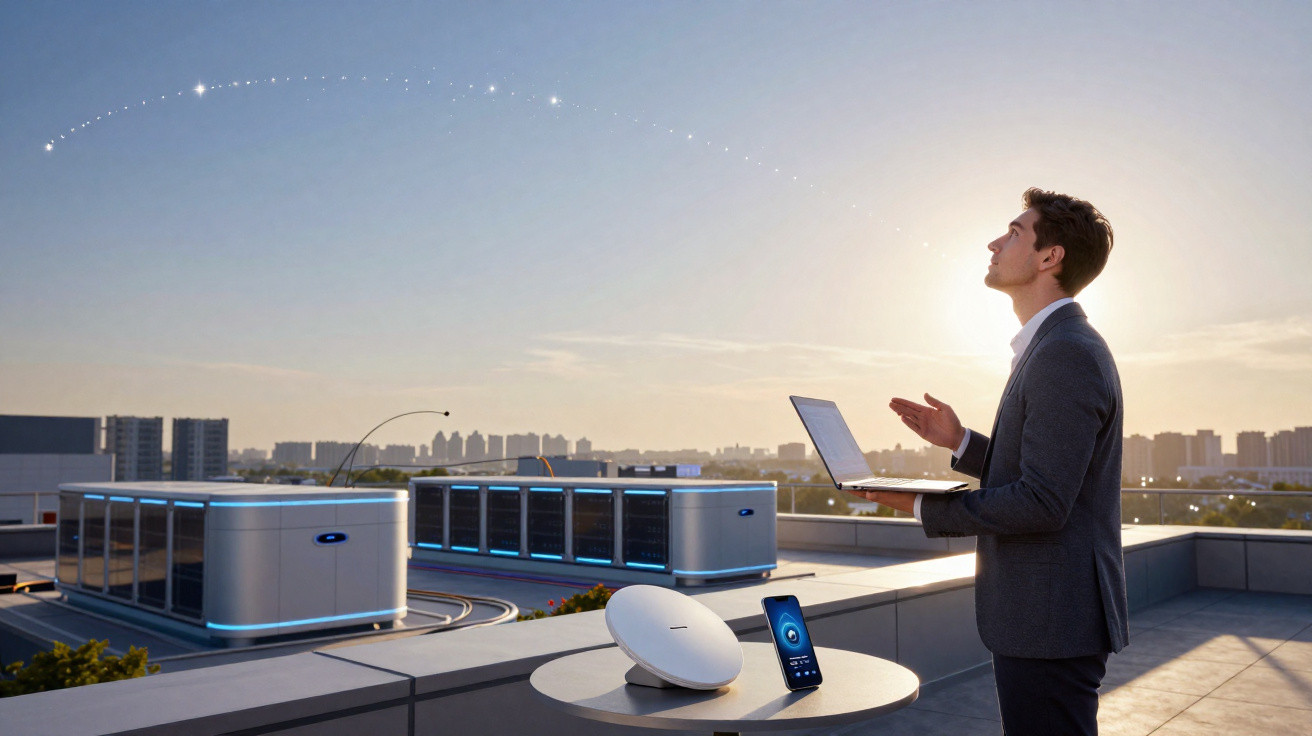
Starlink is gearing up for a vast new satellite network-around 10 times larger-which could connect more people while cutting latency and increasing throughput.
Starlink Gen 3: SpaceX applies to the FCC for 100,000 satellites
With more than 10,000 active satellites already in orbit, Starlink is currently the dominant player in satellite internet. Demand for its service-particularly for getting online in underserved and hard-to-reach areas-continues to rise.
To meet that appetite, SpaceX is planning a new Starlink constellation that would be 10 times bigger. This is not merely a statement of intent: as reported by PC Mag, the Elon Musk-led company has started the administrative process for Starlink’s “Gen 3” system. SpaceX has submitted a request to the United States authorities-the FCC, which oversees telecommunications-to deploy this next-generation constellation comprising 100,000 satellites.
Lower orbit, reduced latency and “several gigabits” of throughput
The proposed constellation would not only expand in scale; it also promises meaningful upgrades for users. Starlink’s new system would operate in a lower orbit, which should reduce latency.
In addition, SpaceX says it wants to offer speeds of “several gigabits” to more people around the world. Put simply, the company is aiming for a clear step up from what Starlink currently delivers.
Why SpaceX links the upgrade to artificial intelligence usage
Beyond keeping pace with demand, SpaceX indicates the improvements are also intended to prepare for emerging uses tied to artificial intelligence. “AI requires considerable uplink capacity to support the high-definition spatial and audio data essential for real-time decision-making and industrial automation,” SpaceX explains in its application, according to PC Mag. “Without that, the United States cannot be competitive in the AI revolution.”
SpaceX is also preparing a constellation of data centres
In any case, the number of active SpaceX satellites could become extremely high in the coming years. The company also wants to make its mark in artificial intelligence by launching data centres in space, with the aim of reducing the energy cost of compute.
To underline that ambition, the firm has recently renamed its artificial intelligence laboratory, now called “SpaceXAI”.
SpaceX has not yet tested this technology. Even so, if it proves itself, Elon Musk has not ruled out deploying up to one million satellites in space to handle artificial intelligence computing.






Comments
No comments yet. Be the first to comment!
Leave a Comment