
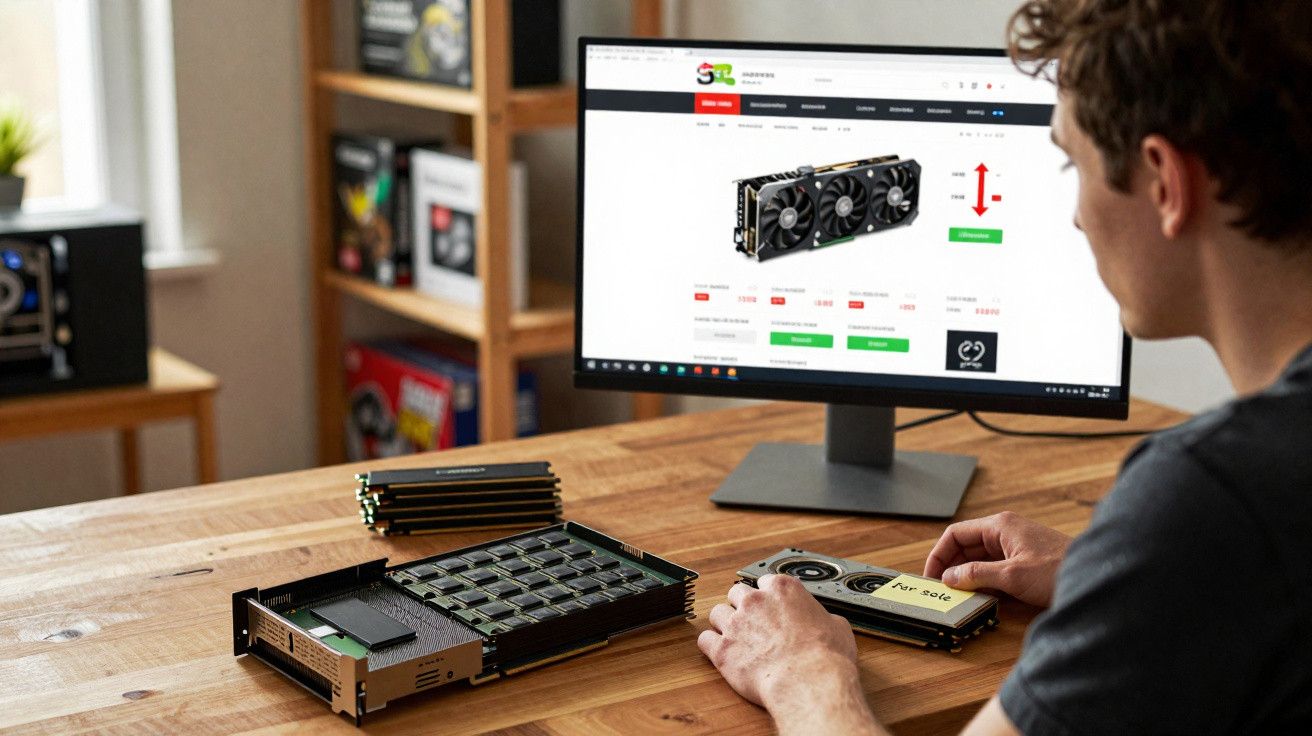
PC gamers briefly thought they were in the clear, but that calm is ending: manufacturers are warning of a fresh upswing in graphics card prices.
For months, graphics cards stayed surprisingly steady while laptops, RAM and other components climbed sharply. Now that stability is cracking. NVIDIA has formally briefed its partners that graphics memory is getting more expensive - pushing the whole market into the next round of price rises.
What NVIDIA has announced internally
This chain reaction stems from an internal message that was leaked to the industry outlet Benchlife. It focuses on expiring supply agreements for memory chips - specifically GDDR6 and GDDR7 - used on current and upcoming gaming GPUs.
NVIDIA is keeping the official price of its GPU chips stable, but is factoring in significantly higher purchasing costs for the accompanying graphics memory configurations.
That may sound like a minor technical detail, but it lands straight on retail pricing. Memory is now one of the costliest single line items on a modern graphics card. The more gigabytes of VRAM a model carries, the more the new calculations bite.
What makes it particularly sensitive: for some time, there has been an internal idea that GPUs could increasingly be shipped as “naked” chips. In that scenario, ASUS, MSI, Gigabyte and others would need to source the memory entirely themselves - at market rates, without preferential terms. That shifts even more risk onto the board partners.
Why costs are exploding right now
The root cause sits in the memory market. DRAM and GDDR manufacturers have adjusted production and investment over recent years to match demand. At the same time, areas such as AI, data centres and high-end gaming are pushing for ever more - and ever faster - memory.
- Production costs for modern memory chips are rising significantly.
- Contracts under older, cheaper terms expire in early 2026.
- Manufacturers are tuning capacity towards higher-margin segments such as servers.
The result is already visible elsewhere: laptops with lots of RAM now cost up to 20 percent more, and standard RAM kits are clearly pricier than a year ago. Graphics cards had lagged behind because vendors were gradually running down stock built with “old” memory. That buffer is now running out.
Manufacturers turn the price screw
Taiwan’s Commercial Times reports that board partners have virtually no room left to absorb the increase. MSI already moved in December on new RTX-50 models, and the report says Gigabyte and ASUS are preparing similar changes.
Once the old inventory is sold, manufacturers will price against the new, more expensive memory baseline - and that shows up immediately on shop price tags.
In Europe, the direction is already clear: cards with 16 gigabytes of VRAM and more are climbing the fastest. Many retailers are showing mark-ups between 15 and 20 percent. This isn’t limited to NVIDIA models either - AMD’s Radeon line-up is also sliding into the new price band.
For the Radeon RX 9000 series, retailers are reporting price jumps of 10 to 18 percent, depending on the model and memory configuration. That makes an affordable route into the upper tier increasingly hard to find.
Greens cut memory, reds bet on full performance
The situation is forcing clear strategic trade-offs. The more memory a card includes, the higher the bill of materials - and the quicker products land in price territory many gamers won’t follow.
NVIDIA partners: less VRAM, lower entry prices
On the NVIDIA side, partners are reacting mainly by leaning harder into 8-gigabyte models. Particularly in the mid-range - around lines such as the RTX 5060 and RTX 5060 Ti 8 GB - that memory size is moving to centre stage.
- 8 GB cards remain within reach on price for many players.
- Lower memory requirements reduce the risk of being stuck with expensive stock.
- Marketing shifts back towards “enough for 1080p” rather than “maxed out in 4K”.
That approach can work for occasional players who mostly game at 1080p. But anyone aiming for high texture settings, ray tracing, and 1440p or 4K will increasingly hit limits with 8 GB - including stutter, streaming delays and cuts to detail.
AMD: more VRAM as a selling point - with risk
AMD is taking a different path. The “reds” are still pushing cards with 16 gigabytes of VRAM, especially XT variants in the higher-performance tier. On paper, the pitch is compelling: more memory, better long-term headroom, and stronger results in memory-hungry titles.
The downside is that these are exactly the models hit hardest in percentage terms by rising memory prices. A card with double the memory doesn’t just cost a little more to build - it costs noticeably more, and that ultimately lands with the buyer.
How hard this really hits PC gamers
Many readers are asking: does this mean every graphics card will become 20 percent more expensive? It’s unlikely to be that severe across every segment. The sharpest increases should concentrate on newly launched or newly produced models with lots of VRAM.
| Segment | Typical VRAM size | Current trend |
|---|---|---|
| Entry-level | 6–8 GB | small to moderate mark-up |
| Mid-range | 8–12 GB | clearly noticeable increase, especially on refreshes |
| Upper-tier / high-end | 16–24 GB | in some cases 15–20% more, depending on model |
If you already have a solid card, there’s no need to panic. Plenty of current GPUs are still well suited to 1080p and 1440p gaming for the next few years. It becomes painful where people have been saving for a specific upgrade and then discover the target card has jumped into a much higher price bracket.
When buying still makes sense - and what you should watch for
The interesting question is the “right” time to buy. Classic advice like “wait for the next generation” only partly applies here, because newer series are being priced with the higher memory costs baked in from day one.
A few straightforward guidelines help:
- Current deals on high-VRAM cards from “old” production can be worthwhile while retailers clear remaining stock.
- If you mainly play at 1080p, choosing 8 GB models deliberately can save money.
- For 1440p and 4K, more VRAM remains crucial - cutting back here can later cost you in reduced detail or lower frame rates.
- Watch pricing: during softer demand, retailers discount even when their wholesale costs have risen.
One more factor that often gets missed: some game engines use memory far more efficiently than others. Competitive shooters typically cope with less VRAM, whereas newer open-world titles or big single-player AAA releases can quickly fill double-digit gigabyte totals. If you mostly play eSports titles, you can more safely economise on memory.
Why VRAM now matters so much for long-term viability
VRAM (video RAM) is the memory located directly on the graphics card, where textures, geometry data and intermediate results are stored. Unlike system RAM, it cannot be upgraded later. The capacity is fixed to the card.
The higher the resolution, texture quality and ray tracing load, the more VRAM you need. When VRAM is full, the GPU has to fall back on much slower routes such as system RAM or even the SSD. That leads to micro-stutter, frame-rate drops and messy streaming pop-in.
Against that backdrop, rising memory prices hurt twice: they don’t only make certain models more expensive, they also push more gamers towards tighter VRAM configurations - and therefore towards systems that reach their limits sooner.
If you’re planning a new graphics card over the next one to two years, it’s worth focusing less on raw teraflop figures or marketing labels and paying very close attention to the memory configuration. In a period where every extra gigabyte costs noticeably more, that single detail can decide whether a card stays enjoyable for three years - or becomes frustrating much sooner.



Comments
No comments yet. Be the first to comment!
Leave a Comment