
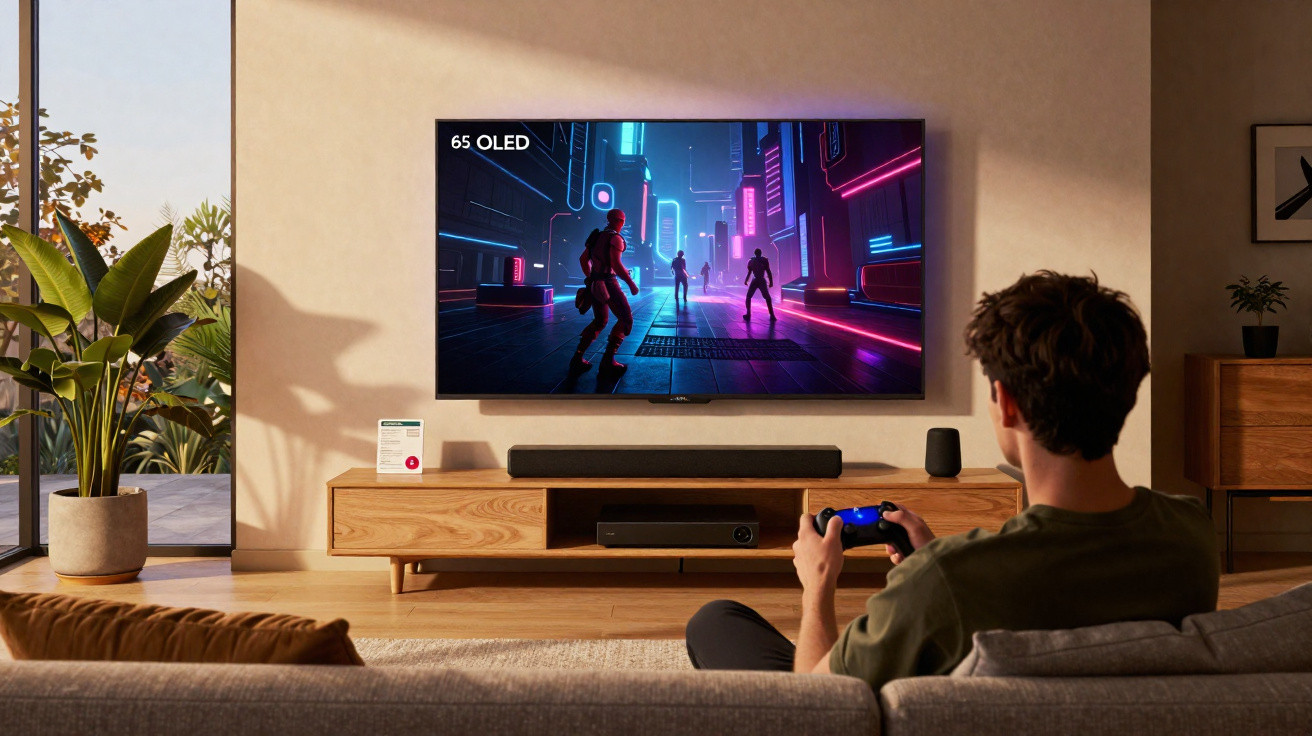
A high-end television that normally sits firmly in the luxury bracket has suddenly slipped into a price range that many tech fans find hard to ignore.
LG’s 65-inch OLED with current Evo technology, a high refresh rate and four HDMI 2.1 ports is currently changing hands for well below its usual asking price. For film lovers and gamers who have been eyeing up a big OLED for a while, this could be the moment to make the move.
What’s behind the LG OLED Evo 65-inch deal
The LG OLED Evo OLED65G5 is one of the manufacturer’s premium sets. Under normal circumstances, it lives in a price band that makes most people pause. According to the retailer, the launch price was around 2.499 euros. A substantial discount campaign has now pushed the figure down significantly.
LG’s 65-inch OLED drops to around 1.529 euros in the sale, suddenly making it realistic for many households.
On top of that, the retailer is offering credit in the form of a shopping voucher, plus extra bonuses once you pass certain basket totals. If you were already considering upgrading a home cinema or gaming setup, bundling multiple purchases can amplify the value of the promotion.
What makes this particularly appealing is that it’s not a stripped-back mid-range model: it’s a large, bright OLED Evo panel designed to properly take advantage of 4K content and modern games consoles.
Technical specifications: what the LG OLED65G5 actually offers
To work out whether this model fits your needs, it helps to check the key specifications.
- Screen size: 65 inches / 164 cm
- Panel technology: OLED Evo with “Perfect Black” certification
- Resolution: 4K Ultra HD (3.840 x 2.160 pixels)
- Refresh rate: 120 Hz native, up to 165 Hz with VRR optimisation
- Connections: 4x HDMI 2.1, 3x USB 2.0, network, optical audio output
- Smart TV platform: webOS 25
- Audio formats: Dolby Atmos, Dolby Digital
- Wireless: Wi‑Fi via Wi‑Fi 6, Bluetooth 5.3, AirPlay 2
- Installation: stand included, VESA 300 x 300 for wall mounting
- Longevity: spare parts available for 8 years, according to the manufacturer
All of that places the television squarely in the upper tier: current connectivity, up-to-date software, and a panel that has already scored very highly in independent lab testing.
Picture quality: why OLED Evo attracts so much praise
At the heart of the set is a self-emissive OLED Evo panel. Unlike traditional LCD televisions, it doesn’t rely on a backlight; instead, each individual pixel can be switched fully on or fully off.
The result: blacks look genuinely black rather than dark grey, and bright elements practically leap off the screen.
Because light is controlled with pixel-level precision, contrast is effectively near-infinite. In dark film sequences, sci‑fi series or horror movies, you can typically make out far more detail in shadow areas without bright parts of the image washing out.
The 4K resolution also means that even at a 65-inch screen size, individual pixels are hard to spot unless you sit extremely close. For UHD Blu‑rays, high-resolution streaming and current console games, sharpness is right where you want it.
The TV supports common HDR formats, which is essentially a requirement for modern content. HDR expands brightness and colour range, making things like sunsets, neon lighting or flames look markedly more lifelike. This is where OLED Evo tends to excel, because it doesn’t need to lift dark areas to keep bright highlights visible.
Energy consumption at 65 inches
A 65-inch television is not designed to be frugal, and the energy label reflects that. In SDR content, the set sits in a mid-level efficiency class; in HDR, the higher luminance pushes it further down. If you watch for several hours every day, it’s worth keeping in mind.
| Mode | Consumption per 1,000 hours |
|---|---|
| SDR | ca. 85 kWh |
| HDR | ca. 222 kWh |
For a premium OLED of this size, these figures are within the typical range. With a few tweaks-using an Eco picture mode, for example, or lowering peak brightness-you can reduce consumption noticeably.
Why this TV is so interesting for gamers
Plenty of deals primarily appeal to film fans, but with the OLED65G5, LG is very clearly targeting gamers as well. The first clue is the four HDMI 2.1 inputs. In practical terms, that means you can run a PlayStation 5, an Xbox Series X, a gaming PC and perhaps a streaming device or AV receiver at full bandwidth at the same time, without constantly swapping cables.
The key feature is the high refresh rate with variable refresh (VRR). The set runs at 120 Hz natively and can reach up to 165 Hz with VRR optimisation. Your console or PC can then adjust frame rate dynamically to match real performance, which makes screen tearing and stutter far less noticeable.
For fast shooters, racing games or competitive multiplayer titles, this mix of low latency, 120–165 Hz and OLED blacks is a genuinely strong argument.
There’s another advantage: in dark gameplay sections-think horror titles or stealth games-the deep black levels help reveal finer detail in the environment. That can look better, and in some situations it can also offer a gameplay edge, because enemies or objects stand out sooner.
Sound and a home-cinema feel
The television supports Dolby Atmos and Dolby Digital. Built-in speakers cannot fully replace true Atmos, but with sensible placement they can deliver a wider soundstage. If you already have a soundbar or an AV receiver, you can of course make use of those formats through your external audio setup.
In an average living room, a 65-inch screen can quickly feel cinema-like. 4K films, HDR series and streaming services benefit from the size, and if you choose the viewing distance well-roughly between 2.5 and 3.5 metres-you get a highly immersive experience.
webOS 25: smart TV features and voice control
LG is once again using webOS, with this model running version 25. The interface is widely considered straightforward, and the major streaming apps are typically available straight away, including big video platforms, catch-up services and music apps.
Alongside the standard remote, you also get voice control. The built-in Google Assistant can make it easier to search for content, switch channels or control compatible smart-home devices. If you prefer, you can simply say the channel name rather than digging through menus.
With Wi‑Fi 6 and Bluetooth 5.3, connectivity is also well covered. Streaming remains stable, and accessories such as controllers, headphones or keyboards can be paired wirelessly. AirPlay 2 makes it particularly convenient for Apple users to send content from an iPhone, iPad or Mac.
Who is this purchase genuinely worth it for?
Not everyone needs a 65-inch OLED. In smaller rooms it can feel oversized, and anyone who only occasionally watches linear TV is unlikely to exploit what the panel can do. In certain scenarios, however, the purchase makes a lot of sense.
- Home cinema fans: If you regularly stream films and series in 4K or watch UHD Blu‑rays, you benefit hugely from the contrast and HDR support.
- Gamers with current hardware: Owners of a PlayStation 5, Xbox Series X or a powerful gaming PC can get far more from their devices thanks to HDMI 2.1, VRR and 120–165 Hz.
- Large living rooms or open-plan kitchen-living spaces: The image spreads better across the room, and 65 inches doesn’t feel overwhelming.
- Long-term users: With a durability index of around 8,2/10 and confirmed spare-part availability over 8 years, this model is aimed at buyers who want to keep the TV for many years.
If you mainly watch HD cable channels or rarely play games, a cheaper LCD model may be sufficient. But if the high price has previously put you off a large OLED, the current discount creates an opportunity you don’t often see.
What to keep in mind with OLED in general
OLED televisions are rightly seen as a reference for picture quality, but they have their own characteristics. Prolonged static images-such as news tickers or persistent UI elements in games-can leave marks over time. Modern sets include protective measures like pixel shifting or automatic brightness adjustment, and in tests LG generally performs solidly in this area. Even so, it’s not something to dismiss entirely.
If you use the TV in a mixed way-films, series, games and standard TV channels-you significantly reduce the risk. Short breaks where you turn the screen off also help. For a typical household with varied use, it usually isn’t an everyday issue.
Practical tips for everyday use
To get the most from the LG OLED Evo, it’s worth adjusting a few settings. In the picture options you’ll usually find preset modes such as “Cinema”, “Game” or “Filmmaker Mode”. For films, Filmmaker Mode or Cinema mode is often the best choice, because colours appear more natural and the image isn’t artificially sharpened.
For gaming, the dedicated game mode is recommended. It reduces image processing and lowers input lag. Combined with VRR, gameplay feels much more immediate. If you own a console capable of 120 Hz output, make sure you actually enable 4K at 120 Hz in the system settings-otherwise you may unknowingly stay at 60 Hz.
For audio, it’s worth checking the sound settings too. Many people are surprised how much better even the internal speakers sound once you move away from the default “Standard” mode and select a cinema or music profile instead. With a suitable soundbar, the overall package finally moves into true mini home-cinema territory.



Comments
No comments yet. Be the first to comment!
Leave a Comment