
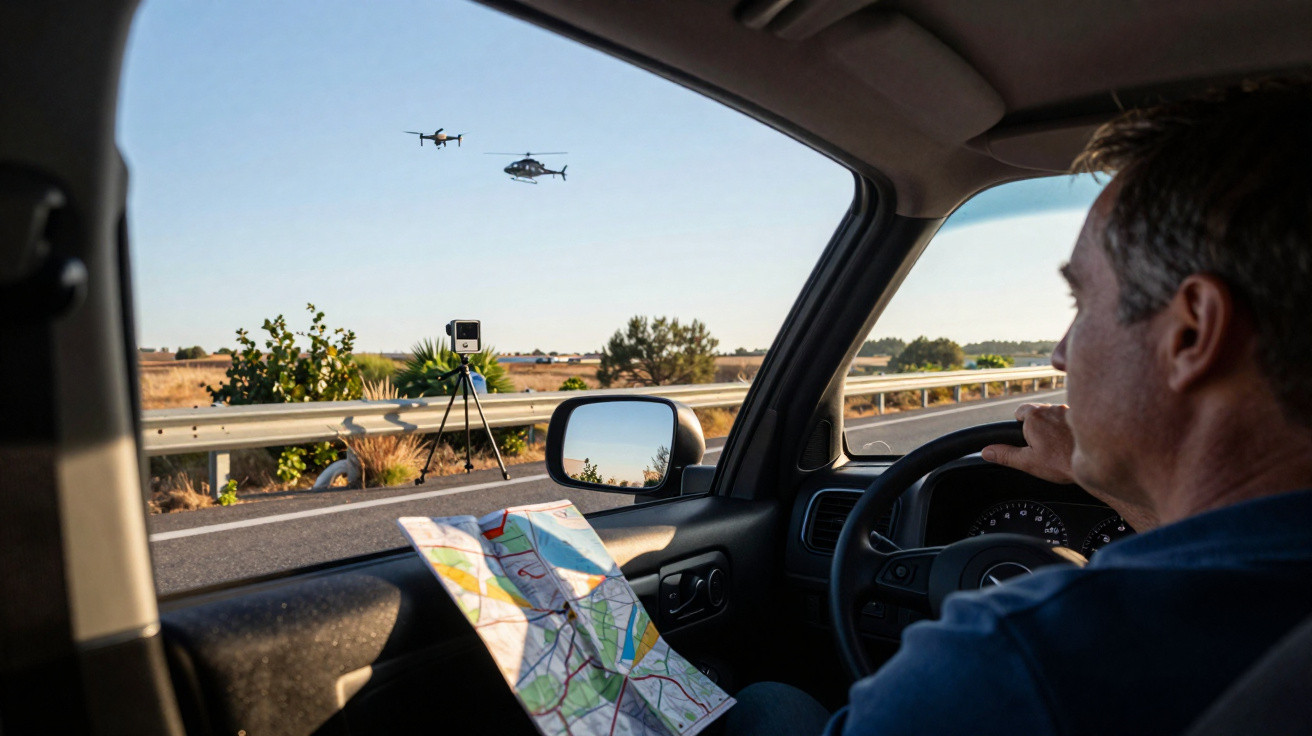
Holiday traffic in Spain is about to become far more nerve-racking for anyone who speeds - and not in the way you might expect.
With Easter weekend nearing and millions of drivers preparing to travel across Spanish roads, the country’s traffic authority is quietly introducing a new wave of covert enforcement. The familiar fixed speed camera boxes are increasingly being replaced - or supplemented - by devices that are smaller, mobile and extremely hard to notice, backed up by aircraft that can observe motorists from hundreds of metres in the air.
Velolaser: the tiny speed camera hiding in plain sight
Spain’s traffic authority, the Dirección General de Tráfico (DGT), has adopted a small radar unit known as the Velolaser. It is compact enough to be carried in a backpack and can be set up by an officer at the roadside in just minutes.
"The Velolaser is designed to be almost impossible to spot at 120–130 km/h, even for drivers on high alert."
Rather than the well-known grey roadside cabinets, these units are designed to disappear into their surroundings. Officers are able to:
- Conceal them just behind a crash barrier
- Attach them to the rear of a traffic sign
- Place them on a small tripod in long grass
- Fit them to the side of an unmarked police vehicle
This versatility allows the police to relocate cameras repeatedly, covering multiple road sections within a single shift. The intention is simple: to prevent drivers from depending on crowdsourced navigation apps that flag static speed checks.
Laser beams and long-range precision
The Velolaser feels particularly unforgiving for fast drivers because of how far it can work from. Using laser beams, it can measure speed at more than a kilometre away. In practice, by the time a driver notices anything unusual, their speed has typically already been logged.
"At over one kilometre, the device has already recorded multiple speed measurements per second and captured a high-definition image of the number plate."
Officers often choose long, straight stretches of motorway or major roads where motorists tend to accelerate with confidence, assuming any hazard will be visible well in advance. On these sections, the Velolaser can discreetly monitor vehicles and assemble an accurate speed record long before the car reaches the device.
Because it is portable, teams can reposition it several times in a day. A unit placed near a toll booth in the morning could be redeployed later on a rural dual carriageway used by holiday traffic heading for the coast.
Speed enforcement now comes from the sky
Motorists who believe they can simply scan the verges for cameras and then accelerate harder face a different threat: surveillance from above. Spain now pairs ground-based kit with a network of helicopters and drones to track driver behaviour from the air.
Helicopters watching from 700 metres up
Spain’s fleet of around 15 DGT helicopters carries high-powered cameras and image-processing systems. They typically fly at roughly 700 metres altitude - well above the height at which most drivers would consciously register them.
"From that height, the cameras can track vehicles between roughly 80 and 350 km/h while keeping a clear view over about one kilometre of road."
These helicopters patrol high-traffic routes, especially during peak travel windows such as Easter, summer getaways and long weekends. They can shadow a speeding vehicle over several kilometres and relay details to officers on the ground. In certain situations, they can also supply the visual evidence required for penalties without an immediate roadside stop.
Drones: low, quiet and increasingly punitive
Alongside the helicopters is a fleet of roughly 40 traffic drones. Operated remotely from the ground, they usually fly at around 100 metres. At that height the noise is limited, and in heavy traffic many drivers never notice them at all.
A typical drone offers about one hour of flight autonomy and can monitor speeds up to approximately 80 km/h. That makes them well suited to secondary roads, resort approach routes and ring roads around major cities.
"About half of these drones are now formally authorised to trigger fines directly from the air, with no roadside checkpoint needed."
In other words, a driver can be penalised without seeing a police officer, a barrier or a flashing camera. The notice arrives later, based on recorded imagery and speed calculations saved during the drone’s flight.
Why Spain is tightening its grip on speeding
Spain has long attracted foreign drivers - from French and Portuguese holidaymakers to British tourists who rent a car or drive their own. The DGT has tied part of its road-safety approach to these large, seasonal travel surges.
At Easter, the motorway network often turns into an almost continuous convoy. With congestion, frequent lane changes and impatient overtaking, the likelihood of collisions rises. Speeding is treated as a factor that worsens outcomes, turning small errors into serious crashes.
Authorities argue that highly visible fixed cameras can lose their impact when drivers brake for a few hundred metres and then speed up again. By making enforcement mobile and harder to predict, they aim to reduce average speeds over an entire journey.
| Tool | Typical location | Main target |
|---|---|---|
| Velolaser | Roadside, crash barriers, unmarked cars | Excess speed on main roads and motorways |
| Helicopters | Busy intercity routes, long-distance corridors | High-speed offences and risky manoeuvres |
| Drones | Urban fringes, secondary roads, resort access | Moderate speeding, lane discipline, distractions |
What this means for foreign drivers in Spain
For UK or US nationals driving in Spain, this shift changes the risk calculation. Using navigation apps to identify fixed cameras offers much less reassurance than it once did. A driver may check for known camera points, see nothing, and still be monitored by a Velolaser around the next bend - or by a helicopter overhead.
Many European countries, Spain included, take part in cross-border enforcement arrangements. As a result, a speeding fine recorded by these systems can follow a foreign-registered vehicle home. Hire-car firms also commonly pass on driver details and may add administration charges on top of the penalty.
For visitors, the safest and least expensive approach is straightforward: keep close to posted limits, particularly on long, quiet motorway stretches where speed can creep up without being noticed.
Key terms and real-world scenarios
Understanding the tech: radar vs laser
Conventional speed cameras often use radar, sending radio waves to calculate how quickly a vehicle is approaching. The Velolaser, however, relies on laser beams, which allow more precise targeting over greater distances. It can pick out a single car or motorbike in dense traffic and measure its speed even when surrounded by other vehicles.
That accuracy helps officers uphold penalties if a driver disputes the result. Because the system can log multiple readings per second, it can show consistent excess speed rather than a lone snapshot captured at a borderline moment.
A typical holiday motorway scenario
Imagine a family setting off from Madrid to the coast. It is early, traffic is lighter than anticipated, and the motorway is straight and clear. The driver sees no fixed cameras on the sat-nav and increases speed from 120 km/h to 140 km/h for “just a few minutes”.
A Velolaser is positioned behind a safety barrier one kilometre ahead. Well before the vehicle draws alongside it, the laser has already locked on and recorded a sequence of speeds. The driver spots the small unit at the last moment and brakes sharply. By then, the evidence file is already complete.
A helicopter working the same corridor could later verify continued fast driving and provide added visual context: tailgating, close overtakes or abrupt lane changes. Together, these tools give the DGT a layered view of behaviour, rather than isolated flashes.
Risks, side effects and how to adapt
The most obvious risk for drivers is financial: fines, points on a licence (where applicable), and administration fees from hire-car companies. There is also a practical danger: braking sharply at the last second when a hidden device finally becomes visible - something that can itself trigger incidents if vehicles behind are too close.
A helpful adjustment is psychological rather than technical. Instead of trying to play cat-and-mouse with enforcement, drivers can set cruise control a few kilometres per hour below the limit, particularly on unfamiliar routes. It also helps to check local limits when travelling between regions within Spain, as rules can differ between motorways, dual carriageways and conventional roads.
For anyone still tempted to “make up time” during holiday drives, Spain’s updated approach carries a simple warning: you may not see the camera, the drone or the helicopter - but they may see you long before you can respond.






Comments
No comments yet. Be the first to comment!
Leave a Comment