
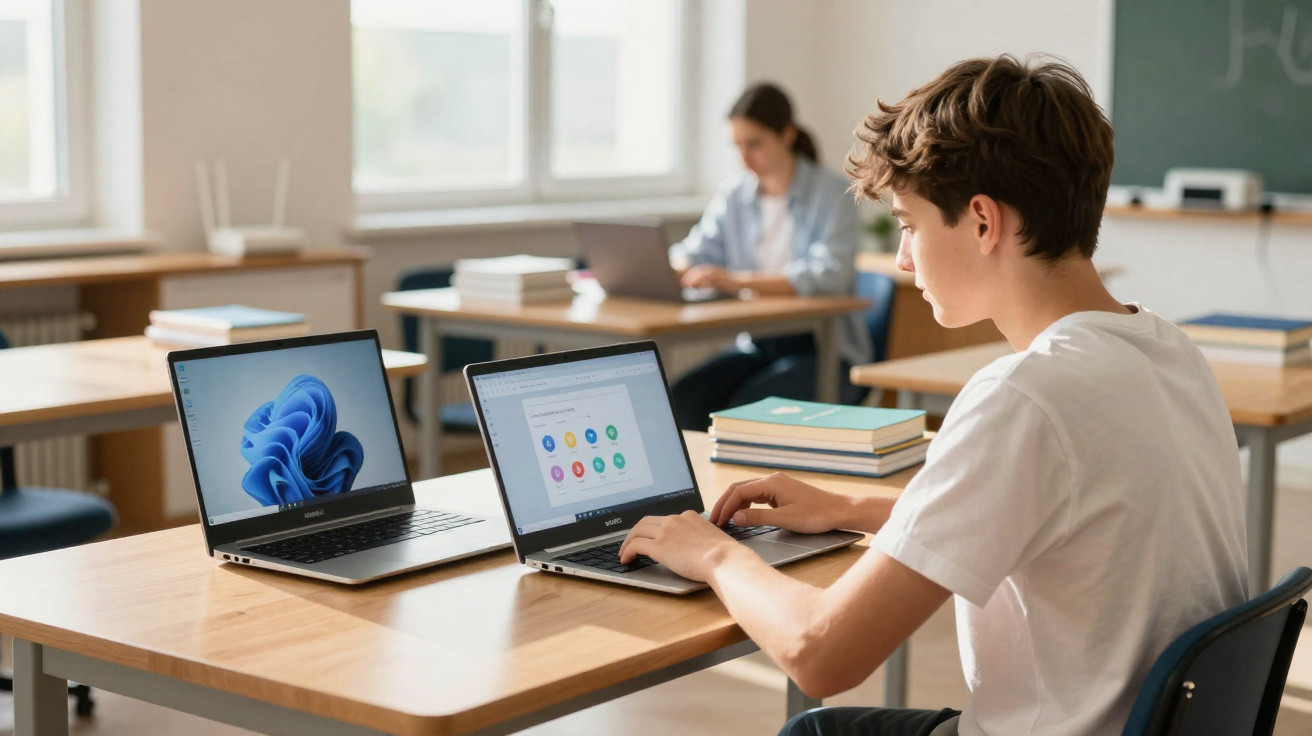
Upper-secondary students in the Île-de-France region will finally say goodbye (and it is easy to imagine they will not be sorry) to UNOWHY’s ageing, sluggish Y13 laptops running Windows. From the next school year, they will instead be issued brand-new Asus Chromebooks.
Since 2019, the Île-de-France Regional Council has placed a laptop in the school bag of every pupil arriving at upper secondary school. After several cohorts equipped with Y13 PCs that struggled under Windows-an operating system heavy enough to overwhelm their modest processors-the change is likely to be a relief. From September 2026, new first-year pupils will be given an Asus Chromebook CM14 free of charge (model CM1406CM4A, for anyone who cares about the exact reference), swapping Microsoft’s burden for the lighter touch of Google’s own ChromeOS.
Pupils in their second and final years will, however, keep their Y13 devices until their school-leaving examinations. For a few years, the two ecosystems will therefore coexist in classrooms.
How the rollout will work for pupils and parents
To collect the new computer, pupils will have to go through the regional app; a personal QR code will act as their pass during distribution at school. Once devices have been handed out, parents will receive a confirmation message in Pronote stating that the pupil has received the equipment. So what exactly is inside this CM14?
Subscribe to Presse-citron
Under the CM14 shell: hardware built for the cloud
Although Asus only announced the CM1406 recently (on 6 May 2026), it is not designed to be a performance powerhouse. That is not a problem, given that pupils are unlikely to need more than what it already offers. It runs on a MediaTek Kompanio 540 processor-an eight-core ARM chip that comfortably outclasses the old Intel Celeron parts used in the earliest Y13 models. It draws very little power, stays cool, copes well with light multitasking and, as you will see, supports some very up-to-date standards.
Alongside the processor are 8 GB of ultra-fast LPDDR5x memory and 128 GB of eMMC (embedded MultiMediaCard) storage. That is more than enough for the machine to boot in under 10 seconds, and to handle browser tabs without complaint-exactly the kind of workload ChromeOS is built around.
The display will not win awards, but it is perfectly serviceable: it has an anti-reflective finish and a Full HD resolution (1920 × 1080 pixels). The panel occupies a generous portion of the lid, and while brightness is nothing exceptional at this entry-level price point, it is still adequate for working in Word or using the school’s online portal.
Connectivity is restrained, but practical: an HDMI port for an external monitor, two full-function USB-C ports, one standard USB port, plus a combined headphone/microphone jack. It also supports Wi‑Fi 7 and Bluetooth 5.4-specifications that many €800 laptops still do not include. According to Asus, the CM1406 weighs just 1.12 kg and promises up to 23 hours of battery life. That figure should be treated with caution, but it should still be enough for pupils to get through several school days without hunting for a plug socket.
In short, this is a modestly configured computer that-at a price of €0 (thanks to parents’ taxes)-delivers an unbeatable quality-to-price ratio.
The downside of an all-online approach
The main criticism is straightforward: a Chromebook only really thrives with an internet connection. With this new device, pupils will therefore have to sign in using their monLycée.net credentials; their files will be stored automatically in the regional Drive rather than locally; and few applications are truly installed on the machine. Google Workspace runs in the browser, as does Microsoft 365.
In practice, the CM14’s 128 GB will mostly act as a buffer between the laptop and the cloud. That is likely the trade-off for a lightweight device that is easy to manage at scale-an approach that makes sense for the Regional Council, which will be able to administer its new fleet without difficulty. The laptop will only show its full strengths, however, if school Wi‑Fi networks do not buckle as soon as 30 people try to connect at the same time.
Support, ownership, and the end of the UNOWHY era
If anything goes wrong, after-sales support will be handled by Asus as well as the FNAC‑DARTY network-a reassuring detail given how widely they are present across the region. After passing their school-leaving examinations, pupils will keep the computer and become its official owners, free to do what they like with it, without the software restrictions imposed by the regional administration. Anyone who no longer wants it will still be able to return it for reuse.
How long will Asus remain the dominant name in Île-de-France school bags? For now, the Regional Council has not announced how long it is committing to the Taiwanese manufacturer. What is clear is that UNOWHY, the previous supplier, is bowing out. With its contract coming to an end, it should stop for good in 2028, once the final cohorts equipped with Y13 machines have left upper secondary school. All things considered, the CM14 is an impressively well-judged device for a publicly funded education programme-many of us would have loved to have had one alongside our Clairefontaine notebooks.

Comments
No comments yet. Be the first to comment!
Leave a Comment