
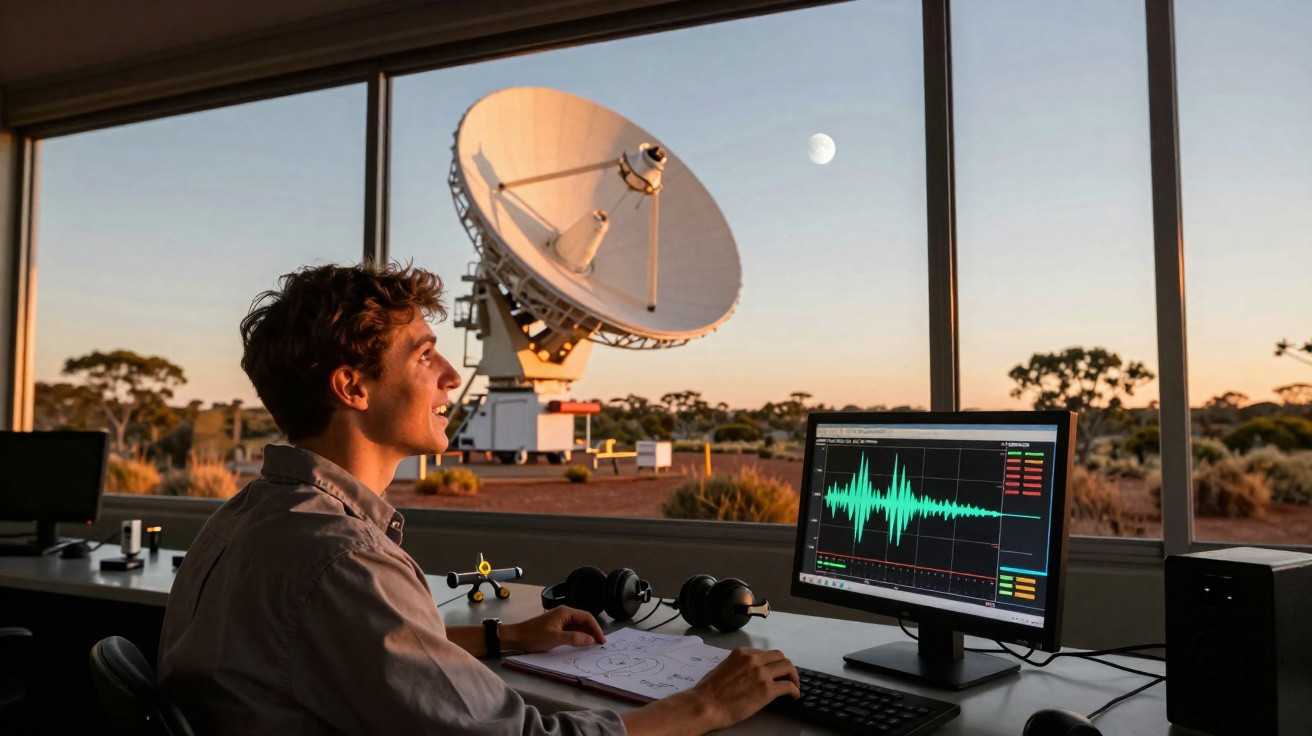
Scientists have picked up the first successful signal received by ‘New Norcia 3’, a newly constructed deep-space antenna in Western Australia, confirming the dish can talk to spacecraft operating well beyond Earth.
That inaugural link immediately boosts Europe’s capacity to send commands and receive data from far-flung missions, without forcing them to fight over limited communications slots.
New Norcia 3 goes online
At New Norcia, roughly 129 km north of Perth, the New Norcia 3 dish sits alongside an older antenna and a 4.6 m launcher-tracking aerial.
From the remote outback station, site leader Suzy Jackson at Australia’s national science agency (CSIRO) keeps the equipment synchronised, accurately pointed and ready to work.
Her team took over a location already handling contacts for Mars Express, which orbits Mars, and BepiColombo, a probe currently en route to Mercury-and the arrival of a second large dish reshapes that load.
Extra availability relieves today’s pressure first, and then creates headroom for more demanding missions waiting in the queue.
Why another dish
Europe established three deep-space antennas in Australia, Spain and Argentina so that Earth’s rotation would not break contact with a spacecraft.
That three-station arrangement still holds up, but today’s missions send vastly more data, particularly when cameras and instruments can run continuously.
By 2024, officials warned the existing network was close to capacity, meaning planners had to ration communications windows far more tightly.
Adding a second 35 m antenna at New Norcia removed the pinch point more quickly than building an entirely new deep-space site.
Hearing faint traffic
Deep-space antennas prove their value by spotting extremely weak signals from vehicles hundreds of millions of miles away.
The new dish relies on cryogenic cooling-intense cold that reduces electronic noise-with some components cooled to about -263 °C.
With that extra sensitivity, the station can capture weaker transmissions more reliably and bring down more usable data.
Sensitivity cannot eliminate the effects of distance, but it does reduce the day-to-day penalty that distance typically forces on mission planning.
Geography helps too
Western Australia also gives the station a location advantage that engineering alone could not replicate elsewhere.
“It’s terrible for mobile phone coverage but just perfect for clear skies, without interference from people’s phones and televisions,” said Jackson.
A quiet radio environment makes it easier for the antenna to separate faint spacecraft signals from the electronic clutter that overwhelms more populated regions.
Spain and Argentina round out the network, passing missions around the planet as Earth turns and one horizon gives way to the next.
Timing keeps lock
Catching a distant transmission is only part of the task, because the station also has to determine precisely when the signal arrives.
A maser-an ultra-stable timing source for radio systems-keeps the site in sync so commands, data and tracking remain coherent.
This level of timing accuracy matters most when controllers measure motion, target commands or conduct experiments that depend on minuscule delays.
Even a slight drift can smear the outcome, which is why the station protects its timing chain so carefully.
Running New Norcia 3
When CSIRO assumed local operations in 2019, Jackson became the first woman to run the New Norcia site.
CSIRO’s seven-person crew monitors performance, repairs hardware and ensures the huge structure is prepared for each communications pass.
“We did once have to chase a small brown snake out of the master room,” said Jackson. The blend of routine engineering and outback surprises underlines why a ground station is never only a dish.
Capacity changes choices
With more antenna hours available, controllers can ease off constant download rationing and plan around what missions actually need.
The antenna introduces Ka band, a higher-frequency channel that supports faster downlinks, in addition to the frequencies Europe already uses.
The site was also engineered so the new dish can be paired with the older one for combined reception when missions require extra support.
That adaptability may be most valuable in emergencies, when operators need both speed and margin rather than having to choose between them.
Europe’s busier sky
The new dish comes online as Europe balances a broader mission mix than the earlier network was designed to serve.
Some spacecraft-such as BepiColombo and Hera-head deep into the Solar System, while others require long, regular science downlinks.
Upcoming projects raise the stakes again, with Vigil set to monitor dangerous solar activity and Plato intended to search for other worlds.
Antenna time seldom attracts attention, yet without it even outstanding spacecraft can end up waiting their turn to connect.
Next steps for New Norcia 3
New Norcia 3 also carries a political signal, reflecting Europe’s decision to reinforce a longstanding partnership with Australia.
Co-funded with the Australian Space Agency, the programme extends collaboration that has linked Australia and Europe for decades.
Australian officials expect the site to create jobs and deliver local economic benefit over an estimated 50-year lifetime.
For Europe, the advantage is practical autonomy: more control over when its spacecraft connect, receive commands and return data.
A second giant dish in the Australian outback does not, by itself, remake exploration-but it changes what missions are able to request.
As Europe sends up more probes, telescopes and space-weather missions, New Norcia is set to become an even busier link between Earth and deep space.
Image credit: Thales Alenia Space






Comments
No comments yet. Be the first to comment!
Leave a Comment