
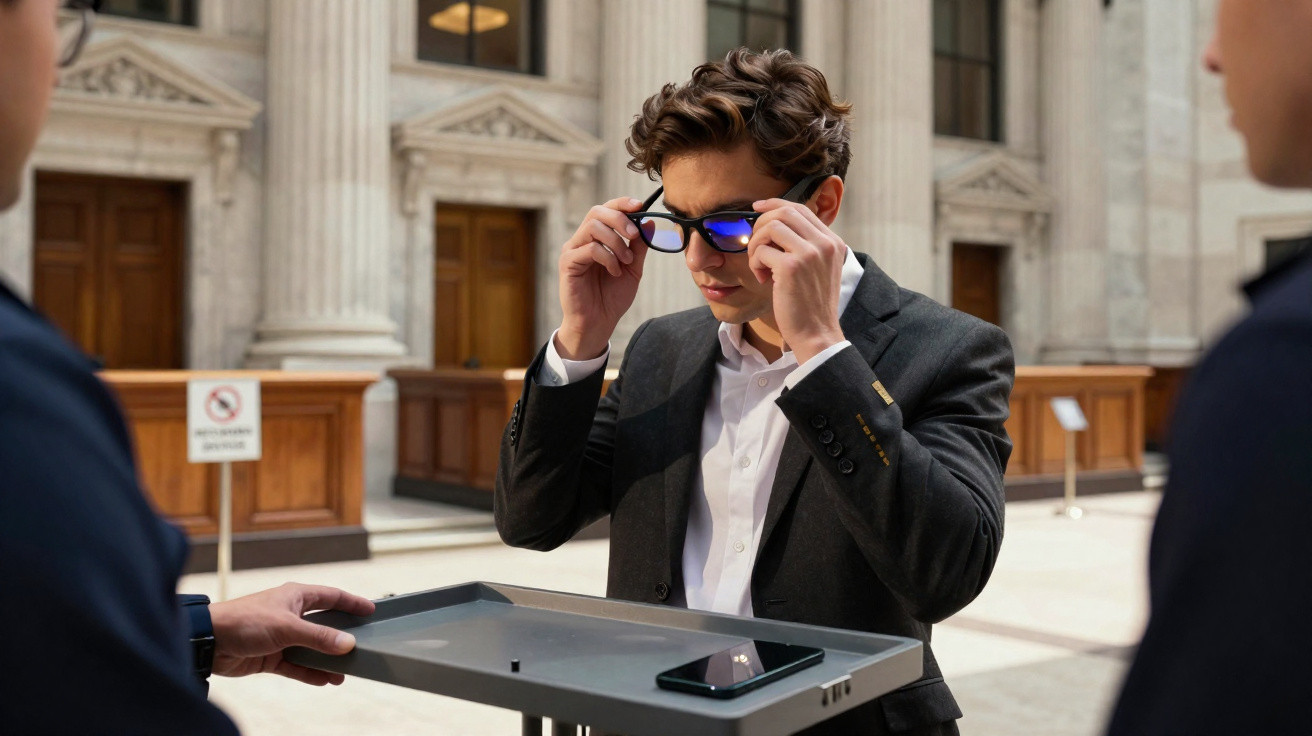
With Ray-Ban Meta selling strongly, an unusual wave of suspicion is building around connected glasses - and they have now been completely barred from New York State’s courts. Here is why the mood is turning sharply against Mark Zuckerberg’s flagship device.
From Monday 20 July 2026, New York State will enforce a total, absolute ban on connected glasses across all 1,240 of its courts. Backed by Justin Barry, the executive director of the state’s court system, the move is designed to stop covert recording of hearings - something strictly forbidden under local law in order to protect jurors and witnesses.
What the New York State courthouse ban covers
The restriction applies to everyone: members of the public, witnesses, and also prosecutors and lawyers. Even frames fitted with prescription corrective lenses are included. Anyone arriving at the security screening points wearing such a device will be required to hand it over to court officers at the entrance and switch to ordinary glasses for the duration of their time inside.
The California trial incident that raised the alarm
This hard-line decision follows an episode from February during a California trial focused on social media addiction. Mark Zuckerberg’s own lawyers were sharply reprimanded by the judge because they were openly wearing their Ray-Ban Meta glasses while escorting Meta’s chief into the building - an incident that intensified concerns about the risk of identifying jurors.
The fear of covert recording
New York’s courts moved quickly primarily because these discreet frames blur the usual boundaries of consent. Ray-Ban Meta can capture what’s happening with a simple tap on the arm, with almost no one noticing. In the enclosed environment of a courtroom, that capability can directly threaten the confidentiality of deliberations and could be used to intimidate jurors.
Meta does include a small white LED that flashes to indicate recording, but critics argue this safeguard is inadequate - especially since a genuine online black market has grown up around defeating it. For a fee, specialists will conceal the diode with subtle adhesive strips, or even physically destroy the lighting circuit so users can film without others realising.
On 7 July, Meta updated its official FAQ and pushed a mandatory software update: if the system detects that the capture LED is blocked, damaged, or removed entirely, the camera is automatically disabled. The company has also launched a clampdown on its Marketplace platform to ban accounts offering these physical modifications. It is a forceful response - but a late one, and it underlines how difficult the manufacturer finds it to control the misuse of its technology.
A crisis of trust that goes far beyond the courts
Outside courtrooms, a broader loss of confidence is forming around Meta’s flagship product. Early privacy worries have been reignited by recent code leaks. The Electronic Frontier Foundation (EFF) has reported that the company quietly built a facial-recognition tool called NameTag into its app, capable of identifying strangers on the street. More concerning still, an internal project known as Super Sensing suggests the firm is testing passive, continuous recording - where the glasses film constantly to feed the AI’s memory.
And that is not all. A recent class action has highlighted that human contractors have watched highly intimate clips sent to Meta’s servers, including nude scenes or the entry of bank codes. The shift is significant enough that cruise operator Royal Caribbean is now banning them from sensitive areas, while Illinois is examining legislation to prohibit them while driving.





Comments
No comments yet. Be the first to comment!
Leave a Comment