
The pub went quiet for a heartbeat when the signal dropped. Four people paused mid-scroll with their phones raised, the barman grumbled about the storm outside, and the football stream on the telly collapsed into a blocky mess. That small, familiar surge of panic.
By the window, though, a bloke in a red windbreaker unzipped his rucksack, took out a slim black device, set it near the glass and tapped his phone. An icon popped up: “Starlink Mobile – Connected”. His video didn’t miss a beat. Ours did.
When he said, “It’s satellite. No dish, no new phone. Just works.”, nobody bought it at first.
He only shrugged and added, “The sky is enough now.”
Starlink takes satellite internet out of the backyard and puts it in your pocket
For a long time, Starlink meant a single picture in most people’s minds: a white, pizza-box-like dish fixed to a roof, angled at the sky like a stubborn sunflower. Skip ahead to now, and that mental image already feels out of date. Starlink is quietly introducing a mobile satellite internet line that behaves less like installed home kit and more like a normal phone accessory.
Think of it as a portable hotspot - except instead of clinging to a couple of 4G bars, it connects to a swarm of low‑orbit satellites. There’s no engineer drilling into your wall. No cables running across the lounge. You switch it on, your phone finds Wi‑Fi, and you’re away.
I spoke to an early tester who lives in a village where dependable connectivity comes from one ageing copper line and a mobile mast that’s barely hanging on. When the weather turns, WhatsApp calls cut out. Netflix is a non-starter. After he got a Starlink mobile unit, he walked up the hill behind his house, powered it up, and watched his phone jump from “No Service” to a stable video call with his brother abroad.
He also sent me speed-test screenshots taken from the passenger seat on a road trip: 40, 60, sometimes 100 Mbps while moving through fields and woodland where his network normally gives up completely. “I didn’t change phones, I didn’t change SIM,” he laughed. “Just changed who I ‘talk’ to: ground tower vs sky.”
The underlying maths is blunt. Mobile networks struggle in the last 5% of territory, where a new mast costs a fortune to serve a tiny number of people. Satellites, by contrast, don’t care whether there are five people, five hundred, or a single camper with a power bank. Starlink’s low‑orbit network already covers vast areas; linking phones into that mesh via a pocket-sized device is simply the next move.
Latency sits lower than old-school satellite, speeds can feel closer to home fibre on a good day, and the setup hassle is almost nil. It flips the usual pyramid: rural, remote and on-the-move users get something that feels oddly premium, while city users can suddenly seem a bit… last-generation.
How this new mobile Starlink actually works in real life
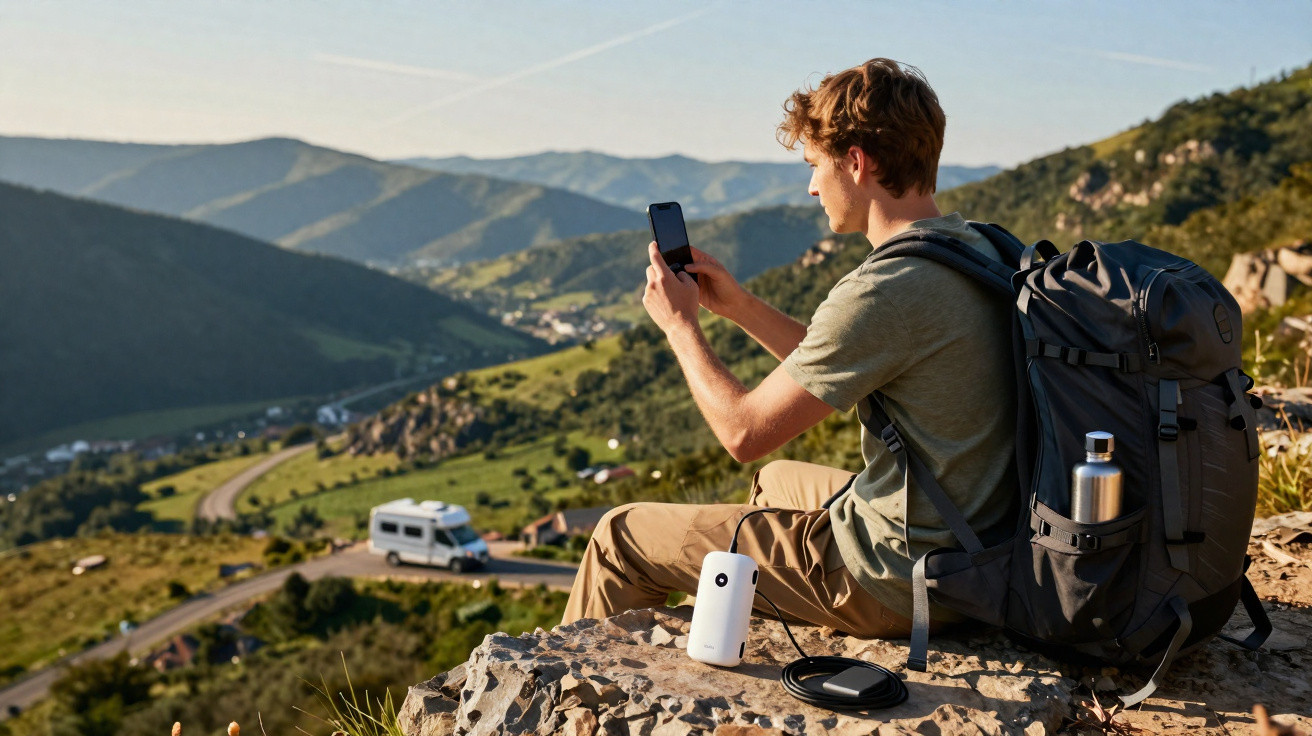
Using it is almost comically straightforward. You take the unit out of the box - it resembles a thick power bank or a compact Wi‑Fi router - connect it to a USB‑C battery or a mains socket, step outside (or at least close to a window), and give it a few seconds to link up with satellites. A small LED or an app alert confirms it’s online.
After that, your phone does what it already does: it joins a Wi‑Fi network. You don’t need a special browsing app. You don’t need a bespoke handset. To an iPhone or Android phone, it’s just another router - even though, behind the scenes, your data is bouncing through space rather than a mast tucked behind a billboard.
People are already fitting it into their routines in creative ways. A van-life couple I interviewed said they work remotely from lay-bys, beaches and supermarket car parks - as long as they can see a patch of sky. They park up, power the unit from their 12 V socket, and in under a minute their laptops and phones are connected. On days when they can’t afford a Zoom call to fall over, they keep local 4G as a backup and run on Starlink.
A mountain guide told me he used it on a multi‑day trek. At the highest refuge - the place where the usual “No Service” notice used to cut people off from home - he took out the device and let clients send photos and quick voice notes. “It’s not about being glued to the web,” he said. “It’s about knowing you’re not completely cut off if something goes wrong.”
The platform is still new, and you feel that at the edges. Speeds can rise and fall with satellite availability and how many people nearby are using the service. Heavy rain and thick snowfall can dent performance. And there are data caps and fair‑use policies - reminders that this isn’t magic, but a paid service with boundaries. Let’s be honest: hardly anyone reads every line of the terms each time they connect.
Even so, the trajectory is hard to miss. Starlink is shifting satellite connectivity from a fixed appliance into something you travel with. You don’t “install” it - you pack it. The mental leap from “big piece of kit on the roof” to “small gadget in my bag” is enormous. Once something slips into a coat pocket, people begin inventing uses no lab team planned for.
What to know before you jump on mobile satellite internet
Start with a practical point that’s dull but essential: treat the unit like a pet that needs a decent view of the sky. Not perfect - just decent. In a car, set it near the rear window rather than burying it on the floor under coats. Indoors, a windowsill or balcony will beat the centre of the room every time. The fewer thick walls between the device and open air, the more consistent the connection.
Next comes power. This isn’t like a SIM card that just sits there. It needs charging. Many early adopters now carry a dedicated power bank for their Starlink unit, particularly travellers and people working out in the field. Plan for those two constraints - sky and power - and the rest is surprisingly low-friction.
Then there’s the emotional bit that never appears in spec sheets. We all know the moment: you finally get away to a remote cabin to “switch off”… and still end up checking email because, well, now you can. The risk with a pocket satellite link isn’t only cost or coverage; it’s that the line between connected time and proper disconnection gets even blurrier.
Quite a few people I spoke to ended up making their own rules: satellite on during work days, off at weekends. Or only switched on for safety check-ins while hiking. The common trap is treating the gadget as a toy, then quietly feeling overwhelmed when the world follows you into every quiet place. A bit of intention makes a big difference.
“Connectivity is shifting from ‘where there are cables’ to ‘where there is sky,’” one telecom analyst told me. “That sounds poetic, but it’s going to feel very practical, very fast.”
- Coverage reality – Look at the Starlink coverage map and check local regulations before you buy. Some areas are still being switched on, and some places have restrictions on use.
- Battery strategy – Match the unit with a reliable power bank or a vehicle socket. Running out of power halfway through a call is more painful than any dodgy Wi‑Fi.
- Data expectations – Mobile satellite packages typically include fair‑use thresholds. Streaming heavily all day, every day, will hit limits sooner than a home connection.
- Emergency mindset – Treat this as a safety net, not a substitute for local emergency numbers, radios or common sense in remote settings.
- Privacy basics – Your phone sees the hotspot as ordinary Wi‑Fi. Use strong passwords and keep firmware up to date, the same way you would with a home router.
A new normal where “no service” stops being an excuse
Walk through any train carriage and you’ll still hear “offline” used like a minor complaint. Tunnels. Dead spots between cities. That one valley your provider has never invested in. Portable satellite internet won’t delete all of that overnight, but it changes the default. The question shifts from “Is there coverage here?” to “Do I feel like carrying coverage with me today?”
For journalists on assignment, remote workers living nomad-style, rural households, rescue teams, small-boat owners and, yes, content creators chasing sunsets on forgotten cliffs, that’s not an abstract question. It affects day-to-day planning, safety margins and earnings. A world where sky equals signal is a different mental map than the one we grew up with.
This will also trigger arguments: about digital fatigue, about environmental impact, and about the advantage held by people who can afford to stay online everywhere. At the same time, it unlocks capabilities that used to belong to large organisations carrying bulky satellite phones. The next time a storm knocks out the connection in a pub and someone quietly brings back full-speed internet from a rucksack, don’t only ask, “What gadget is that?” You may want to ask where your own line sits between freedom and dependence on that invisible thread to the sky.
| Key point | Detail | Value for the reader |
|---|---|---|
| Portable satellite hotspot | Starlink’s new mobile unit works like a Wi‑Fi router that talks directly to satellites | Understand that you don’t need a new phone or dish to get satellite internet |
| Sky + power as the only constraints | Needs a partial view of the sky and a power source, but no installation or technician | Helps you judge if this fits your travel, home, or work setup |
| New habits and limits | Data caps, battery management, and mental boundaries around “always online” use | Let you avoid surprises on cost, performance, and digital overload |
FAQ:
- Question 1 Does Starlink’s mobile satellite internet work with any smartphone?
- Question 2 Can I use this instead of my regular home internet?
- Question 3 Will my existing apps and streaming services work normally?
- Question 4 What happens if I’m in a country where Starlink isn’t officially available?
- Question 5 Is the latency good enough for video calls and online gaming?





Comments
No comments yet. Be the first to comment!
Leave a Comment