
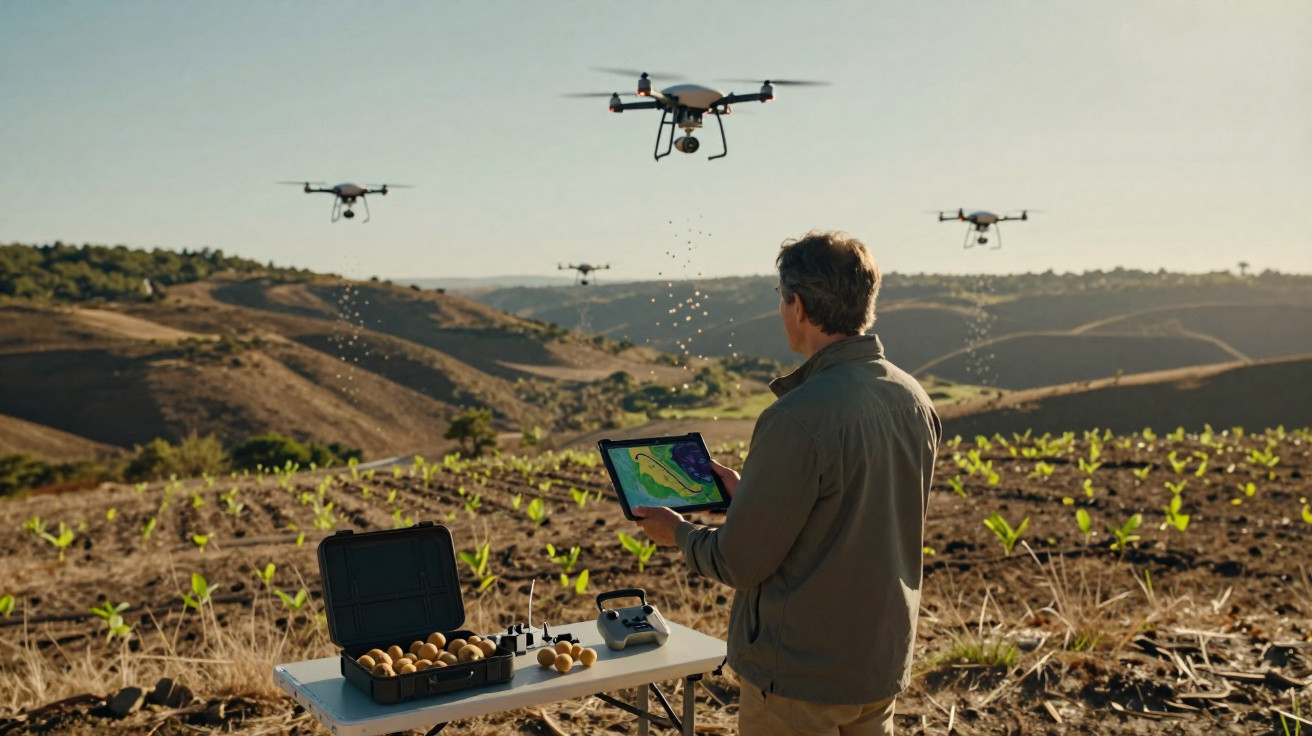
A former NASA engineer has turned to drones as partners in large-scale reforestation, with the aim of planting millions of trees a year across degraded landscapes. The concept is both straightforward and bold: survey land from above, pinpoint the best planting spots, and deploy seed capsules quickly-cutting down on time, cost, and the challenges of reaching remote ground.
How did drones become reforestation machines?
The approach begins with drones carrying out a detailed read of the site. They fly over the area, gather data, and make it easier to see where there is exposed soil, erosion, slope, moisture, and the most suitable conditions for new seedlings or seeds.
Once that assessment is complete, other drones can release biodegradable capsules containing seeds and nutrients. Instead of relying solely on teams trekking through difficult terrain, the technology makes it possible to cover vast areas far more rapidly.
Why does this method attract so much attention?
Traditional reforestation typically requires labour, time, transporting seedlings, and physical access to the land. In burned, mountainous, flooded, or distant regions, planting by hand can be slow and expensive.
- Speed: drones can reach many sites in less time.
- Access: they can get to places where teams would struggle to enter.
- Mapping: they help select spots with a higher likelihood of germination.
- Precision: they reduce random planting and improve how seeds are used.
- Scale: the goal is to turn reforestation into a much larger operation.
How does seed planting work?
Seeds are not simply dropped without thought. They can be placed inside capsules designed to protect what’s inside and provide a small store of nutrients during the first days.
- The drone identifies the area set out for planting.
- The capsules are fired or placed at predetermined points.
- Each capsule carries seeds suited to the local environment.
- Mapping helps avoid areas that are too dry, compacted, or otherwise unsuitable.
- Follow-up monitoring shows where germination happened and where extra planting is needed.
What are the limits of this technology?
Despite the promise, drones do not restore forests on their own. For a forest to genuinely return, it is essential to choose native species, safeguard the area from fire, trampling, deforestation, and encroachment, and track plant growth over the years.
Another key issue is seed survival rates. Planting millions does not mean they will all become mature trees. Climate, soil, rainfall, animals, pests, and ongoing maintenance all directly shape the final outcome.
Why could this idea change the future of forests?
The real strength of the technology is that it speeds up a step that is usually slow and labour-intensive. In degraded areas, drones can help kick-start recovery-particularly when combined with local teams, nurseries, environmental protection, and ecological planning.
Used well, the solution does not replace human care, but expands what people can achieve. Drones, the right seeds, and continuous monitoring can turn reforestation into a faster response to erosion, biodiversity loss, and the degradation of natural landscapes.




Comments
No comments yet. Be the first to comment!
Leave a Comment